
System Design Interview Rubric: How to Evaluate Trade-offs Like a Senior Engineer
Pass your next system design interview by mastering architectural trade-offs. Learn how to confidently evaluate Latency vs. Throughput, the CAP Theorem (Consistency vs. Availability), & SQL vs. NoSQL.

This blog covers:
Why perfect systems never exist
Balancing speed against data accuracy
How interviewers grade decision-making
Choosing the right database structure

Software engineering changes drastically when moving from a local environment to a distributed environment.
In a university setting or a small boot camp project, the focus is usually on correctness. The code must compile.
The function must return the expected value. The tests must pass. This creates a binary mindset where a solution is either right or wrong.
However, when designing systems for millions of users, this binary logic dissolves.
A solution that works perfectly for one thousand users will often crash completely when served to one million users.
A database that provides instant results for simple data might become incredibly slow when handling complex relationships.
This shift from “correctness” to “fitness for purpose” is the primary hurdle for beginners.
The Myth of the Perfect Solution
Many candidates start their interview preparation by searching for the best technologies.
They memorize that a certain database is fast or that a specific caching tool is popular. They enter the interview room waiting for a chance to use these tools. They assume that if they pick the “fast” database, they will get a high score.
This approach fails because it ignores the fundamental reality of computer science. Resources are finite.
A computer processor has a limit on how many operations it can perform per second. A network cable has a limit on how much data it can transmit. A hard drive has a limit on how fast it can write information.
Because of these physical limitations, it is impossible to design a system that is instant, completely reliable, and incredibly cheap all at the same time. To improve one attribute, you must take resources away from another.
This exchange is called a trade-off.
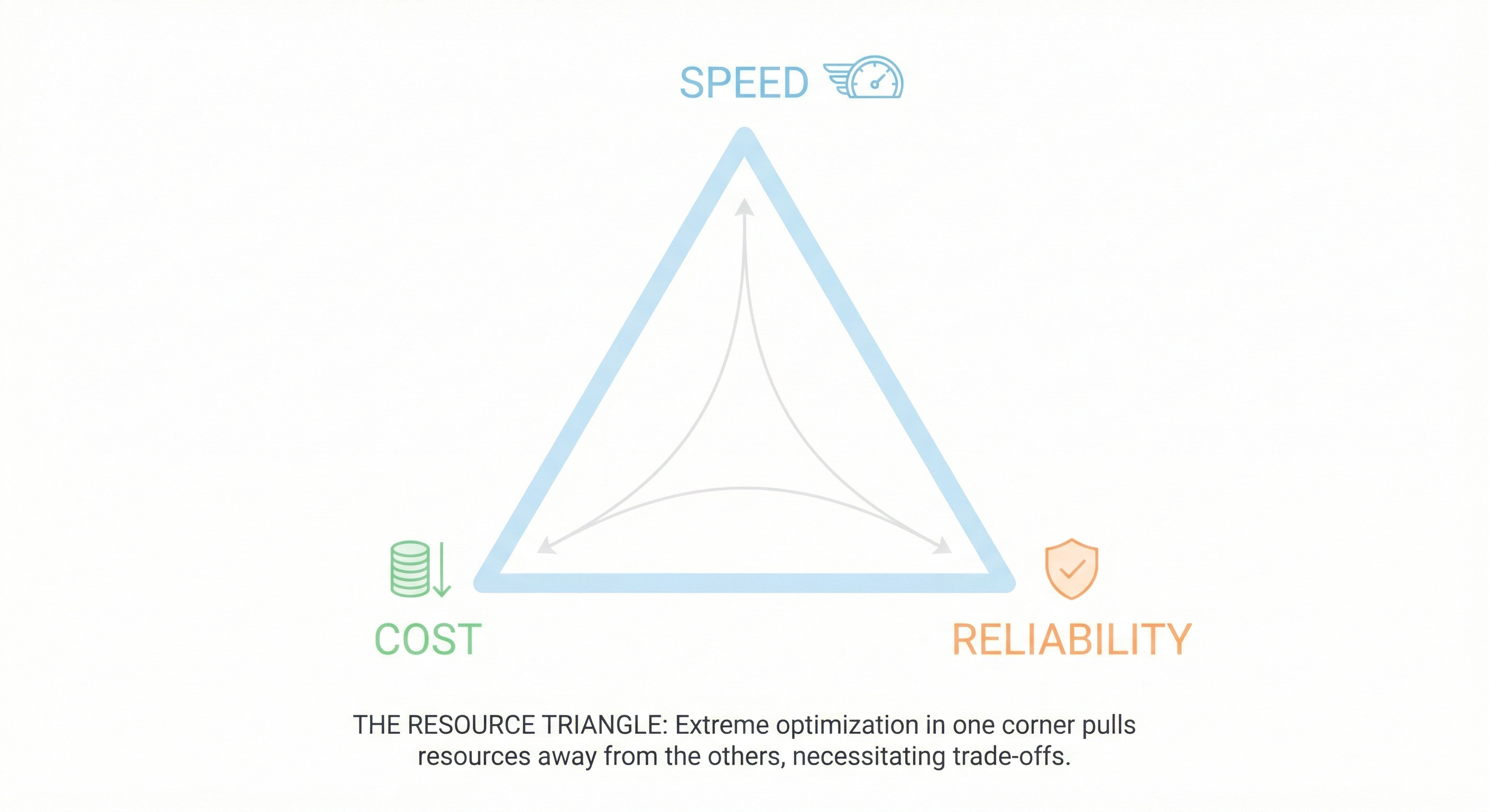
An interviewer does not grade you on choosing the “best” tool. They grade you on your ability to identify the cost of the tool you chose. They want to know if you understand what you are giving up to get the performance you want.
Defining the Concept of Trade-offs
A trade-off is a decision where you accept a disadvantage in one area to secure an advantage in another. It is a strategic compromise.
When you write code, you make these compromises constantly, even if you do not notice them.
For example, you might write a piece of code that is very easy for other humans to read. However, to make it readable, you might use more variable names and more lines of code, which technically consumes slightly more memory.
Alternatively, you could write code that is extremely compressed and uses very little memory, but it might be impossible for another human to understand.
In system design, the stakes are much higher. The compromises you make determine if the system fails under load or if it loses user data.
There are four major categories of trade-offs that appear in almost every system design interview. Understanding the mechanics of these will allow you to answer the vast majority of questions asked by interviewers.
1. Latency vs. Throughput
This is the conflict between individual speed and total system capacity.
Latency is the duration of time it takes to complete a single specific task. It is measured in units of time, such as milliseconds or seconds.
If a user requests a profile page and it appears on their screen in 200 milliseconds, the latency is 200 milliseconds.
Throughput is the quantity of work the system can perform in a given unit of time. It is measured in units of volume, such as requests per second or megabytes per second. If a server can download 500 images per minute, the throughput is 500 images per minute.
Beginners often assume that improving one automatically improves the other. This is incorrect. Frequently, strict optimization for throughput hurts latency.
Consider a system that processes data logs. To get the lowest possible latency, the system should process every log entry the exact moment it arrives. This ensures the data is available immediately.
However, this is inefficient for the hardware. The computer must constantly switch contexts and open new connections for every single tiny piece of data.
To improve throughput, an engineer might decide to use “batching.” The system waits until it collects 1,000 log entries and then processes them all at once.
This is much more efficient for the hardware and allows the system to handle a massive volume of logs overall.
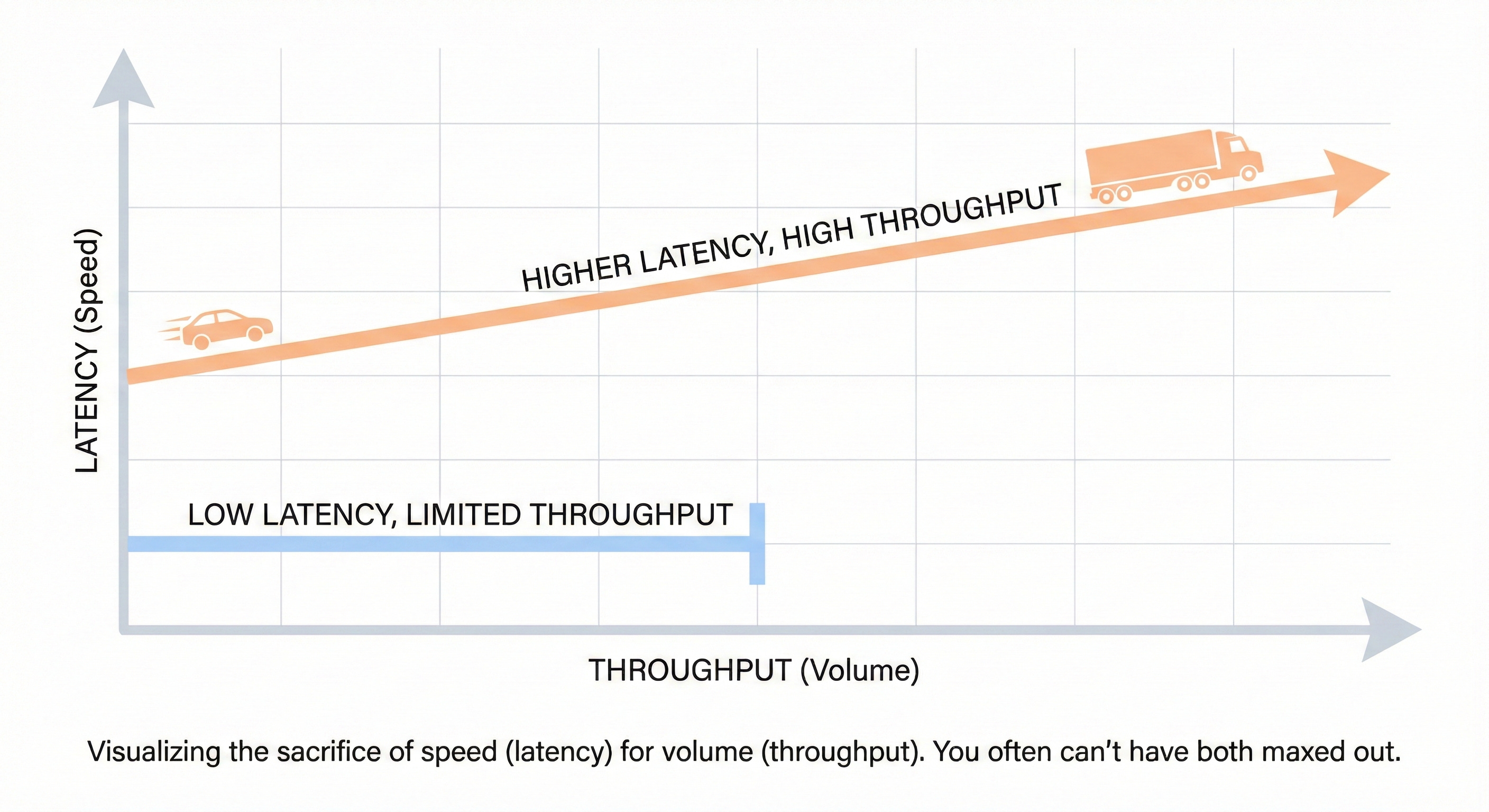
The trade-off is that the first log entry in the batch must wait for the other 999 entries to arrive before it is processed. The latency for that specific entry increases significantly.
The Decision Point: If you are designing a real-time chat application, you care about Latency. You want the message to appear instantly. You accept that this might be less efficient for the servers.
If you are designing a monthly payroll system, you care about Throughput. It does not matter if the calculation takes an hour, as long as millions of payments are processed correctly. You accept high latency to gain the efficiency needed to handle the volume.
2. Consistency vs. Availability
This trade-off is central to distributed systems and is often referenced by the CAP Theorem. It deals with how systems handle errors when servers lose connection to one another.
Keep reading with a 7-day free trial
Subscribe to System Design Nuggets to keep reading this post and get 7 days of free access to the full post archives.