
7 Things to Do Tonight If Your System Design Interview Is Tomorrow
What to Actually Do the Evening Before a System Design Interview, Backed by How Interviews Are Really Scored and Why Cramming Backfires


The evening before a system design interview is a strange window of time.
Weeks of preparation are already behind, and the interview is just hours away.
Most candidates spend this evening doing the worst possible thing, which is cramming new material in a panic. They open new articles, watch new videos, and try to memorize architectures they have never seen before. This approach almost always backfires.
The reason is simple.
The night before an interview is not for learning. It is for sharpening, calming, and preparing.
New information learned in a rush rarely sticks and often crowds out the solid knowledge already in place.
A tired, overloaded mind performs worse than a rested, focused one, no matter how many extra facts it crammed in at midnight.
System design interviews reward clear thinking, calm communication, and structured answers.
None of those come from cramming. They come from being well rested, mentally organized, and confident in a small set of reliable tools.
The candidates who perform best treat the final evening as a tune-up, not a final exam.
This guide lays out seven specific things to do tonight. Each one is chosen because it has a high payoff for tomorrow and a low cost in stress.
Together, they turn a nervous evening into a calm, productive one. They work for junior engineers facing their first loop and for senior engineers who want to walk in sharp.
1. Review Your Framework, Not New Material
The single most important thing to review tonight is the framework that guides every answer.
A framework is a clear, repeatable set of steps for tackling any system design question.
Having one prevents the panic that comes from staring at a blank whiteboard.
Walk through the steps slowly in your mind.
Clarify the requirements.
Estimate the scale.
Define the core operations the system needs.
Draw the high-level design.
Go deep on the most important parts.
Handle failures and edge cases.
Say each step to yourself until the order feels automatic.
Resist the urge to learn anything new.
If a concept has not been studied by now, tonight is not the time. Reinforcing the framework gives a far better return, because the framework is what carries a candidate through any question, even an unfamiliar one.
2. Refresh the Core Numbers and Building Blocks
A short, light review of the basics pays off tomorrow.
Spend a little time refreshing the key numbers used in rough estimates, such as how to calculate requests per second, how to size storage per day, and the typical latency ranges for common operations. These small calculations come up in almost every interview, and being smooth with them signals confidence.
Then refresh the core building blocks. These are the pieces that show up in nearly every design: the load balancer that spreads traffic across servers, the cache that speeds up reads, the database that stores the data, the queue that handles background work, and the API that connects everything.
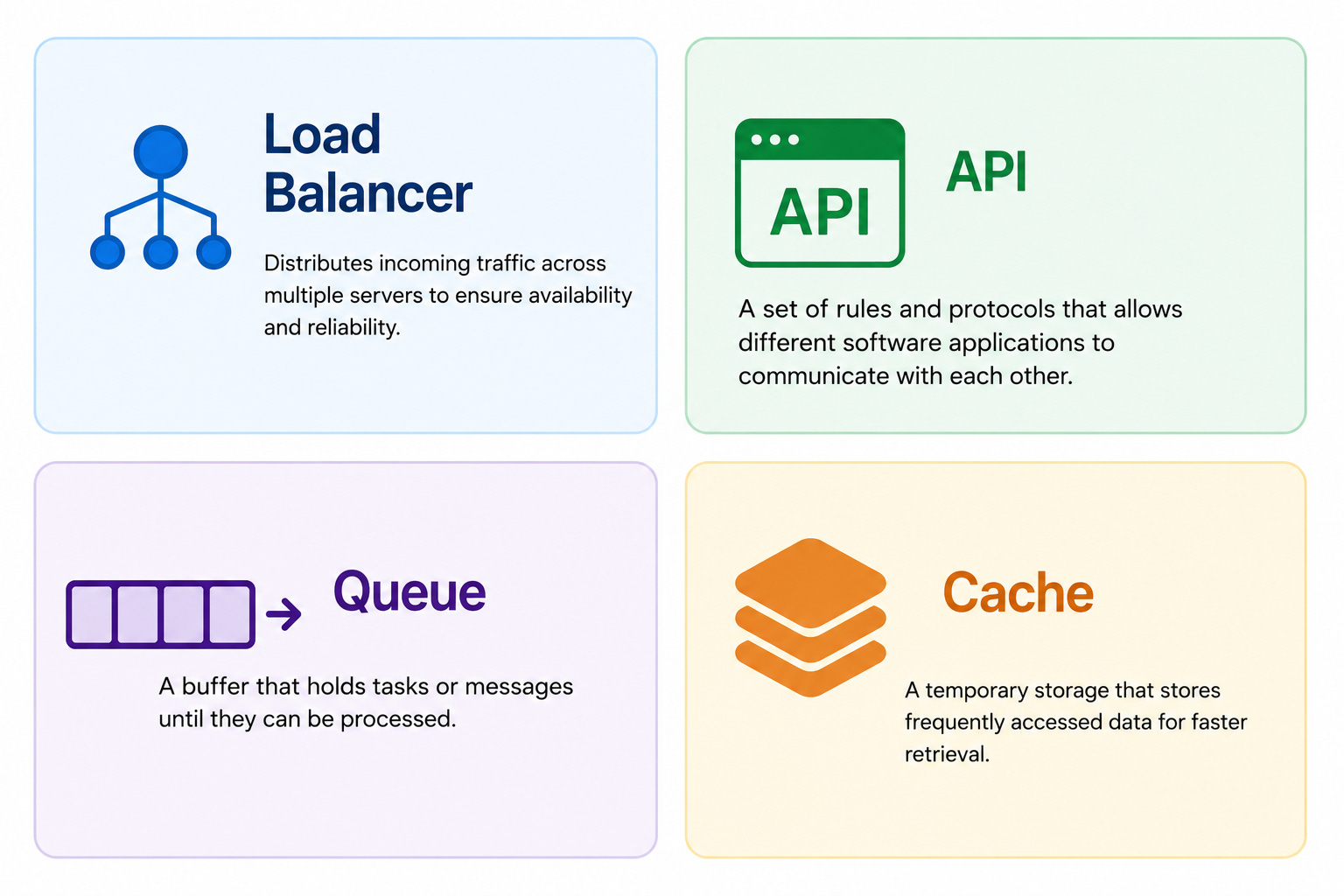
Make sure each one is fresh and ready to use.
Keep this review light and quick.
The goal is to dust off knowledge that already exists, not to study it deeply again. A relaxed pass over the basics is enough.
3. Rehearse Your Trade-off Explanations
Interviewers care less about the perfect answer and more about how a candidate reasons through choices. This means trade-offs are one of the most rewarded skills in the entire interview.
A trade-off is the cost that comes with any design decision.