
Why “Eventually Consistent” Is the Most Dangerous Phrase in System Design Interviews
Eventual consistency is powerful but misunderstood. This guide breaks down the concept for beginners and shows how to use it correctly in system design discussions.

This guide covers:
What consistency actually means
Strong vs. eventual consistency
Why interviewers keep probing
Where eventual consistency fails
Answering the follow-up correctly
There is a pattern that plays out in system design interviews more often than it should.
The interviewer asks how two parts of a system will stay in sync.
The candidate pauses, nods, and says: “We can make it eventually consistent.”
The room goes quiet for a second.
The interviewer writes something down.
The candidate assumes they gave a good answer because the phrase sounds authoritative and technical. It references distributed systems theory. It feels like the kind of thing a senior engineer would say.
But here is the problem.
“Eventually consistent” is not an answer. It is the beginning of one.
And when candidates treat it as a complete response, interviewers notice.
What they are really looking for is the next layer of depth: what does “eventually” mean in your system? How long is the delay? What happens to users during that window? What breaks if the delay is longer than expected?
Most candidates never get to those questions because they stop talking too soon.
That is what makes the phrase dangerous. It gives you a false sense of having answered the question when you have barely started.
This post is going to unpack what consistency actually means in distributed systems, why “eventually consistent” is so much more nuanced than it sounds, and how to talk about it in a way that actually impresses interviewers.
What Does “Consistency” Mean in Distributed Systems?
Before we understand “eventual” consistency deeply, we need to define consistency itself.
In distributed systems, consistency refers to whether all nodes (servers) in a system see the same data at the same time after a write operation.
Key term: A node is a single server or machine in a distributed system. When your data is stored across multiple nodes (for reliability or performance), the question of consistency is: after you update data on one node, how quickly do the other nodes reflect that change?
This is not a concern for a single-server application.
If there is one database, one machine, one copy of the data, then every read always sees the latest write. Consistency is automatic.
The moment you have multiple copies of data spread across different machines, or different regions, or different services, consistency becomes a design decision. You have to choose how and when those copies get synchronized. And every choice has trade-offs.
Strong Consistency vs. Eventual Consistency
There are two ends of the spectrum that come up in nearly every system design conversation.
Let’s define both clearly.
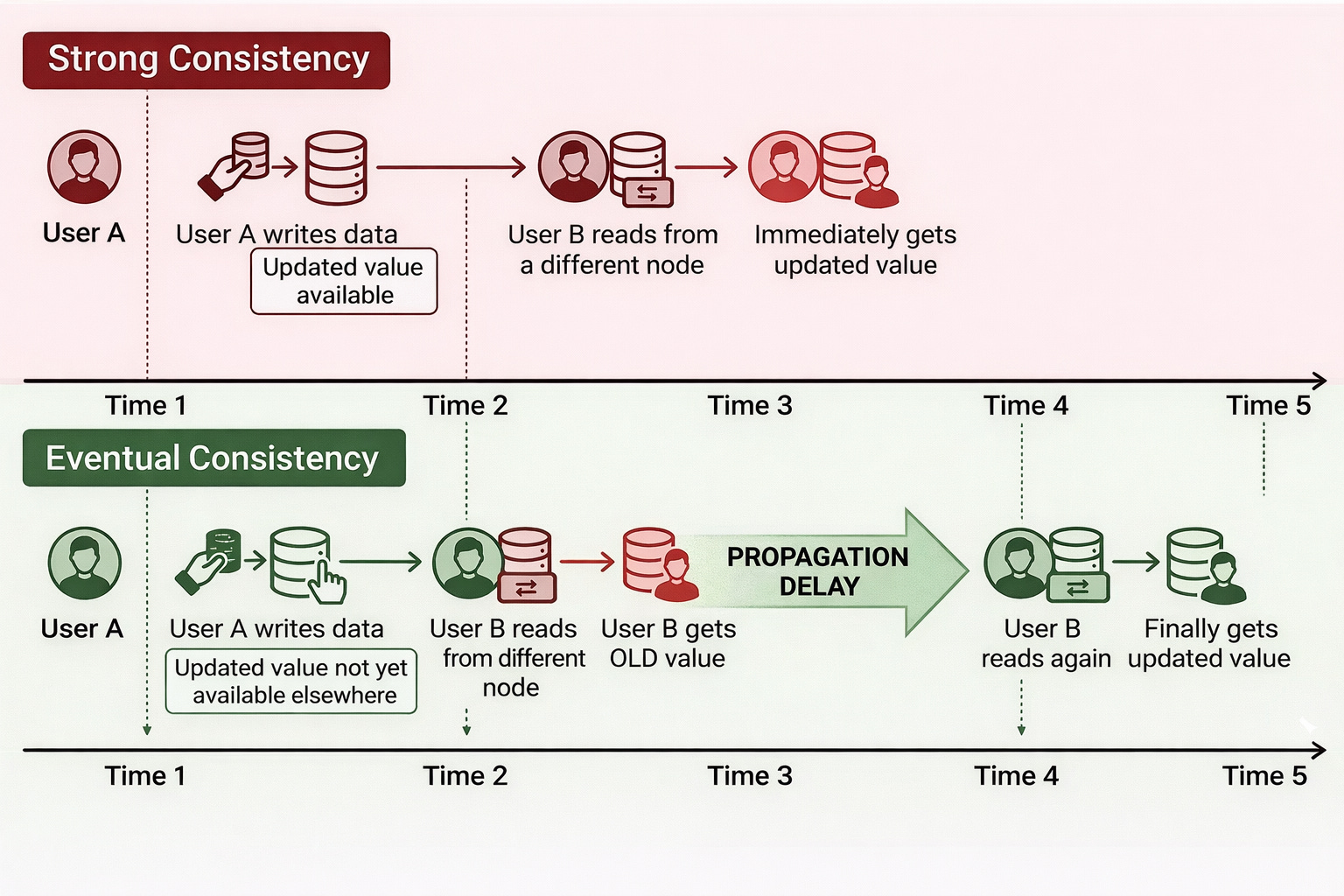
Strong Consistency
After a write completes, every subsequent read from any node will return the updated value.
There is no window where old data is visible.
The system guarantees that all readers see the same thing, immediately.
Eventual Consistency
After a write completes, different nodes may return different values for a short period. Given enough time and no new writes, all nodes will eventually converge to the same value. But there is no guarantee about how long that takes.
Strong consistency is easier to reason about. Your code does not have to worry about stale reads. But it is slower because the system has to coordinate between nodes before confirming a write.
That coordination takes network round trips, which take time.
Eventual consistency is faster.
Writes can complete without waiting for every node to acknowledge the update. But your application has to deal with the possibility that a user might read old data for some period after a write.
The system is optimizing for speed and availability at the cost of immediate accuracy.
Key term: Availability in this context means the system’s ability to respond to every request. A strongly consistent system might become temporarily unavailable during network issues because it refuses to serve data that could be stale. An eventually consistent system stays available by serving whatever data it has, even if it is slightly outdated.
Why Interviewers Keep Pushing After You Say It
Here is the thing most candidates miss.
Interviewers are not testing whether you know the term “eventual consistency.” They are testing whether you understand what it costs.