
Understanding Microservices Architecture For Beginners
Explore the basics of microservices architecture. This guide explains how independent software components communicate and operate behind the scenes.

This blog will explore:
Breaking down massive software codebases
Scaling large software applications today
Communicating across distributed system networks
Managing isolated database storage units

Building complex software applications usually starts with a highly simplified codebase.
Developers write all the necessary logic in one single centralized location.
Over time, the software codebase grows continuously and rapidly. The files eventually become a massive, tangled web of logic.
Making a small code change suddenly breaks completely unrelated software features. Deploying updates becomes a highly risky and terrifying engineering process.
Understanding how to solve this exact software scaling problem is absolutely critical. Large technology companies rely on specific architectural patterns to keep software running.
Without these specific patterns, adding new features becomes impossibly slow. Engineers end up spending all their time fixing broken code.
The core concept behind microservices is separating one massive program into tiny programs.
Instead of writing one application that does everything, engineers write dozens of small applications.
Each small application focuses on exactly one technical task. They run completely independently and communicate over a computer network.
This completely solves the massive structural bottleneck of traditional software design.
Subscribe to my publication to receive informational guides in the future.
The Traditional Monolithic Approach
Before exploring modern system design, we must examine the traditional way of building software.
Historically, engineers built applications as a single indivisible unit.
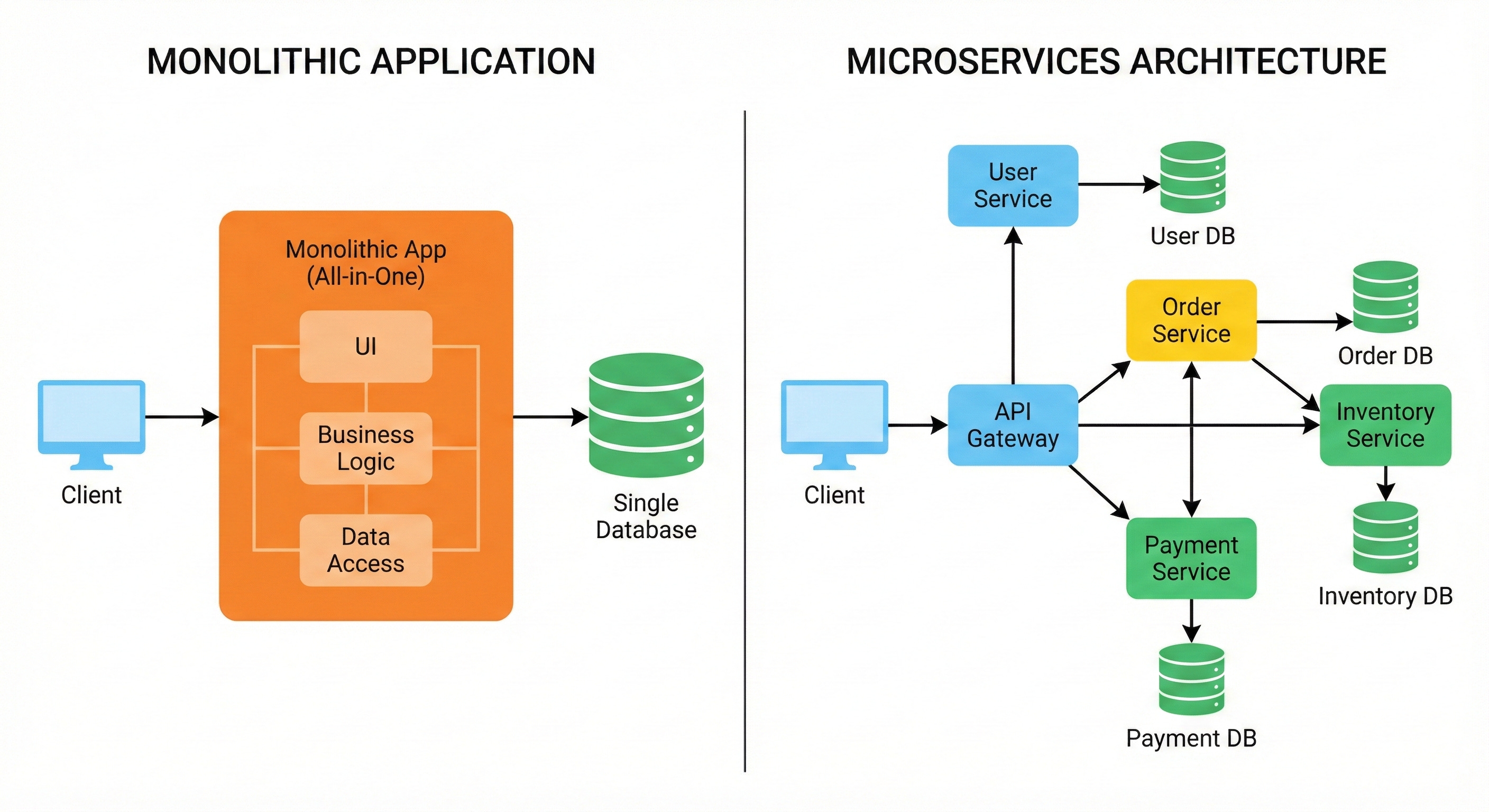
The user interface logic, the backend processing, and the database connections were bundled together.
We call this a monolithic architecture.
When a monolithic application runs, it operates as a single process on a server. Every internal software function can call any other function instantly in shared memory. They share the exact same processing resources at all times.
This traditional approach works perfectly in the early stages of software development.
A monolith is highly straightforward to build and test initially. Deploying the software simply involves copying one large application file to a server. Tracking software bugs is relatively simple because everything happens within a single process.
Developers can easily read the entire codebase in one single centralized location.
However, severe technical problems emerge as the software scales up.
When an application processes millions of network requests, the monolithic design becomes a massive bottleneck.
If one specific data processing module requires massive computing power, engineers cannot isolate it. They must duplicate the entire massive application across multiple new computer servers.
Furthermore, maintaining the massive codebase becomes a nightmare for engineering teams.
A simple code update to the user authentication module might accidentally corrupt the data reporting module. Deployments become highly coordinated, incredibly dangerous, and extremely slow.
A single fatal memory error anywhere in the codebase can cause the entire server to crash completely.
Breaking It Down With Microservices
Software engineers needed a better way to handle massive application scale.
Instead of building one massive application, they decided to build many small applications. They split the large software project into distinct, fully independent components. This new architectural style fundamentally changes how software is physically structured.
Each small application focuses on handling exactly one specific technical task.
One standalone application handles processing user logins exclusively. Another entirely separate application manages tracking system analytics or generating data reports. We call these small, highly focused software applications microservices.
They are totally independent pieces of computer software. They do not share a single codebase whatsoever. They do not share server memory space at any time. They are developed, tested, and deployed entirely on their own schedule.
This strict separation of concerns provides immense technical flexibility.
A team of engineers can rewrite the entire reporting service from scratch without touching the login service.
This architectural pattern fundamentally changes how software is built, maintained, and scaled. Complex applications transform into a network of cooperating individual services.
How Microservices Work Behind the Scenes
The transition from a single application to dozens of small applications introduces profound technical changes. Engineers must completely rethink how the software operates at a foundational hardware level.
Let us explore the mechanics of how this architecture actually functions in a real environment. Distributed systems require a completely different operational mindset.