
The Senior Engineer’s Guide to Behavioral Interviews: 50 Essential Questions
Don't fail the "soft skills" round. Understand why behavior impacts system architecture (Conway's Law), and practice with 50 essential questions on leadership, conflict, and mentorship.

The interview room often goes silent after a non-technical question is asked.
A candidate might be able to reverse a binary tree on a whiteboard in five minutes or design a scalable database schema without breaking a sweat.
Yet, when asked about a time they disagreed with a manager, they stumble. They might struggle to articulate their thoughts or fail to demonstrate the maturity required for the role.
This is a common scenario in the tech industry.
Great code is the baseline requirement for an engineering job.
However, as responsibilities grow, the job becomes less about writing syntax and more about making decisions, mentoring others, and navigating complex team dynamics. This transition is often invisible to students and early-career developers.
They spend hours grinding algorithms but very little time understanding the behavioral patterns that define successful senior engineers.
Understanding these behavioral expectations is critical. It is not just about passing an interview. It is about understanding what the job actually entails.
By looking at the questions asked of senior candidates, juniors can reverse-engineer the skills they need to acquire today.
This guide breaks down the behavioral interview into its core components and provides a comprehensive list of questions that test these essential attributes.
Key Takeaways
Behavior reflects Architecture: In senior roles, how you interact with a team directly impacts the stability and scalability of the system architecture you design.
The STAR Method is Essential: Structure every answer using the Situation, Task, Action, and Result framework to provide clarity and impact during the interview.
Failure is a Learning Tool: Senior engineers are expected to own their mistakes and explain the post-mortem process used to prevent recurrence.
Leadership is Not Just Management: You can demonstrate leadership by mentoring juniors, resolving technical disputes, and driving project completion without a manager title.
Context Matters: Answers should reflect an understanding of trade-offs between speed, quality, and cost in software development.
Why Behavior Impacts Architecture
It might seem strange to ask a programmer about conflict resolution or disagreement.
However, the systems organizations design are often constrained to produce designs that are copies of the communication structures of these organizations. This means the way a team communicates ultimately dictates the structure of the software.
If two engineers cannot agree on an API definition, the software components they build may not integrate correctly.
If a senior leader cannot admit a mistake, a critical bug might persist in production for weeks.
Behavioral interviews assess whether a candidate possesses the “soft skills” necessary to maintain the “hard skills” of the system.
In this context, Leadership Principles refer to a set of values that guide decision-making. These principles include things like “Customer Obsession,” “Bias for Action,” and “Ownership.”
While the specific names may vary by company, the core requirement remains the same.
The interviewer wants to know if the candidate acts like an owner of the product or just a temporary contributor.
The Framework for Success: STAR
Before diving into the questions, it is essential to understand how to structure an answer.
Without a structure, answers can become long, winding stories that miss the point.
The industry standard for this is the STAR method.
Situation: This sets the stage. It describes the specific context or problem. It should be brief and provide just enough detail for the interviewer to understand the stakes.
Task: This explains what was required. What was the goal? What were the constraints? This highlights the challenge.
Action: This is the most important part. It details the specific steps taken to solve the problem. It focuses on “I” rather than “We.” It explains the reasoning behind decisions.
Result: This reveals the outcome. Did the project succeed? What metrics improved? If it failed, what was learned?
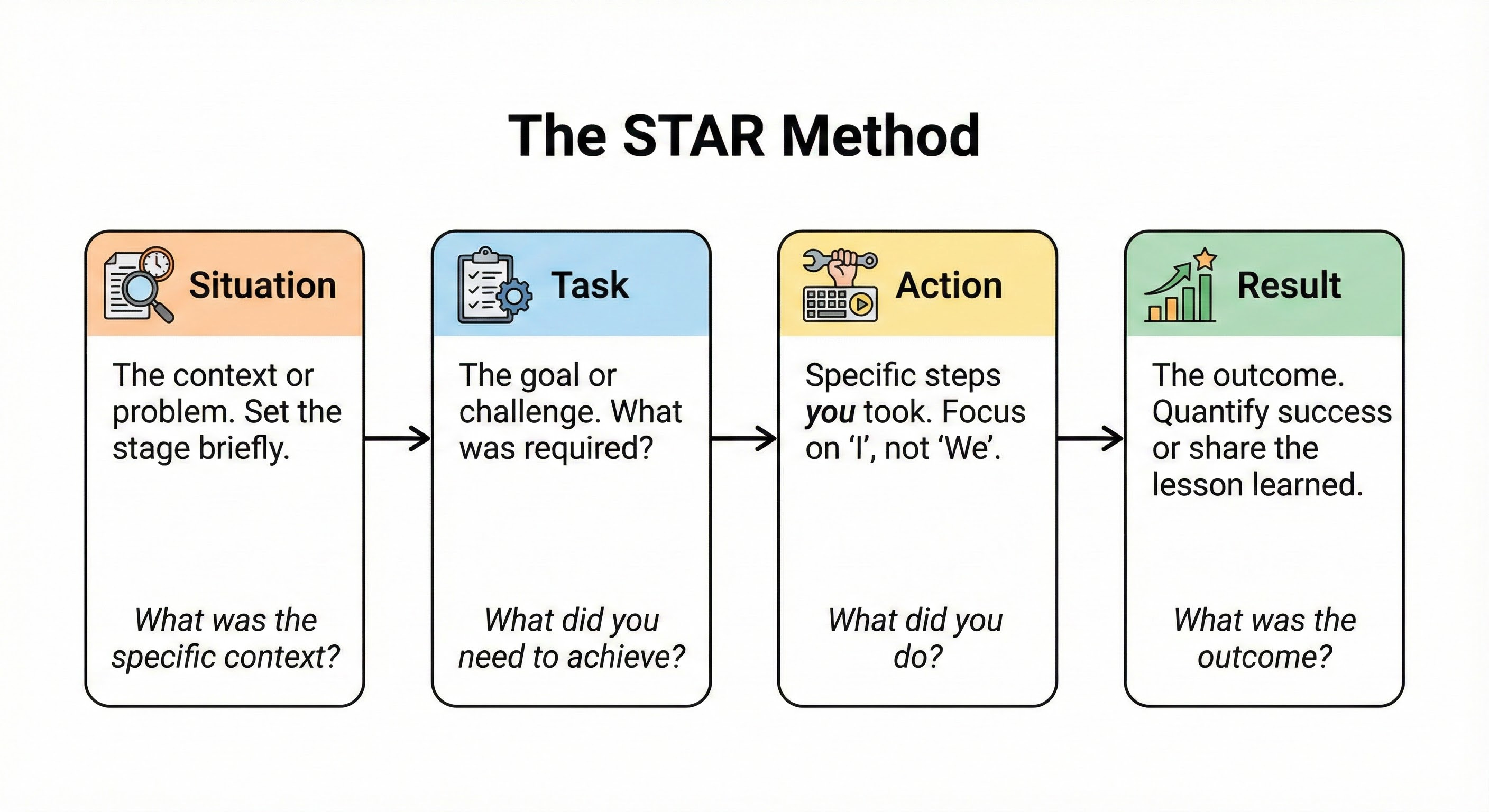
Using this framework transforms a vague anecdote into a professional case study. It shows logical thinking and clear communication.
Category 1: Ownership and Delivering Results
Focus: Taking responsibility and ensuring projects cross the finish line.
Senior engineers must deliver value.
They do not wait for permission to fix broken things. This category tests the ability to overcome obstacles and handle responsibility.
The interviewer is looking for “agency,” which is the feeling that you are in control of your work and can affect change.
What they look for: They want to see that you care about the product as a whole. They want to know that when you see a fire, you pick up a bucket of water, even if it is not your assigned week to fight fires.
Tell me about a time you had to make a complex technical trade-off to meet a deadline.
Describe a situation where you took ownership of a project that was falling behind.
Give an example of a time you went above and beyond your defined job description to fix a critical issue.
Tell me about a time you had to compromise on code quality to release a feature on time.
Describe a time when you noticed a gap in the system architecture and took the initiative to fix it without being asked.
Tell me about a time you faced a blocker that threatened to derail the project. How did you resolve it?
Give an example of a calculation or estimation you made that turned out to be wrong. How did you handle the impact?
Describe a time you pushed back against a requirement because you knew it would harm the system’s stability.
Tell me about a project where you had to work with very limited resources or budget.
Give an example of a time you had to pivot your strategy halfway through a project.
Category 2: Technical Conflict and Disagreement
Focus: Navigating differing opinions on design and implementation.
Distributed systems often have no single “correct” answer.
There are only trade-offs.
One database might be faster but more expensive; another might be cheaper but harder to scale. These questions test how a candidate handles dissent.
What they look for: The goal here is to show Disagreement and Commitment. It is acceptable to argue for a specific database or framework, but once the team decides, the senior engineer must support the team’s choice.
Avoid painting the other party as “wrong.” Focus on the data used to resolve the conflict.
Tell me about a time you disagreed with a manager or lead regarding a technical decision.
Describe a situation where you and a peer had different ideas on how to solve a problem. How did you decide?
Give an example of a time you committed to a decision you did not agree with.
Tell me about a time you had to convince a team to adopt a new technology or framework.
Describe a time you received critical feedback on your code or design. How did you react?
Tell me about a time you had to mediate a dispute between two other engineers.
Give an example of a time you realized your argument was wrong in the middle of a debate.
Describe a time you felt strongly about a feature but the data proved you wrong.
Tell me about a difficult conversation you had with a stakeholder about why a feature could not be built.
Give an example of how you handle code reviews when the author disagrees with your assessment.
Category 3: Customer Obsession and System Design
Focus: Working backwards from the user to the technology.
The code exists to solve a problem for a user. These questions ensure the engineer understands the business case, not just the compilation process. It connects the “how” of the code to the “why” of the business.
What they look for: The “customer” can be an external user or an internal team using your API.
Focus on empathy. Show that you understand the pain the user feels when the system is slow or broken.
A senior engineer prioritizes the user experience over their own desire to use cool new tech.
Tell me about a time you changed a technical design based on customer feedback.
Describe a time you had to refuse a customer request because it was technically infeasible.
Give an example of a feature you built that directly improved the user experience.
Tell me about a time you identified a pain point for the user that the product team had missed.
Describe a situation where you had to balance strict security requirements with user convenience.
Give an example of a time you used production metrics to understand how users were actually using the system.
Tell me about a time a system failure impacted the customer. How did you communicate this?
Describe a time you simplified a complex process to make it easier for the end user.
Tell me about a time you prioritized a bug fix over a new feature because of customer impact.
Give an example of how you ensure your technical documentation is understandable for non-technical stakeholders.
Category 4: Mentorship and Team Growth
Focus: Elevating the skills of the people around you.
A senior engineer is a force multiplier. They make the whole team better.
If you are the smartest person in the room but you do not help others, you are a bottleneck, not a leader.
What they look for: Highlight patience and investment in others.
Senior roles require shifting from “I built this” to “We built this.”
Show that you can teach without being condescending. They want to see that you can replicate your success in others.
Tell me about a time you mentored a junior developer who was struggling.
Describe a time you helped a colleague get promoted.
Give an example of a time you improved the team’s onboarding process.
Tell me about a time you let a junior engineer take the lead on a project you could have done faster yourself.
Describe how you handle a team member who is consistently underperforming.
Give an example of a knowledge-sharing session or workshop you organized.
Tell me about a time you advocated for diversity or inclusion within your engineering team.
Describe a time you helped a peer debug a complex issue that was not your responsibility.
Give an example of how you promote code quality standards within a team.
Tell me about a time you delegated a critical task. How did you ensure it was successful?
Category 5: Failure, Learning, and Curiosity
Focus: Handling mistakes and keeping up with technology.
Technology changes rapidly. A rigid engineer becomes obsolete. Furthermore, systems break.
The reaction to breakage is critical.
What they look for: Do not hide the failure.
The interviewer wants to hear about the Post-Mortem. Explain the root cause analysis.
Did you add automated tests to prevent it from happening again?
Did you update the documentation?
The value lies in the recovery and the lesson, not the error itself.
Tell me about the biggest technical mistake you made in your career.
Describe a time you caused an outage in production. How did you fix it?
Give an example of a technology you learned recently. Why did you choose it?
Tell me about a time you implemented a solution that failed to scale.
Describe a situation where you had to go deep into a legacy codebase to find a root cause.
Give an example of a time you anticipated a problem before it happened and prevented it.
Tell me about a time you had to unlearn an old habit or practice.
Describe a post-mortem process you led after a significant failure.
Give an example of a risk you took that did not pay off.
Tell me about a time you felt overwhelmed by the complexity of a system. How did you manage it?
Conclusion
Mastering these 50 questions is about more than memorizing scripts. It is about understanding the mindset of a senior leader in technology.
The behavioral interview is the mechanism companies use to ensure that a candidate’s technical brilliance is matched by their emotional intelligence and leadership capability.
When preparing, remember to keep the focus on the why and the how.
Why did you choose that specific database?
How did you convince the team to follow your lead?
Why did the system fail, and how did you ensure it would not fail again?
By analyzing these questions and preparing structured responses, a candidate demonstrates they are ready to handle the complexities of large-scale system design and team management. This preparation bridges the gap between writing code and building enduring software solutions.
Key Takeaways Summary:
Behavior reflects Architecture: The way a team communicates dictates the structure of the system they build.
Use the STAR Method: Always structure answers with Situation, Task, Action, and Result.
Own the Outcome: Whether good or bad, take responsibility for the results of the project.
Prioritize the Customer: Technical decisions should always trace back to user value.
Mentorship is Key: Seniority is defined by how much you help others grow, not just by individual code output.