
Scale to Zero: How Serverless Architecture Replaces Traditional System Design
Stop studying Google-scale problems. Discover the practical system design approach that allows junior developers to build production-ready apps for free.


The gap between academic computer science theory and the practical reality of shipping software is often a source of frustration for new developers.
University curriculums and standard system design textbooks frequently emphasize the architecture of massive, distributed systems.
Students spend months learning about hardware load balancers, database sharding strategies, and multi-region replication protocols. These concepts are undeniably vital for technology giants that serve billions of users.
However, they often act as unnecessary obstacles for a developer trying to launch a first project, a portfolio piece, or a startup idea.
The primary constraint for a new project is rarely handling petabytes of data.
The real constraints are development speed, operational complexity, and financial resources.
Attempting to build a “Google-scale” infrastructure from day one is usually a mistake. It introduces significant maintenance overhead and forces the developer to pay for expensive servers that sit idle most of the time.
This tendency toward over-engineering can kill a project before it even acquires its first user.
Fortunately, the software industry has evolved to solve this specific problem.
A new architectural pattern has emerged that prioritizes high availability, low maintenance, and zero upfront cost. This is often referred to as the “Indie Hacker Stack.”
By leveraging managed services and serverless technologies, a single developer can now architect a global, high-performance system that scales automatically.
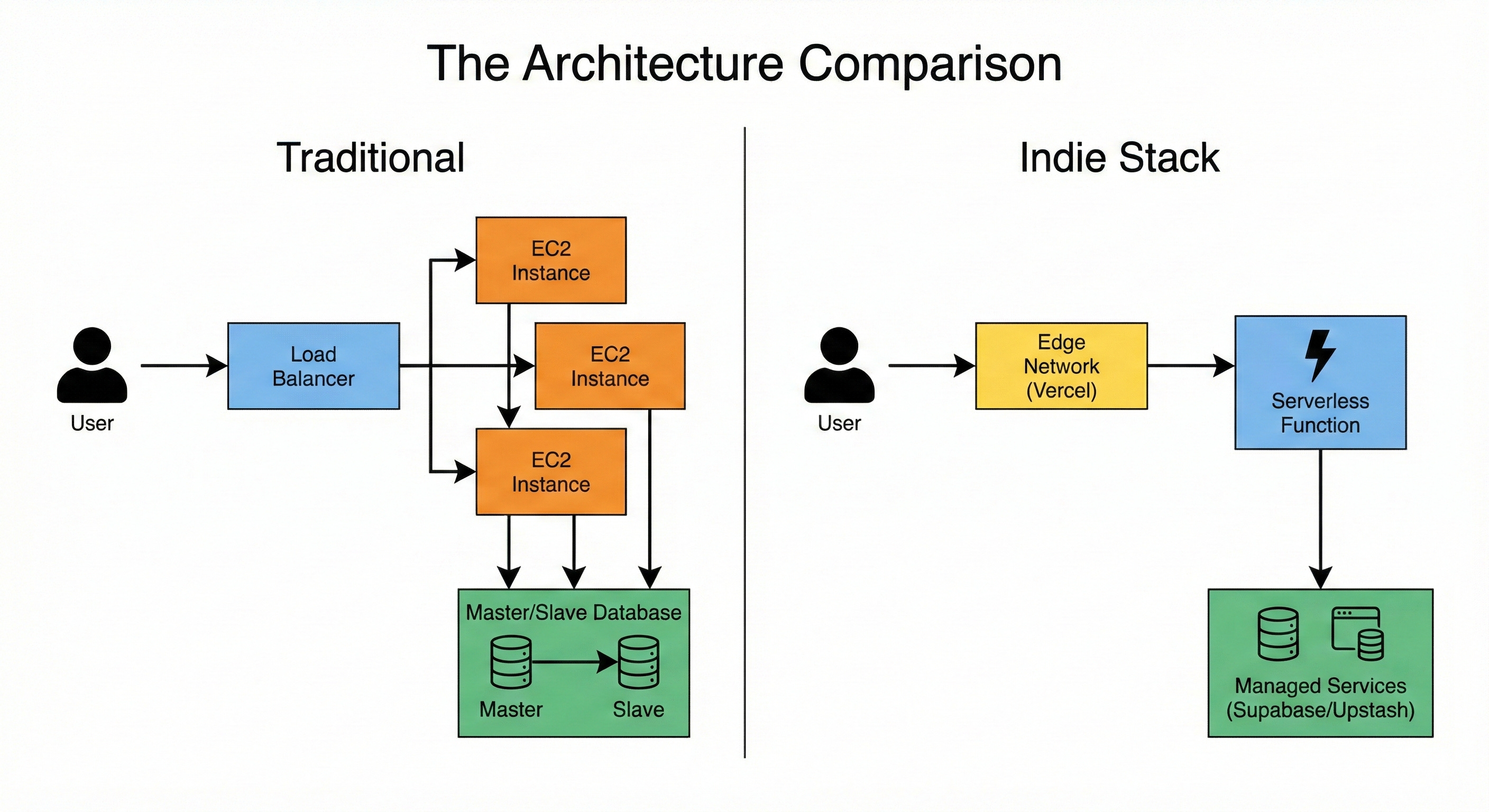
This guide explores the technical mechanics of this stack. It focuses on replacing complex, manual infrastructure with modern tools: Vercel for compute, Supabase for data, and Upstash for caching.
The Core Philosophy: Scale to Zero
Traditional system design is built on the concept of provisioned capacity.
A developer rents a virtual server (a computer in a data center) and pays a fixed monthly fee for it. This server runs 24 hours a day, waiting for requests.
If the application receives no traffic, the developer still pays the full price.
If the traffic exceeds the server’s capacity, the application crashes.
The Indie Hacker stack operates on a different financial and technical model known as “Scale to Zero.”
In this model, the infrastructure does not exist in a running state until a request arrives. When a user interacts with the application, the necessary computing resources are allocated instantly.
Once the request is processed, the resources are released.
The developer pays only for the milliseconds of computation used. If no one uses the application, the cost is exactly zero. This shifts the focus from capacity planning to logic implementation.
The Compute Layer: The Edge (Vercel/Netlify)
The entry point for any web application is the compute layer. This is where the application logic resides and where user requests are processed.
In a traditional architecture, this would be a monolithic web server sitting in a specific region, such as Northern Virginia or Frankfurt.
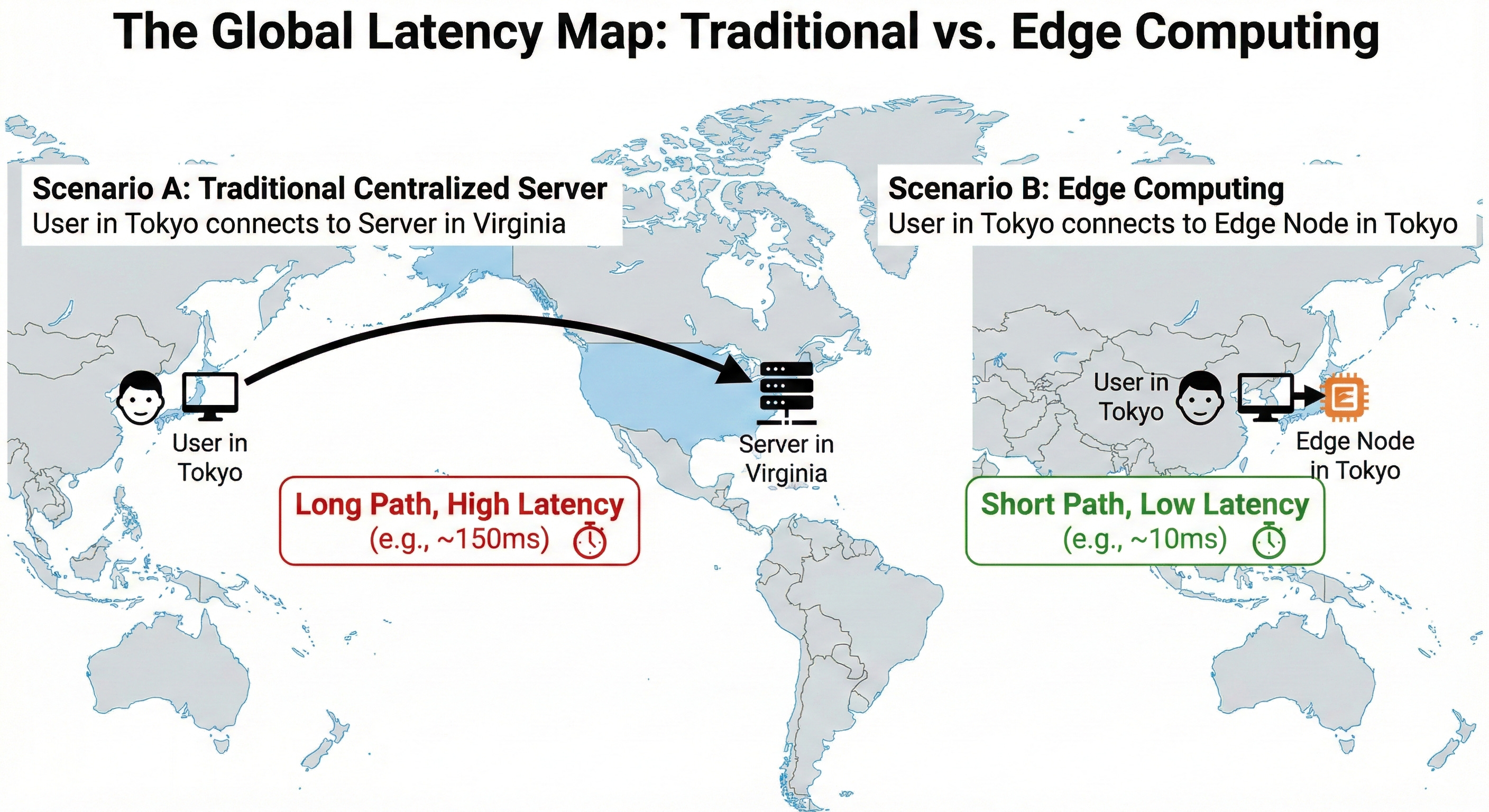
This physical location creates a problem known as latency.
Latency is the time it takes for data to travel from the user’s device to the server and back.
If a user in Tokyo accesses a server in Virginia, the signal must travel halfway around the world. This is bound by the speed of light, resulting in a noticeable delay.
Platforms like Vercel and Netlify solve this by deploying code to “The Edge.”
Distributed Execution
The Edge refers to a global network of servers located in hundreds of cities worldwide.
When a developer pushes code to these platforms, it is not copied to a single machine. It is replicated across the entire global network.
Keep reading with a 7-day free trial
Subscribe to System Design Nuggets to keep reading this post and get 7 days of free access to the full post archives.