
The Junior Engineering Crisis: How to Get Hired When AI Writes Almost All Code
As AI automates entry-level coding tasks, junior software engineers face a shrinking job market. This post explores the "Experience Paradox," the risks of "vibe coding," & gives a plan to get hired.

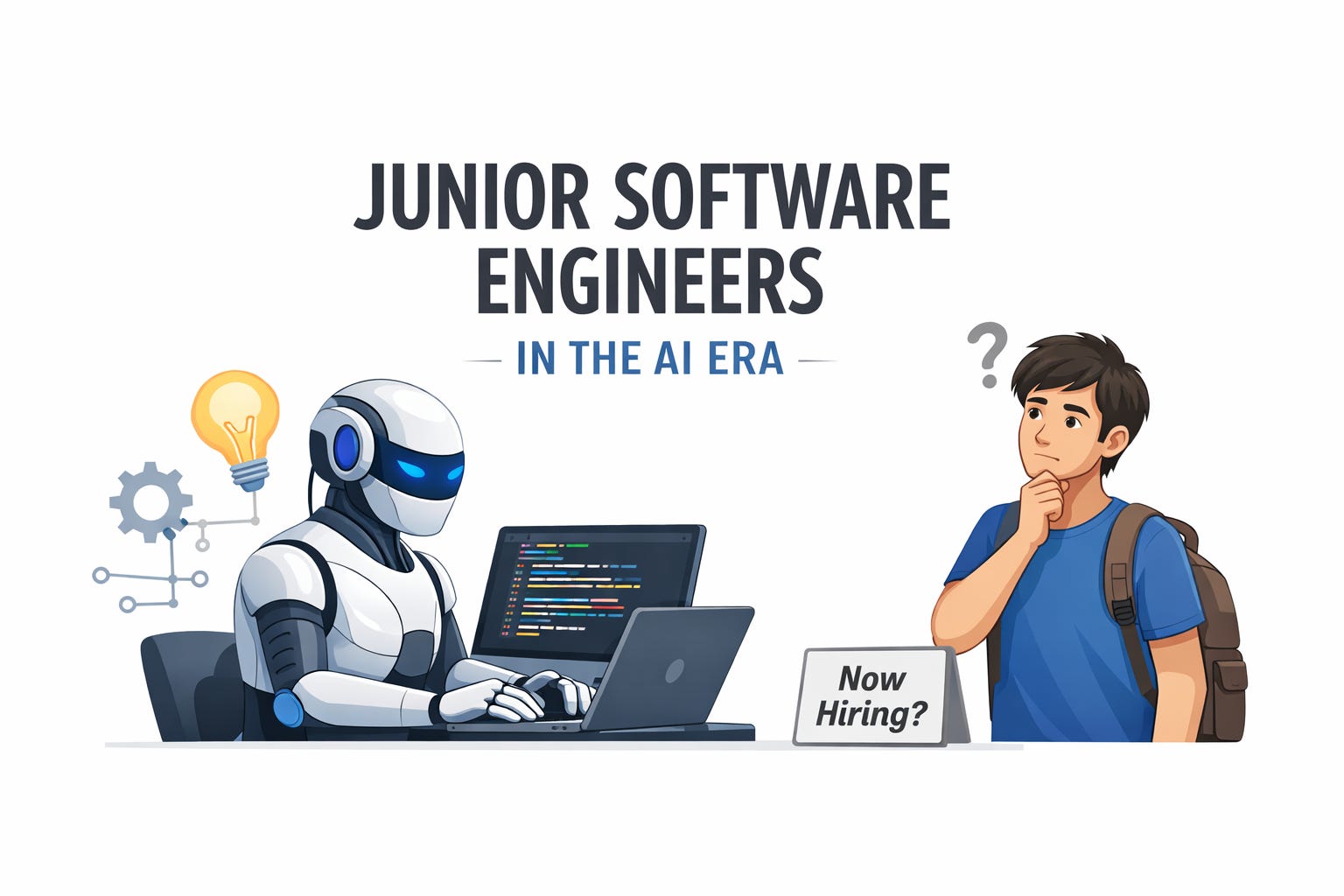
So, the question of the town is: What happens to software engineering when AI writes almost all code?
If you are paying attention to broader industry trends, a stark reality is unfolding: we are rapidly approaching an inflection point where AI models write almost all the code.
For senior and staff-level engineers, this is a golden age. Armed with AI, their productivity has skyrocketed. They have transitioned from being manual “authors” of code to being “editors” and technical directors, orchestrating AI agents to multiply their output and build out complex architectures at lightspeed.
If you are a student or a junior dev today, the “Junior-level task” is going extinct. To get hired in 2026 and beyond, you cannot just be a “coder.” You must become a Systems Architect who uses AI as a compiler.
Your job is no longer about writing code from scratch; it is about reading, editing, orchestrating, and validating AI-generated systems.
Here are the five primary challenges facing the next generation of engineers and a detailed plan to overcome them.
1. The Extinction of “Entry-Level” Tasks
The Challenge: Companies are becoming hesitant to hire juniors because they struggle to find work that isn’t already solvable by a senior engineer with an AI tool. If a Senior + Cursor can do the work of three juniors, the economic incentive to hire “trainees” vanishes.
The Strategy: Master AI Orchestration
Pivot from “Syntax Coder” to “AI Orchestrator”: You can no longer market yourself purely on your ability to type out React components or Python loops from memory. The market assumes AI can do that. Instead, market your ability to deliver outcomes rapidly. Master AI tools deeply. If you are a junior who knows how to leverage Cursor, Copilot, and Claude to deliver feature output at the volume of a traditional mid-level engineer, you become an undeniable asset. Show employers that hiring you means hiring a highly leveraged builder.
Master the “Glue Work”: AI is spectacular at writing isolated, self-contained, stateless functions, but it notoriously struggles with connecting disparate, messy systems. Learn how to glue things together. Master cloud infrastructure provisioning (AWS/GCP), CI/CD deployment pipelines (GitHub Actions), containerization (Docker), database schema migrations, and messy third-party API integrations (like Stripe or OAuth). If the AI writes the logic, you must be the expert who deploys, hosts, secures, and scales it in the cloud.
Target Legacy and Niche Technologies: AI models are heavily trained on modern, popular, open-source frameworks. They often hallucinate wildly or fail completely when faced with obscure, proprietary, or massively undocumented ten-year-old monolithic codebases. By learning how to navigate, document, and safely refactor complex legacy systems (e.g., migrating an old Java Spring app to modern microservices), you offer a deeply human capability that AI currently cannot match.
2. The “Experience Paradox” (The Rising Bar)
The Challenge: Because AI makes everyone more productive, the “minimum viable junior” has moved up. Hiring managers now expect a junior to have the architectural intuition of a mid-level engineer. You are being judged on your “Engineering Judgment” before you’ve even had your first job.
The Strategy: Study System Design Early
At DesignGurus.io, we’ve always advocated for early mastery of fundamentals. In the AI era, this is no longer optional.
Study System Design Immediately: Do not wait until you are aiming for a Senior role to learn system architecture. (This is exactly why mastering resources like DesignGurus’ Grokking System Design courses early in your career is now essential). Understand the trade-offs between monoliths and microservices, SQL vs. NoSQL, event-driven architectures, API gateways, and caching strategies. The AI can write the microservice, but the human must decide if a microservice is actually needed in the first place.
Master Context Management (Layered Specs): Practice taking a vague business idea and breaking it down into rigorous technical requirements. Write Product Requirement Documents (PRDs) and Technical Specs for your personal projects before you write a single prompt or line of code. Prove to hiring managers that you can translate “fuzzy human needs” into “rigid machine instructions.” AI models are incredibly dependent on the context they are fed; learning to structure that context makes you an elite prompt architect.
Highlight Soft Skills and Empathy: Become a “Product-Minded Engineer.” AI cannot sit in a room with a frustrated client to figure out what they actually want. It cannot negotiate technical debt timelines with a non-technical CEO, nor can it mentor a peer. Over-index on emotional intelligence, active listening, and strong written communication. These are the domains where human engineers will remain untouchable for decades to come.
3. The Mentorship Gap
The Challenge: Senior engineers are in “hyper-productivity mode.” They feel they don’t have time to mentor juniors because the friction of teaching feels higher than the friction of just asking an LLM to do the task.
Keep reading with a 7-day free trial
Subscribe to System Design Nuggets to keep reading this post and get 7 days of free access to the full post archives.