
The 8-Week System Design Study Plan: From Zero to Interview-Ready
A step-by-step 8-week plan to prepare for system design interviews from scratch. Covers core concepts, practice strategies, and common mistakes to avoid.

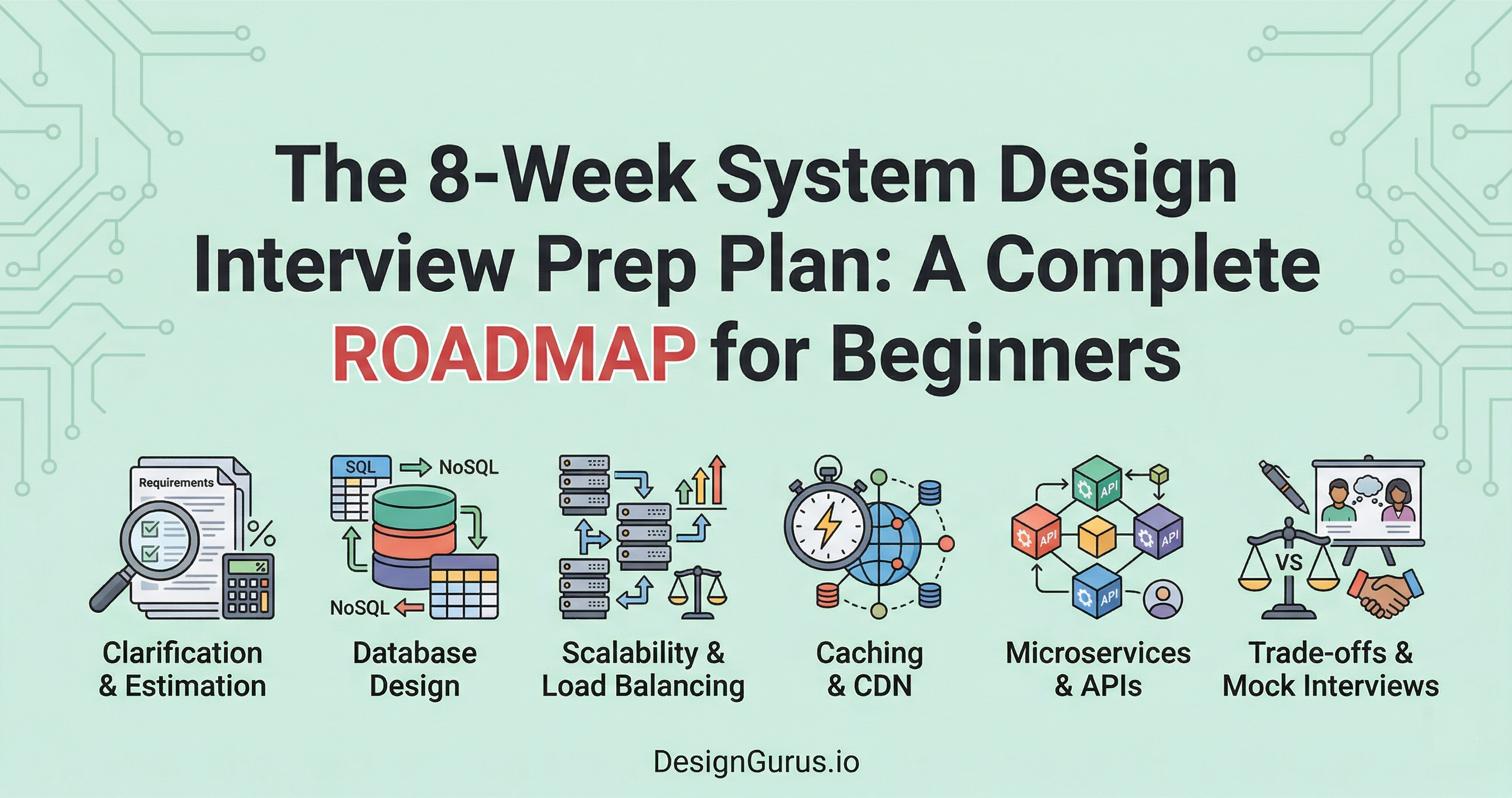
What this blog covers:
Week-by-week structured preparation roadmap
Core system design concepts explained simply
Common interview patterns and question types
Practice strategies that actually work
Mistakes beginners make (and how to avoid them)
System design interviews are scary.
There is no single right answer.
There is no leetcode-style verdict that says “Accepted” in green.
You walk into a room (or a Zoom call), someone asks you to design Twitter or Netflix or a URL shortener, and suddenly you are supposed to talk about databases, caching, load balancing, and things you have never built before.
The worst part?
Most college courses never teach this stuff. You graduate knowing how to write algorithms and data structures, but nobody tells you how to think about building software that serves millions of users.
And here is the thing.
Companies are asking these questions more than ever, even for mid-level and sometimes junior roles. It is not going away.
But the good news?
System design is a learnable skill.
You do not need years of experience building large-scale systems. You need a structured plan, the right concepts, and consistent practice over a few weeks.
That is exactly what this post gives you.
Why 8 Weeks? Why Not Cram It All in a Weekend?
System design is not something you memorize overnight. It is about building mental models.
You need to understand how different pieces of a system connect, why certain decisions are made, and what trade-offs exist.
Eight weeks gives you enough time to learn the fundamentals, practice applying them, and let the ideas settle in your brain. Rushing through it leads to surface-level understanding, and interviewers can spot that immediately.
Each week in this plan builds on the previous one.
Think of it as stacking blocks. You cannot talk about caching strategies if you do not first understand what a database is doing and why it might be slow.
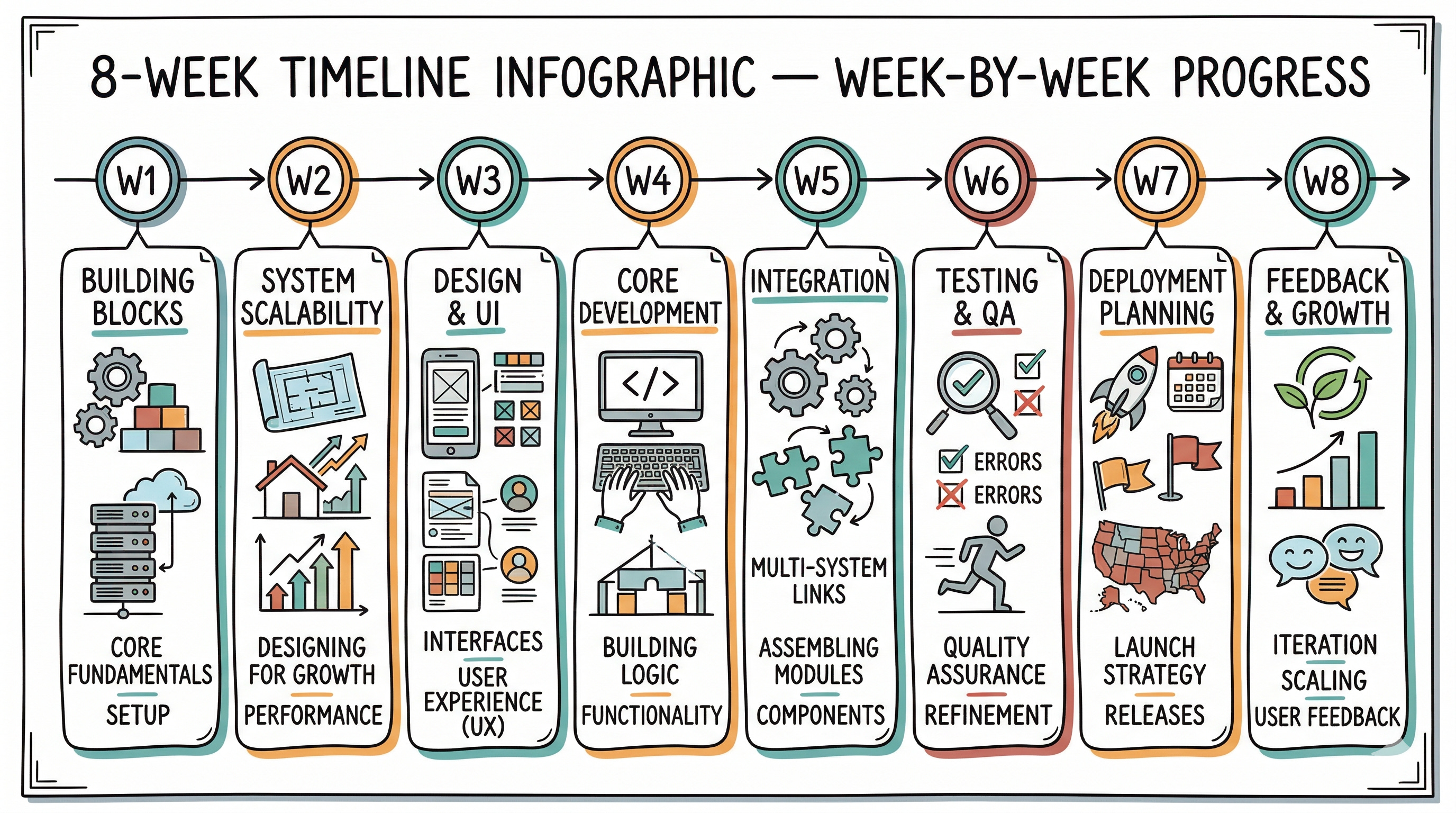
Week 1: Learn the Building Blocks
Before you can design anything, you need to know the vocabulary.
This week is about understanding the fundamental components that show up in almost every system design discussion.
What to focus on:
Client-Server Model — This is the basic idea that one machine (the client, like your phone or browser) sends a request, and another machine (the server) processes it and sends back a response. Every web application works this way.
Databases — Where your data lives. There are two broad types. Relational databases (like PostgreSQL or MySQL) store data in structured tables with rows and columns. Non-relational databases (like MongoDB or Cassandra) store data in more flexible formats. You should understand when to use which.
APIs — An API (Application Programming Interface) is just a set of rules that lets two pieces of software talk to each other. When your phone app shows you the weather, it is calling a weather API behind the scenes.
Networking basics — Understand what happens when you type a URL into your browser. DNS resolves the domain name to an IP address, your browser opens a connection, sends an HTTP request, and the server responds. You do not need to be a networking expert, but this mental picture helps a lot.
Spend this week reading and watching introductory content.
Take notes. Draw simple diagrams.
The goal is not mastery.
The goal is familiarity.
Week 2: Scalability and Performance
This is where system design really starts.
The core question behind almost every system design interview is: “What happens when this system gets really popular?”
Key concepts:
Vertical scaling vs. horizontal scaling — Vertical scaling means making one machine more powerful (more RAM, better CPU). Horizontal scaling means adding more machines. Horizontal scaling is almost always the preferred approach for large systems because there is a limit to how powerful a single machine can get.
Load balancing — When you have multiple servers, a load balancer sits in front of them and distributes incoming requests so no single server gets overwhelmed. It is essentially a traffic director.
Caching — A cache is a temporary storage layer that keeps frequently accessed data close to where it is needed, so you do not have to fetch it from the database every single time. Think of it as a shortcut. Redis and Memcached are popular caching tools.
Content Delivery Networks (CDNs) — A CDN stores copies of your static content (images, videos, CSS files) on servers spread across the world. When a user in Tokyo requests an image, they get it from a nearby CDN server instead of your main server in Virginia. This makes things faster.
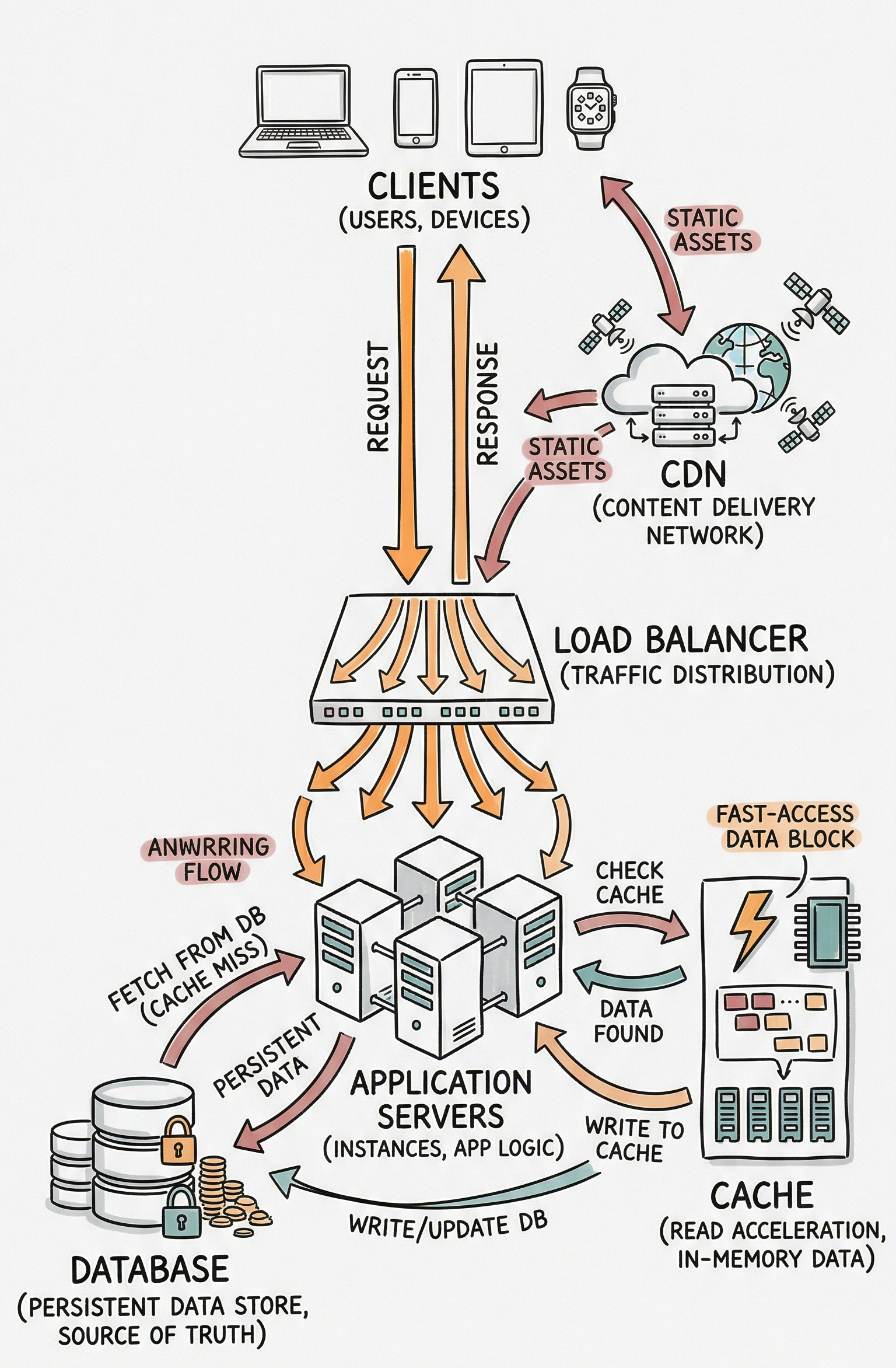
Understanding these four concepts alone will let you handle a huge portion of system design questions at a basic level.
Week 3: Data Storage Deep Dive
Now go deeper into how data is stored, accessed, and organized.
What to study:
SQL vs. NoSQL — Relational databases (SQL) are great when your data has clear relationships and you need strong consistency. NoSQL databases shine when you need flexibility, speed, or you are dealing with massive amounts of unstructured data. Neither is universally better. The right choice depends on the use case.
Database indexing — An index is a data structure that makes searching through a database faster. Without an index, the database has to scan every single row to find what you are looking for. With an index, it can jump straight to the relevant rows.
Replication — This means keeping copies of your database on multiple machines. If one machine dies, another one still has the data. It also helps with read performance because you can spread read requests across replicas.
Keep reading with a 7-day free trial
Subscribe to System Design Nuggets to keep reading this post and get 7 days of free access to the full post archives.