
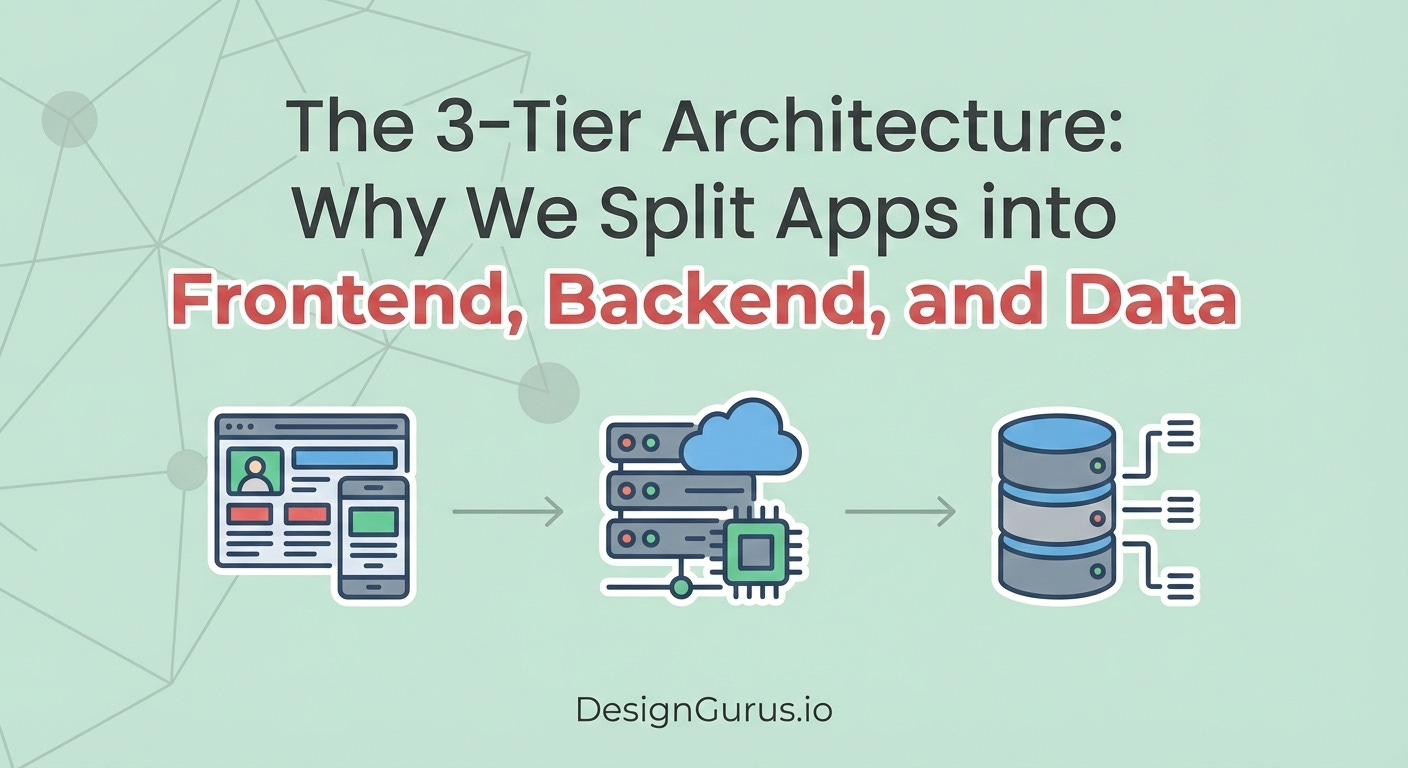
The 3-Tier Architecture: Why We Split Apps into Frontend, Backend, and Data
Frontend vs. Backend vs. Database. Learn why separating presentation, logic, and data is critical for building scalable software.

This blog explains:
front-end, backend, and database architecture
request-response cycle
technical advantages of splitting the system
Software engineering is fundamentally about managing complexity.
When you first learn to program, you typically write scripts where every instruction serves a specific, immediate purpose. You might write a single file that collects input from a user, calculates a result, and writes that result to a text file.
In this context, the code responsible for the visual interface, the code responsible for the logic, and the code responsible for data storage are all interwoven.
This approach, often called “monolithic” or “spaghetti code,” works for small, personal projects. However, as an application grows to serve thousands of users or manage gigabytes of data, this lack of structure becomes a critical liability.
If the user interface code is tightly coupled with the database queries, a simple change to a visual element can break the data storage mechanism.
Furthermore, a single massive file makes it impossible for teams to work in parallel; one developer’s changes will inevitably conflict with another’s.
To solve this, software architects rely on a structural design pattern known as the 3-Tier Architecture.
This pattern is the industry standard for building scalable, secure, and maintainable web and mobile applications. It enforces a strict separation of concerns, ensuring that the interface, the logic, and the data operate as distinct but cooperating components.
What is the 3-Tier Architecture?
The 3-Tier Architecture is a client-server software architecture pattern in which the functional process logic, data access, computer data storage, and user interface are developed and maintained as independent modules.
These modules are referred to as “tiers” because they represent a logical and physical separation of duties.
“Logical” separation means the code is organized into different folders or projects.
“Physical” separation means the code often runs on different hardware or infrastructure.
The three tiers are:
The Presentation Tier (Frontend)
The Application Tier (Backend)
The Data Tier (Database)
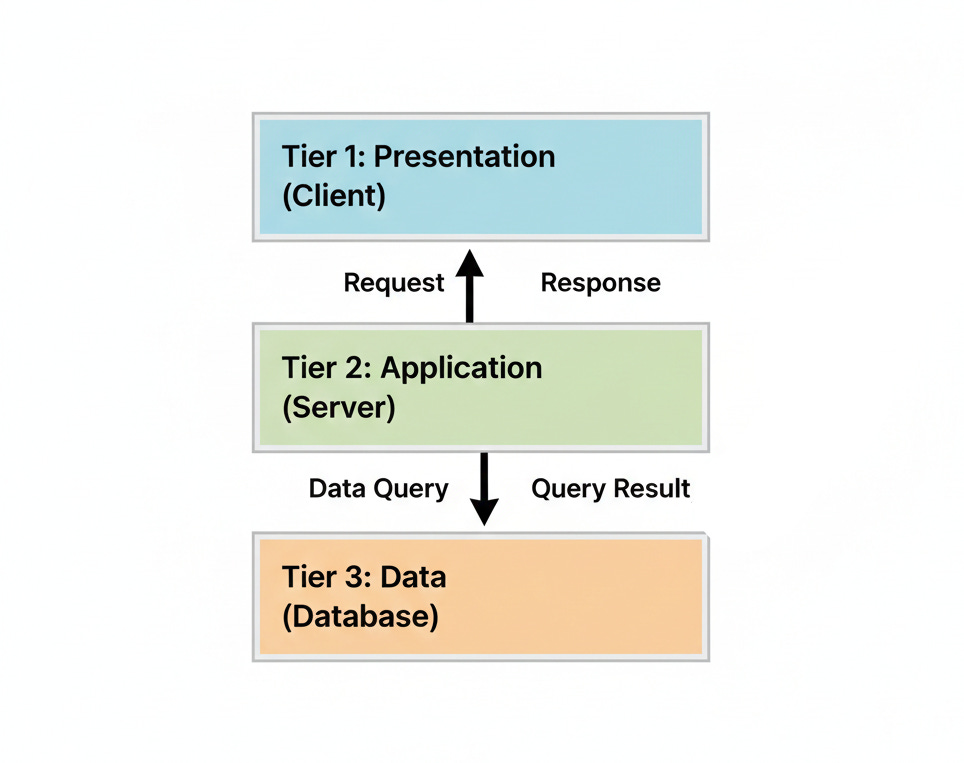
A fundamental rule of this architecture is the linear flow of data.
The Presentation Tier never communicates directly with the Data Tier.
All requests must pass through the Application Tier.
This structure acts as a control mechanism, ensuring that no data is accessed or modified without passing through a layer of business logic and validation.
Keep reading with a 7-day free trial
Subscribe to System Design Nuggets to keep reading this post and get 7 days of free access to the full post archives.