
System Design Interviews Changed in 2026. Here's the New Playbook.
The framework still works. But what interviewers ask, and how they grade you, is not what it was three years ago.

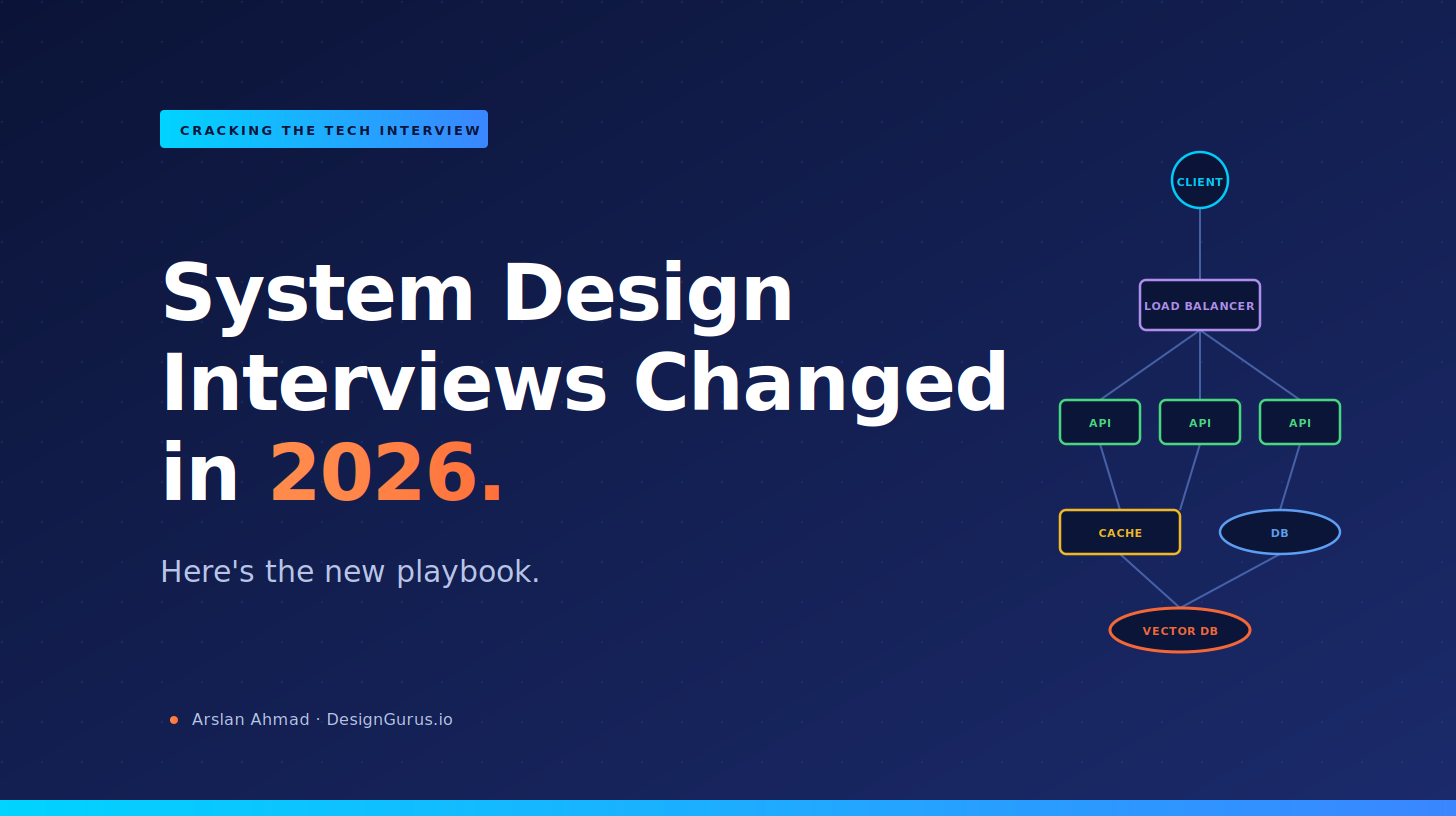
System design interviews look different in 2026.
Three years ago, you could walk into a FAANG loop, sketch a load balancer, a database, and a cache, talk through scaling, and pass.
That bar has moved.
Companies have spent the last two years rebuilding their interview rubrics. Questions are tighter. Expected depth is higher. And a new category of question has shown up that almost no prep guide covers yet.
Here is what actually matters now, condensed from my full system design interview guide.
What Changed
Three things shifted between 2023 and 2026.
1. AI-aware designs are now table stakes.
Interviewers expect you to reason about LLMs, vector stores, and retrieval-augmented generation as part of standard system design, not as a niche specialty. “Design Twitter” is increasingly “Design Twitter, including the recommendation pipeline and a generative summary feature.”
2. Cost is now part of the rubric.
A few years ago, hand-waving about “we would add more servers” was acceptable. Today, senior loops want you to reason about cost per request. If you propose a multi-region active-active setup for a hobby app, that is a red flag. Right-sizing matters.
3. Operational thinking is graded explicitly.
Observability, deployment strategy, on-call burden, and rollback paths are no longer optional bonus topics. Senior candidates who skip them are leaving signal on the table.
Why you care: if you prep using a 2022 guide, you will walk in technically correct and still fail. The framework is the same. The depth of expectations is not.
The 7-Step Framework, Condensed
The framework is the boring part. Boring is good. It keeps you from freezing.
Clarify requirements. Functional, non-functional, scale, constraints. Spend five minutes here. Always.
Estimate. Back-of-the-envelope numbers for QPS, storage, bandwidth. Round generously.
Define the API. A few key endpoints. This grounds the rest of the conversation.
Sketch the data model. What is stored, what is relational, what is not.
Draw the high-level design. Boxes and arrows. Five to seven components, not fifty.
Go deep. Pick two or three components and detail them. Caching, sharding, replication.
Find the bottlenecks. Walk your design back through the requirements and stress-test it.
That is it. The full breakdown with diagrams and worked examples lives in the complete guide on DesignGurus.
The framework matters less than what you do inside each step. That is where 2026-grade depth shows up.
Topics That Actually Matter
Here is what gets asked over and over, in rough order of frequency.
Load balancing strategies, and when each one breaks
Caching layers, including write-through vs. write-behind, invalidation, and stampedes
Database choices. SQL vs. NoSQL is not the real question. Which NoSQL and why is.
Sharding and partitioning, including consistent hashing and hot keys
Replication and consistency. CAP, PACELC, real tradeoffs.
Message queues. Kafka vs. SQS vs. Pub/Sub, and when to skip them entirely.
Rate limiting and throttling
Search and indexing. Elasticsearch is still the default, and you should know why.
Observability. Logs, metrics, traces, alerts.
The new category: vector databases, embedding pipelines, LLM gateways.
Be deep on three or four of these. Be conversant on the rest.
The Questions You Will Actually Get
Sample prompts trending in 2026 loops:
Design a real-time chat system with end-to-end encryption
Design a recommendation feed with an LLM-generated summary on top
Design a multi-tenant analytics dashboard
Design a payment processor with idempotency guarantees
Design a global rate limiter
Design a vector search service for a RAG application
Design a notification system that handles 10M users and 50 channels
Design Uber, where the matching algorithm has to call an ML model
The classic ones still come up. URL shortener, Twitter, YouTube, Instagram, all still in the rotation. The newer ones lean toward AI-adjacent infrastructure or operational complexity.
Five Mistakes That Sink Strong Candidates
Jumping to a solution. Five seconds of “let me clarify a few things” beats five minutes of cleanup later.
Designing for scale that does not exist. A 1K-user app does not need a global Cassandra cluster.
Refusing to commit. “It depends” is fine once. Twice is acceptable. The third time, pick something and defend it.
Going wide instead of deep. Two deep components beats five shallow ones every time.
Skipping operational concerns. If you never said the word “monitoring” or “deployment,” you left points on the table.
Why you care: the rubric in 2026 weights depth, judgment, and operational maturity. Going wide and confident used to be enough. It is not anymore.
How to Prepare in 2026
If you have eight weeks:
Weeks 1 and 2. Fundamentals. Caching, load balancing, databases, queues. Build a mental library of patterns.
Weeks 3 to 5. Practice. Work through 8 to 10 classic questions out loud, in 45-minute timeboxes, against a whiteboard or a tool like Excalidraw.
Weeks 6 and 7. Mock interviews. Real ones, with another engineer. Pattern recognition only forms under pressure.
Week 8. Review your weak spots. Do not learn anything new the week before. Sharpen what you have.
If you have two weeks, compress phase one ruthlessly and double the practice.
Key Takeaways
The 7-step framework still works. The depth bar inside each step has moved up.
AI-adjacent system design questions are now mainstream, not niche.
Cost reasoning and operational thinking are graded explicitly in 2026 loops.
Two deep components beats five shallow ones. Always.
Mock interviews matter more than reading. Pattern recognition forms under pressure.
For the full version, with worked examples, diagrams, and a deeper walkthrough of each step, see the complete system design interview guide.
If you want a structured course rather than self-directed prep, Grokking the System Design Interview covers this material with patterns, sample problems, and full solutions.