
System Design Interview: The 10-Minute Requirement Gathering Framework
Stop failing system design interviews. Learn how to ask the right questions, define technical constraints, and plan scalable software architectures.

This blog will cover:
Defining strict system boundaries
Identifying core software features
Establishing non-functional constraints
Preventing common architecture mistakes
Asking highly effective questions
Software projects frequently collapse before the engineering team writes a single line of code.
Massive platforms are often built to handle complex features that nobody actually requested. Development teams waste thousands of hours designing intricate databases for simple applications that only require basic storage.
This fundamental disconnect between the technical problem and the technical solution leads to total project failure.
The exact same problem occurs during system design interviews.
Candidates routinely fail because they immediately draw architecture diagrams without asking a single clarifying question. They attempt to solve a completely vague prompt by blindly guessing the system constraints. Understanding how to properly extract these constraints is the most critical skill for any software architect.
Gathering requirements prevents catastrophic engineering failures. It transforms an impossible guessing game into a highly structured technical roadmap.
The Core Problem of Ambiguity
Vague technical questions are highly intentional in system design interviews.
An interviewer will simply ask a candidate to design a generic video hosting platform or a generic messaging application.
The prompt is intentionally missing critical details regarding user traffic, data storage limits, and feature sets.
The primary objective is to see if the candidate will ask questions to establish strict technical limits.
Jumping straight into drawing an architecture diagram is a massive engineering mistake.
Software engineering is not just about connecting random servers together. It is about solving highly specific problems within highly specific hardware constraints.
If those technical constraints are never defined, the resulting system architecture will be completely useless.
A system built without constraints will either be too weak to handle incoming traffic or too expensive to operate. The architecture will lack focus and fail to execute its primary purpose.
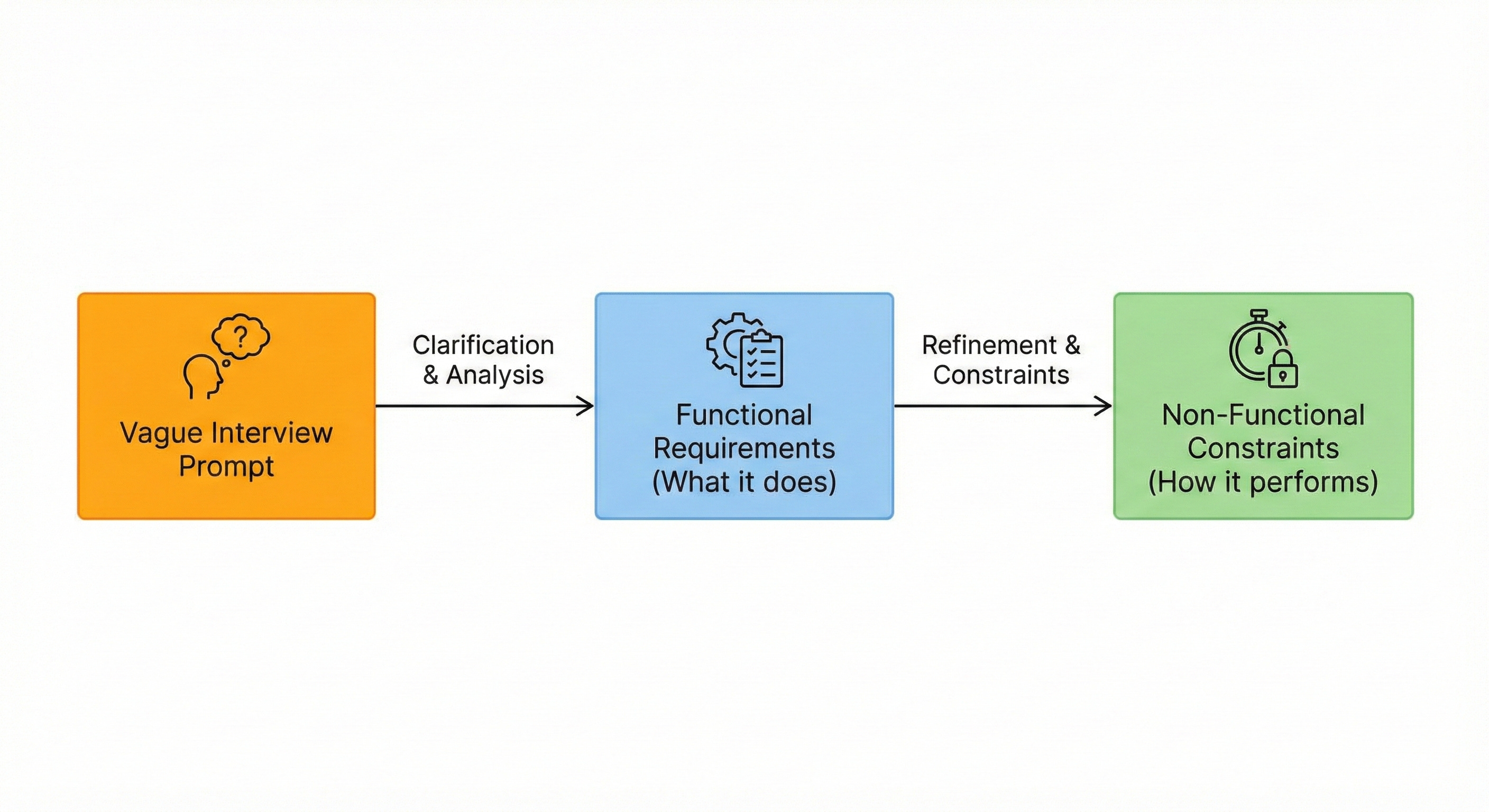
To avoid this, engineers must divide their questions into two distinct categories. These categories are functional requirements and non-functional requirements.
Breaking Down Functional Requirements
Functional requirements define exactly what the system must do to be considered complete. These are the specific technical features and user behaviors that the software will directly support.
If a specific feature is not listed in the functional requirements, the engineering team does not build it. They represent the primary capabilities of the application.
Consider a prompt asking for a generic social media feed. The engineer must ask what specific actions the user is allowed to perform.
Can the user only post text, or can they also upload large video files?
Does the system need to support a complex search feature to find old posts?
Each of these questions completely changes the underlying technology required for the project.
A system that only handles short text messages can utilize simple relational databases. A system that processes high definition video requires specialized storage servers and heavy background processing. Defining these exact functional requirements prevents the scope of the project from expanding uncontrollably.
Defining Out of Scope Features
Just as important as what the software does is what the software does not do. Engineers refer to these excluded elements as out of scope features. Identifying these specific items prevents unnecessary complexity during the initial planning phase.
Attempting to design every possible feature leads to a bloated and messy architecture. The system becomes overly complex and impossible to build within a reasonable timeframe. By explicitly stating what features will be ignored, engineers protect their limited time.
Keep reading with a 7-day free trial
Subscribe to System Design Nuggets to keep reading this post and get 7 days of free access to the full post archives.