
System Design Interview Question: Design a Key-Value Store (like DynamoDB) in 45 Mins
The ultimate Key-Value Store design guide. From functional requirements to cluster diagrams, learn the 14 steps to architecting a system like Amazon DynamoDB.

1. Problem Definition and Scope
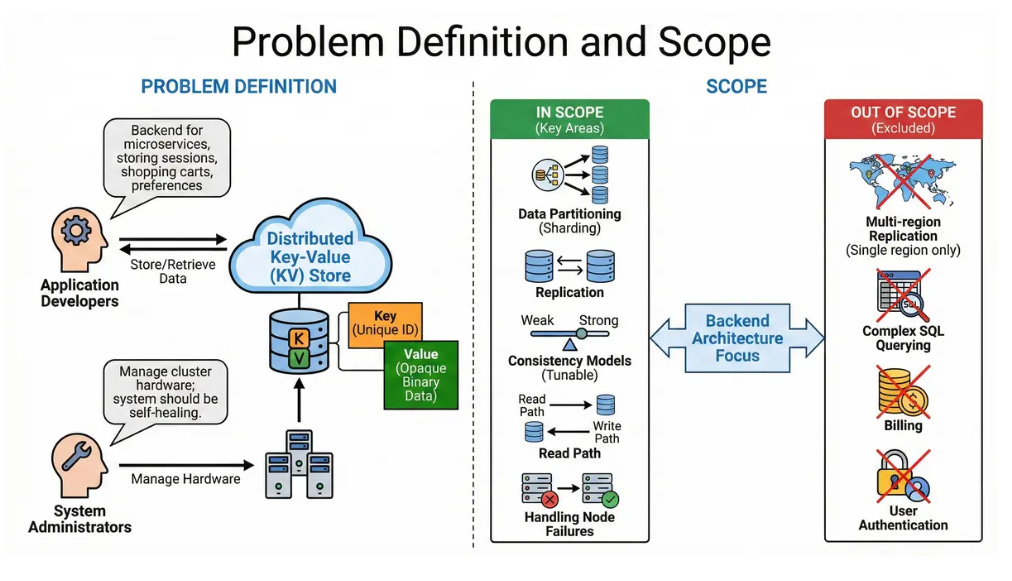
We are designing a distributed Key-Value (KV) store. This is a NoSQL database that allows applications to store data as a collection of key-value pairs, where the key is a unique identifier and the value is opaque binary data (the system does not need to understand the content).
Main User Groups:
Application Developers: They use the KV store as the backend for microservices (e.g., storing user sessions, shopping carts, or product preferences).
System Administrators: They manage the cluster hardware, although the system should be largely self-healing.
Scope: We will focus on the backend architecture required to store, retrieve, and replicate data at scale.
In Scope: Data partitioning (sharding), replication, consistency models (tunable), read/write paths, and handling node failures.
Out of Scope: Multi-region replication (we will focus on a single region with multiple availability zones), complex SQL querying, billing, and user authentication.
2. Clarify Functional Requirements
Must Have:
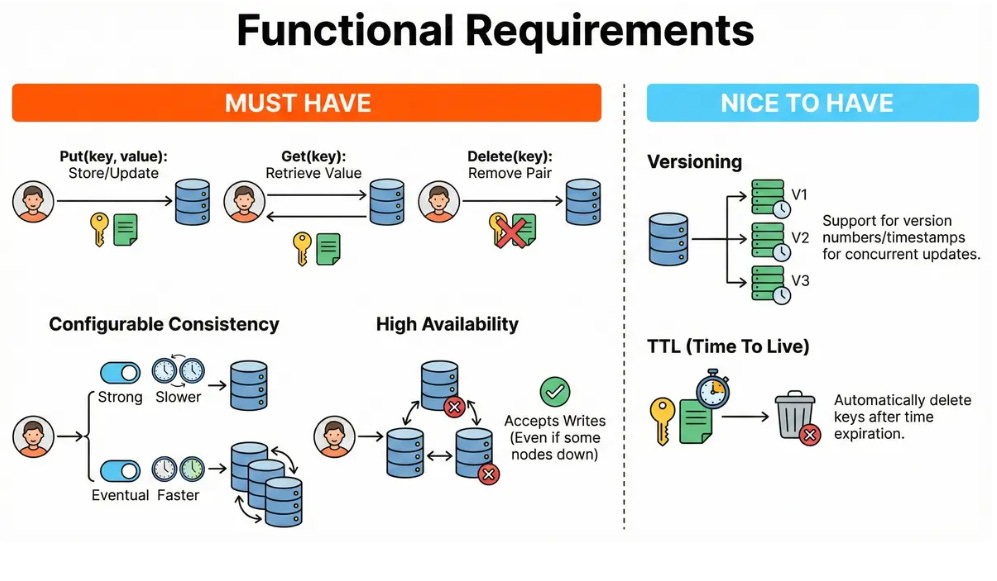
Put(key, value): Users can store or update a value associated with a key.
Get(key): Users can retrieve the value associated with a key.
Delete(key): Users can remove a key-value pair.
Configurable Consistency: Users can choose between strong consistency (slower) or eventual consistency (faster) for each request.
High Availability: The system must accept writes even if some nodes are down.
Nice to Have:
Versioning: Support for version numbers or timestamps to handle concurrent updates.
TTL (Time To Live): Automatically delete keys after a certain time expiration.
3. Clarify Non-Functional Requirements
Scale: Support 100 TB of data and billions of keys.
Throughput: 100,000 queries per second (QPS).
Keep reading with a 7-day free trial
Subscribe to System Design Nuggets to keep reading this post and get 7 days of free access to the full post archives.