
System Design Interviews: How to Fill 45 Minutes With Senior-Level Reasoning
Master your system design interview with a proven 7-step framework, capacity math, and real trade-off tables. Covers scoring rubrics most guides skip.

Last year, a backend engineer at a Series C startup told me he’d spent three weeks reading system design blog posts and still froze ten minutes into his Amazon loop. He knew what a load balancer was. He could sketch boxes on a whiteboard. But when the interviewer asked, “How would you handle 50,000 concurrent WebSocket connections?”, his mind went blank.
That freeze is the single most common failure mode in a system design interview, and it doesn’t come from a lack of intelligence. It comes from preparing breadth without practicing depth. This guide exists to fix that. In this blog, you’ll get a concrete 7-step framework—complete with capacity math you can reuse, trade-off tables you can memorize, and scoring-rubric insights drawn from the hiring-committee side of the table.
Walk away with one thing: the ability to fill 45 minutes of whiteboard time with structured, senior-level reasoning—not rambling. Whether this is your first system design interview or your fifth, the framework below will sharpen your approach.
What Does a System Design Interview Actually Test?
A system design interview measures whether you can decompose an ambiguous problem into a working architecture under time pressure. Interviewers do not expect a production-ready blueprint. They expect structured thinking, explicit trade-offs, and the ability to adjust when assumptions change.
Most companies score candidates across four axes, though the weight varies. After reviewing rubrics at three FAANG-tier companies, here is a realistic breakdown of how points are typically allocated:
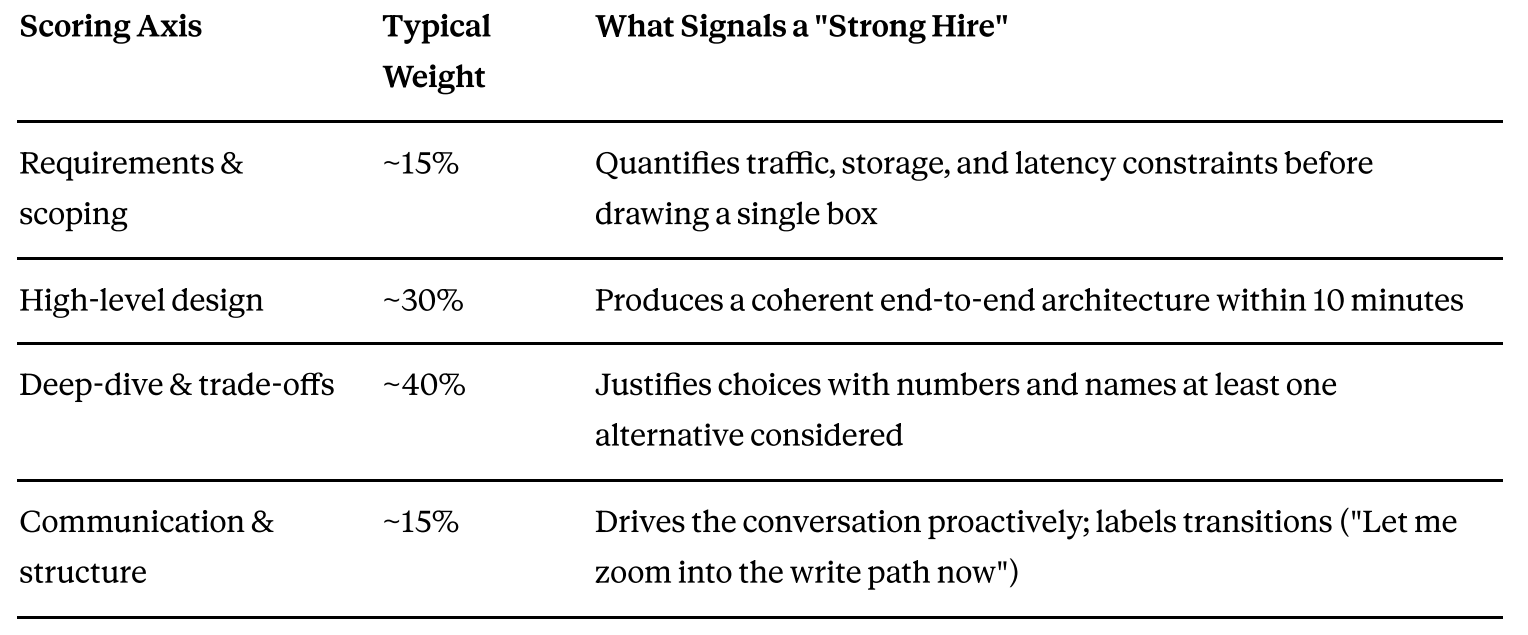
Notice that deep-dive weight dwarfs everything else. Yet most candidates spend 60% of their time on the high-level diagram and rush through the part interviewers care about most.
💡 Interview Pro Tip: Announce your time plan out loud at the start: “I’ll spend 5 minutes on requirements, 10 on the high-level design, 20 on deep dives, and 5 on wrap-up.” Interviewers at Google and Meta have told me this single habit moves a candidate from “mixed” to “lean hire” because it signals senior-level ownership of the conversation.
Step 1: Lock Down the Fundamentals of Distributed Systems
Before you touch a single design problem, make sure five foundational topics feel automatic—meaning you could explain them to a teammate while tired. These aren’t theoretical curiosities; they surface in every system design interview question. Candidates who skip fundamentals hit a ceiling around problem three or four, where surface-level pattern matching stops working, and genuine understanding is the only thing that carries you forward.
The fundamentals below are not an exhaustive textbook list. They’re the specific concepts that show up repeatedly in system design interview prep and that interviewers probe when they want to separate mid-level candidates from senior ones.
Storage Models and When They Matter
Relational databases (PostgreSQL, MySQL) enforce schemas and ACID guarantees, which makes them the default for transactional workloads—booking systems, payment ledgers, user-account tables. Document stores like MongoDB shine when your data is hierarchical and read-heavy with variable schemas. Wide-column stores such as Cassandra handle massive write throughput across regions, which is why Apple uses Cassandra for over 100,000 nodes supporting iMessage and Siri.
Scalability Primitives
Vertical scaling has a hard ceiling; a single AWS r7g.16xlarge tops out at 512 GB of RAM. Beyond that, you need horizontal scaling. Understand read replicas, write sharding, and consistent hashing well enough to sketch them. If you want a structured walkthrough of these primitives with exercises and diagrams, Grokking System Design Fundamentals covers each one alongside capacity-estimation drills that reinforce the math.
Networking Essentials
Know the practical differences: REST for CRUD simplicity, gRPC for low-latency internal service calls (Protobuf cuts payload size by 3–5x versus JSON), WebSockets for persistent bidirectional connections, and SSE when you only need server-to-client push.
⚠️ Common Mistake: Candidates name WebSockets for every “real-time” feature. Notifications and activity feeds rarely need full-duplex communication. SSE is simpler, uses standard HTTP, and works through CDNs. Reach for WebSockets only when the client also pushes data back—chat messages, collaborative editing, multiplayer game state.
Step 2: Build Your Component Toolkit
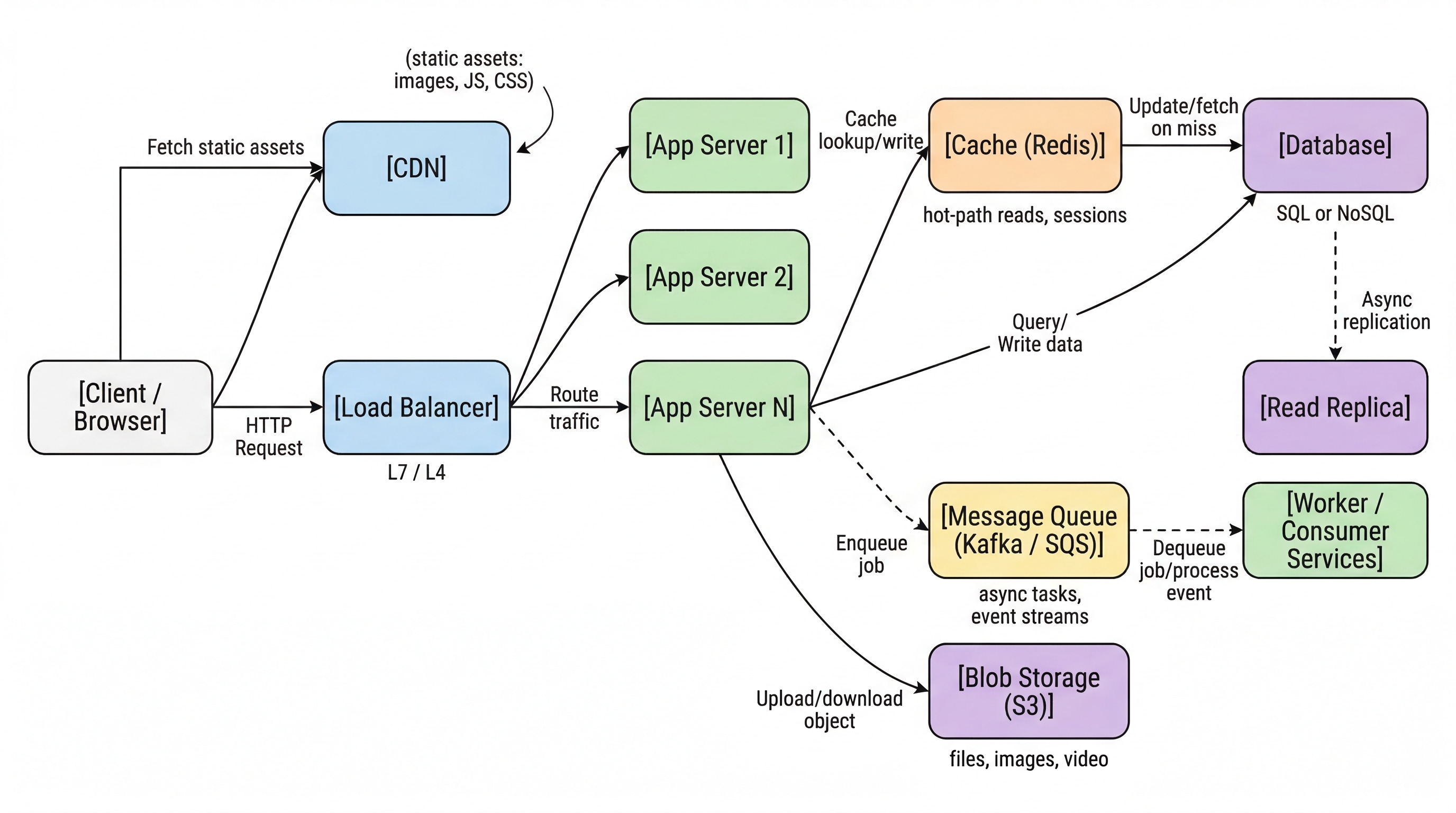
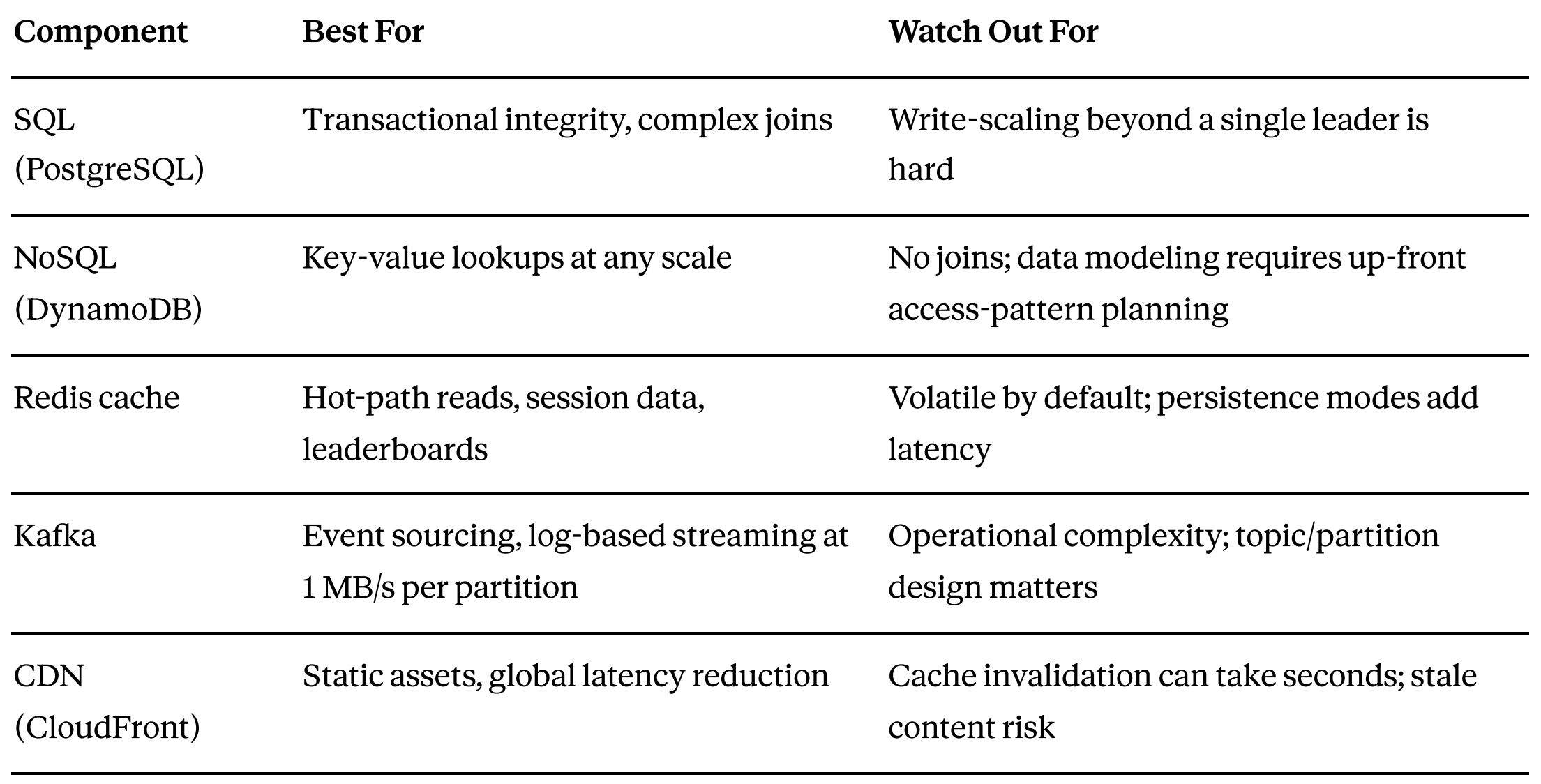
System design is combinatorial: you assemble a solution from a finite set of building blocks. Memorizing their strengths, limits, and failure modes is what separates hand-wavy diagrams from credible architectures. When an interviewer hears you describe why you picked a component—not just that you picked it—you’ve demonstrated the kind of judgment that gets scored as “strong hire.”
Think of your system design interview preparation as stocking a workshop. You don’t need every tool ever made. You need the right seven, and you need to know when each one shines and when it breaks.
The seven components that cover 90% of designs:
Application servers — Stateless compute; scale horizontally behind a load balancer.
Databases — Persistent storage; pick based on read/write ratio and consistency needs.
Caches — Redis or Memcached; a single Redis node can serve ~100k GET ops/sec at sub-millisecond latency.
Message queues — Kafka for ordered, high-throughput event streams; SQS or RabbitMQ for task queues.
Load balancers — L4 (TCP) for raw throughput; L7 (HTTP) when you need content-based routing.
Blob storage — S3-compatible object stores for images, video, and backups at ~$0.023/GB/month.
CDNs — Edge caching for static assets; reduces origin traffic by 60–80% for read-heavy apps.
How Do You Estimate Capacity in a System Design Interview?
Capacity estimation is the practice of converting user-facing requirements (e.g., “500 million monthly active users”) into concrete infrastructure numbers—queries per second, storage per year, and network bandwidth. Interviewers use it to test whether you can ground a design in reality rather than guesswork.
Mini Case Study: URL Shortener at Scale
Suppose your interviewer says: “Design a URL shortener handling 100 million new URLs per day.”
Write QPS: 100M / 86,400 ≈ 1,160 writes/sec. At peak (assume 3× average), that’s ~3,500 writes/sec—easily handled by a single sharded PostgreSQL cluster or DynamoDB table.
Read QPS: If every URL is clicked 10× on average over its lifetime and the read pattern is bursty, plan for 10× write QPS at peak → ~35,000 reads/sec. A Redis cache with a 90% hit rate drops the database load to ~3,500 reads/sec.
Storage: Each record is roughly 500 bytes (short code + long URL + metadata). At 100M/day: 100M × 500 B = 50 GB/day → ~18 TB/year. Three-year retention needs ~54 TB, which fits comfortably in a partitioned database.
That five-minute napkin math told you: the write path is straightforward, reads need a cache layer, and storage is manageable with standard sharding. You’ve now given the interviewer a reason to trust every design decision that follows. This kind of grounded reasoning is what separates a passing system design interview performance from a forgettable one.
💡 Interview Pro Tip: When the interviewer asks about database choice, start by quantifying the read:write ratio. Saying “reads outnumber writes 10:1, so I’ll add a cache” immediately signals senior-level thinking and anchors the rest of your design in data instead of opinion.
Step 3: Master the Art of Trade-Off Communication
Every component choice involves a trade-off, and interviewers are explicitly scoring your ability to articulate alternatives. “I chose X” is mediocre. “I chose X over Y because our read:write ratio is 10:1 and X gives us tunable consistency at the cost of slightly higher write latency” is what gets you hired.
Trade-off fluency is arguably the highest-leverage skill you can develop for a system design interview. It’s the skill that distinguishes a senior engineer from someone who has simply memorized component names. Companies like Google, Meta, and Stripe specifically train their interviewers to probe trade-offs by asking: “What’s the downside of that approach?” or “What would you do differently if latency was your primary concern?”
Practice framing trade-offs with this three-part template:
State the decision: “For the message queue, I’m choosing Kafka.”
Name the alternative: “I considered SQS, which would be simpler operationally.”
Justify with a constraint: “But we need ordered event processing across partitions for exactly-once delivery to the analytics pipeline, and Kafka’s log-based model supports that natively.”
⚠️ Common Mistake: Candidates say “I’ll use a NoSQL database because it’s scalable” without specifying the access pattern. DynamoDB scales beautifully for key-value lookups but forces you to model queries at table-design time. If you need ad-hoc joins across entities, a relational database behind read replicas may scale just as well for your use case—and be far simpler to query. Always tie the technology choice to the specific workload, not to a generic adjective.
Step 4: Practice the Top System Design Interview Questions
Reading about design patterns is passive; designing under a timer is active. After roughly six practice problems, most engineers start recognizing recurring patterns—fanout, event-driven pipelines, geo-sharding—and the anxiety drops. This is not wishful thinking; it mirrors how expertise develops in any complex domain. Chess grandmasters don’t calculate every move from scratch—they recognize board patterns. System design interviews work the same way.
The trick is to practice in the right order. Each problem below is sequenced so that concepts from earlier problems carry forward into later ones, building compound understanding rather than isolated knowledge.
The Sequence That Builds Skills Fastest
Start with problems that isolate one or two concepts, then layer in complexity:
URL Shortener — Hashing, database selection, caching (concepts: key-value store, base62 encoding)
Rate Limiter — Sliding-window algorithms, distributed counters (concepts: Redis atomic ops, token bucket)
Chat System (WhatsApp, Messenger) — WebSocket connection management, message ordering, presence (concepts: fanout, last-write-wins)
News Feed (Twitter/X) — Fanout-on-write vs. fanout-on-read trade-off, ranking (concepts: social graph, timeline cache)
Ride-Sharing (Uber) — Geospatial indexing with quadtrees or S2 cells, real-time matching (concepts: location updates at ~4 Hz per driver)
Video Streaming (YouTube) — Transcoding pipelines, adaptive bitrate, CDN strategy (concepts: chunked upload, DAG-based processing)
Distributed Search (Elasticsearch) — Inverted indexes, sharding by document ID, ranking with TF-IDF or BM25
For a structured walkthrough of 25+ problems with solution templates, capacity math, and component diagrams, Grokking the System Design Interview covers each problem end-to-end and is one of the most referenced resources among candidates who’ve passed FAANG loops.
Step 5: Run a 4-Week Study Plan
Knowing what to study matters less than knowing when. Here’s a realistic schedule for someone with a full-time job:
Week 1 — Foundations (6–8 hours): Review storage models, scalability primitives, and networking essentials. Do the capacity-estimation worksheet above for three different systems.
Week 2 — Building Blocks + First 3 Problems (8–10 hours): Memorize the component table. Design URL Shortener, Rate Limiter, and Chat System with a 45-minute timer each. Write a one-paragraph self-review after each attempt.
Week 3 — Deep Dives + Next 4 Problems (8–10 hours): Tackle News Feed, Ride-Sharing, Video Streaming, and Search. After each, identify the single trade-off you articulated best and the one you fumbled. Focus review on the fumbled ones.
Week 4 — Mock Interviews + Polishing (4–6 hours): Do at least two timed mocks with a peer or a paid mock-interview platform. Record yourself if possible—most candidates speak 30% faster than they think. Treat each mock as a full system design interview simulation, not a casual conversation.
If you’re compressing into two weeks or need a structured crash course with guided practice sessions, the System Design Interview Crash Course distills the essentials into a shorter timeline with daily targets.
What Are the Most Common System Design Interview Mistakes?
The most frequent mistakes are not technical—they are structural. Candidates lose points by spending too long on requirements, skipping capacity math entirely, or designing in silence instead of narrating their reasoning. Fixing these three habits accounts for more score improvement than learning any new technology. Across hundreds of debrief sessions, these structural failures show up in roughly 60% of “no hire” decisions on system design interview rounds.
Pacing Failures
Many engineers burn 15 minutes debating schema fields before they’ve sketched a single service. The fix: set a hard five-minute cap for scoping. Write your functional and non-functional requirements on the whiteboard, confirm with the interviewer, and move on. You can always revisit details during the deep dive. Remember, the deep-dive section is worth 40% of your score—protecting time for it is the highest-leverage thing you can do.
The “Perfect Architecture” Trap
A design that handles every edge case but arrives at minute 40 is worse than a simpler design finished at minute 25 with time to iterate. Interviewers want to see you improve a working system, not construct a flawless one from the start. Start with a naive solution, acknowledge its limitations, and then upgrade it. This iterative approach mirrors real engineering and is exactly what hiring rubrics at Amazon and Meta reward.
💡 Interview Pro Tip: After sketching your high-level design, explicitly ask: “Does this architecture look reasonable, or would you like me to go deeper on a specific component?” This invites the interviewer to co-pilot—which is how real engineering works and what senior-level rubrics reward.
Step 6: Simulate Interview-Day Conditions
Practicing problems silently at your desk is useful, but it won’t prepare you for the performance pressure of a live interview. Your mouth and your brain work differently under observation. Many candidates who ace written design exercises struggle the moment they have to narrate decisions in real time. Bridging that gap is the single highest-ROI activity in the final week of your system design interview preparation.
Three simulation tactics that work:
Whiteboard-only sessions. No IDE, no notes app—just a physical or virtual whiteboard and a 45-minute timer. This trains you to organize thoughts spatially instead of linearly. If you can’t draw a clean architecture in three colors of dry-erase marker, you’re not ready.
Explain-to-record. Open a voice memo and talk through a design from scratch. Play it back. You’ll catch fillers (”um,” “like”), circular reasoning, and sections where you lost your thread. One candidate told me this exercise alone cut his filler-word rate by 70% in a single week.
Adversarial mock partners. Ask your mock partner to interrupt mid-sentence with curveballs: “What if the primary database goes down during a write?” or “How does this change if we need to support 10× the traffic?” Handling pivots gracefully is a top-decile skill that signals genuine distributed systems experience rather than rehearsed answers.
Step 7: Develop a Pre-Interview Checklist
On the morning of your system design interview, review a single checklist rather than re-reading notes. Consolidation reduces anxiety and primes your working memory. The best system design interview candidates don’t cram on the day—they activate a mental framework and walk in calm.
Your 60-second checklist:
I know my time allocation: 5 min scope → 10 min high-level → 20 min deep dive → 5 min wrap-up.
I will quantify before I design: users, QPS, storage, latency SLA.
I will name at least one alternative for every major component choice.
I will narrate my thinking out loud, even when I’m stuck.
I will ask the interviewer for a focus area after the high-level sketch.
Your System Design Interview Starts Now
Five takeaways to carry into your next session:
Deep dives carry 40% of the score. Protect at least 20 minutes for them.
Capacity math is your credibility anchor. Even rough numbers beat no numbers.
Trade-offs must be explicit. Name the alternative; name the constraint; justify the pick.
Six practice problems create pattern recognition. Beyond six, you hit diminishing returns—focus on quality over quantity.
Simulate the pressure. Talking through a design out loud is a fundamentally different skill from thinking it through silently.
Your next step is small and specific: pick one problem from the list above—URL Shortener is the easiest starting point—set a 45-minute timer, and design it end-to-end on a whiteboard. No notes, no reference material. When the timer rings, write down the one thing you’d do differently. That single loop of practice-then-reflect is worth more than another ten hours of reading.
You’ve got everything you need for your system design interview. It is time to get to practice now.