
System Design Interview: 5 Database Anti-Patterns That Scream “Junior”
Discover the top five database anti-patterns that ruin system design interviews and learn how to implement advanced staff level architectural solutions.

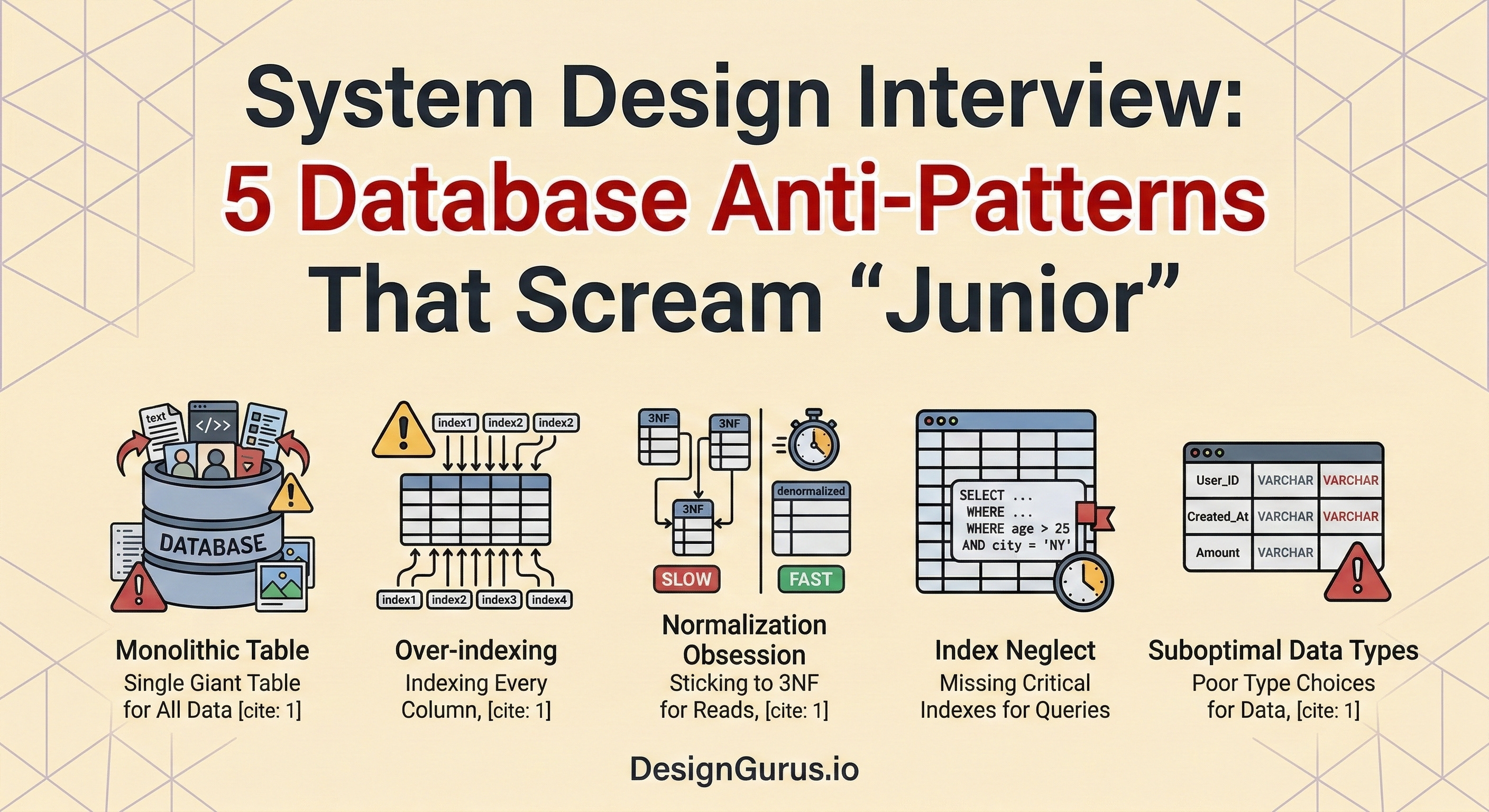
Software applications often function perfectly during local development but collapse completely when network traffic surges.
While application servers easily handle the initial wave of new incoming connections, the underlying database eventually stops functioning under the massive load. Connections time out, the application server freezes, and the entire platform goes offline. This catastrophic failure almost always happens because of poor data modeling and limited architectural foresight.
A whiteboard system design interview reveals the true depth of an engineer. It is a strict test of anticipating system failures before writing any code.
Application servers are relatively simple to multiply when traffic increases, but databases are incredibly complex to scale and require strategic planning. Choosing the wrong storage strategy exposes a massive lack of technical depth.
A classic bottleneck occurs in a simple software architecture relying on a User Table and an Order Table.
When one person creates an order, the system easily writes the data to the hard drive. When a million people create orders simultaneously, the database must line up every single request sequentially. The physical hardware reaches its absolute limit, causing the entire system to crash.
Understanding these data storage pitfalls is critical for passing technical interviews and building robust software. Many candidates rely on familiar patterns that fail under heavy workloads. This guide explores five frequent database design errors and the architectural principles needed to resolve them.
1. Relying on a Single Monolithic Database
The Junior Mistake
Beginners often attempt to place every possible piece of data into a single massive database table. They assume this approach makes fetching information faster because all the data resides in one location.
This wide table structure might work perfectly fine for a small application with a few thousand records. However, it completely falls apart when the system processes large volumes of concurrent transactions.
Inexperienced candidates assume that when a database gets too slow, they can simply upgrade the server hardware. This process is called vertical scaling. It means adding more memory, larger hard drives, and faster processors to a single machine. They believe that a more powerful machine will easily solve any performance constraints.
However, vertical scaling has a strict physical ceiling. There is a maximum limit to how much computing power fits into a single server. Relying solely on vertical scaling is a massive design flaw that reveals a junior experience level.
How It Works Behind the Scenes
Relational databases enforce strict rules to guarantee data accuracy during concurrent operations. Every time new data is saved, the database applies a lock to the specific row being updated.
A lock is a strict mechanism where the database prevents any other process from reading or writing to a piece of data. This ensures that complex operations either complete entirely or fail entirely without corruption.
If all data lives in one massive table, these locks happen frequently and last much longer. Updating a minor session token might lock the entire row, preventing the system from reading the user profile information simultaneously.
As the table grows into millions of rows, the database struggles to maintain performance under these constant locking conditions.
When a database reaches its physical hardware limit, it can no longer process incoming queries efficiently. The system begins queuing requests in a massive backlog. As the queue grows, it consumes all available server memory until the system crashes completely.
The Staff-Level Solution
Senior engineers understand that data must be distributed across multiple smaller servers to survive massive scale. This concept is called horizontal scaling.
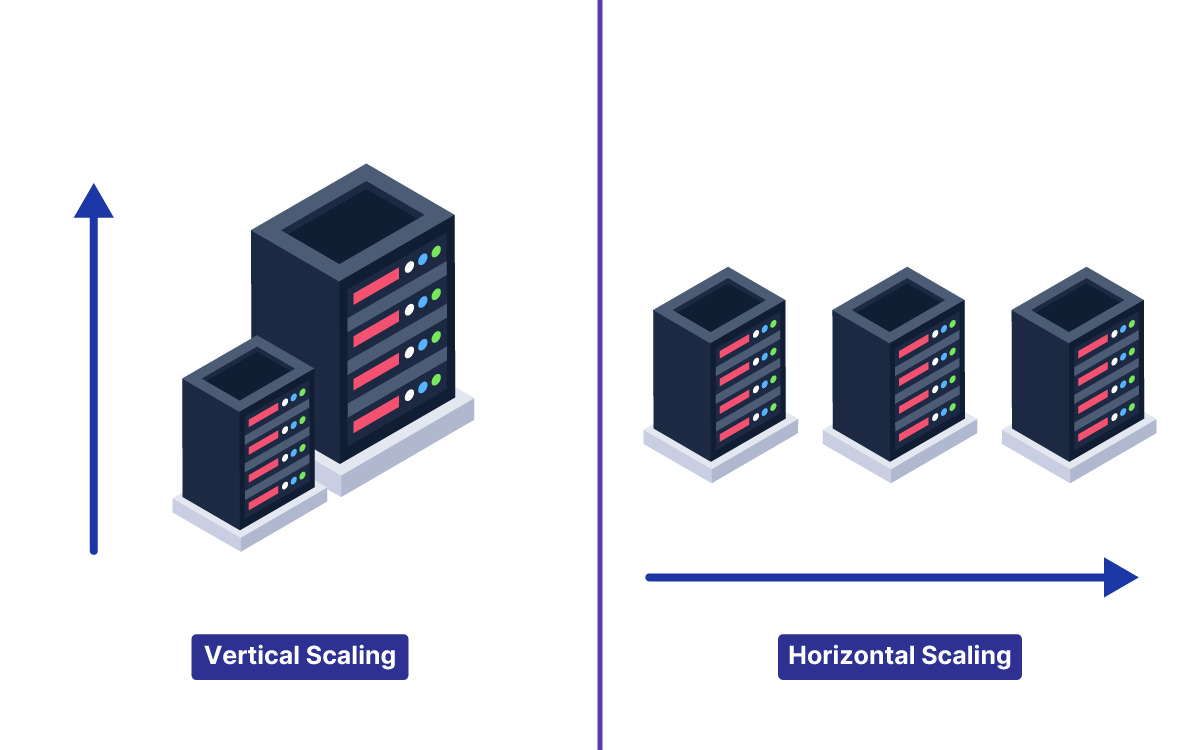
Instead of buying one massive machine, engineers link dozens of smaller standard servers together. This ensures that no single machine becomes a catastrophic constraint for the system.
To achieve this, engineers use a technique called sharding.
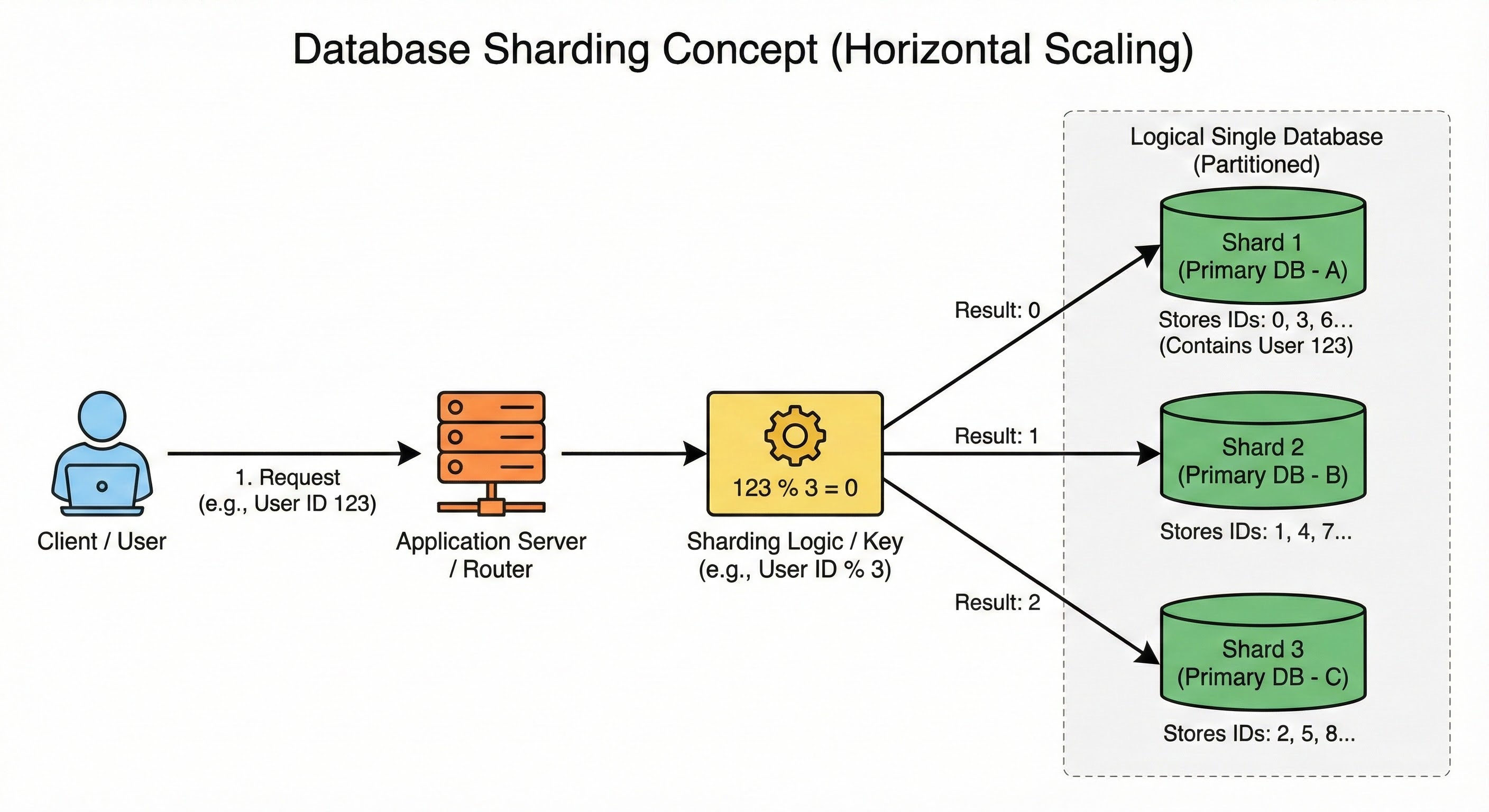
Sharding involves splitting a massive database table into smaller chunks. The data is mathematically divided based on a specific routing key.
For example, the system might put the data for user accounts one through ten thousand on Server A, and the remaining accounts on Server B.
This horizontal scaling allows the system to process multiple queries at the exact same time across different physical machines. Furthermore, mature engineers propose polyglot persistence. This means using multiple different database storage technologies within the same overall architecture. They match the specific database architecture to the exact data workload to demonstrate advanced system design maturity.
2. Ignoring Data Read and Write Ratios
The Junior Mistake
Another glaring design flaw is creating a schema without analyzing the expected network traffic patterns. Candidates often fail to ask whether a system is read-heavy or write-heavy before designing the data storage layer. They treat every system as if it will experience an equal number of reads and writes simultaneously.
Every software application has a distinct traffic pattern that must be understood. Some systems constantly generate and save new data but rarely view it again. Other systems save data once but view it millions of times every single second.
Designing a database without optimizing for the read-to-write ratio leads to massive resource waste. If an application constantly queries data, but the database is optimized for complex writing validation, the entire system suffers. This lack of architectural foresight is an immediate warning sign during a technical interview.
Keep reading with a 7-day free trial
Subscribe to System Design Nuggets to keep reading this post and get 7 days of free access to the full post archives.