
System Design Essential: Dead Letter Queue
Prevent system clogs caused by "Poison Pills." Master the Dead Letter Queue (DLQ) pattern, understand Head-of-Line Blocking, and learn how to implement Exponential Backoff and safe message Redriving.

Building software that functions correctly under ideal conditions is a straightforward task.
The true challenge in system design lies in creating architectures that remain stable when components fail.
In modern distributed systems, applications rarely run in isolation. They communicate constantly, passing data between services to execute complex workflows.
When you transition from writing code on a single machine to designing large-scale distributed architectures, you lose the immediate feedback loop of synchronous execution.
In a monolithic application, an error typically halts the operation and returns an exception to the user.
In a distributed environment relying on message queues, errors are more subtle and difficult to manage.
If a component in your system fails to process a specific piece of data, you face a critical dilemma. You cannot simply delete the data, as it may represent a vital business record. However, you also cannot allow that single failing unit of data to obstruct the rest of your system.
This is where the Dead Letter Queue (DLQ) becomes a mandatory component of your architecture. It is the mechanism that allows your system to acknowledge failure, isolate the problematic data, and continue operating without interruption.
The Core Problem: Asynchronous Failure
To understand the necessity of a Dead Letter Queue, we must first examine the mechanics of a standard message queue. In this configuration, a Producer sends data to a queue, and a Consumer retrieves that data to process it.
Under normal circumstances, the flow is linear.
The consumer retrieves a message, executes the required business logic, and signals to the queue that the work is complete. The queue then removes the message.
However, consider a scenario where a message contains data that the consumer cannot process. The message might be malformed, missing a required field, or contain values that violate the logic of the application.
In the industry, a message that consistently causes a consumer to fail is technically referred to as a Poison Pill.
When the consumer reads this message, it crashes or throws an exception.
Most queuing systems are designed to guarantee message delivery, so they assume the failure was a temporary issue.
The system places the message back at the front of the queue to give the consumer another opportunity.
The consumer restarts, retrieves the first message in the queue, which is the same Poison Pill, and fails again.
Head-of-Line Blocking
This cycle creates a phenomenon known as Head-of-Line Blocking.
Because the first message in the queue can never be processed successfully, the consumer never advances to the second message.
You could have thousands of valid messages waiting in the queue, but none of them will be processed because the system is obstructed by the single failure at the front.
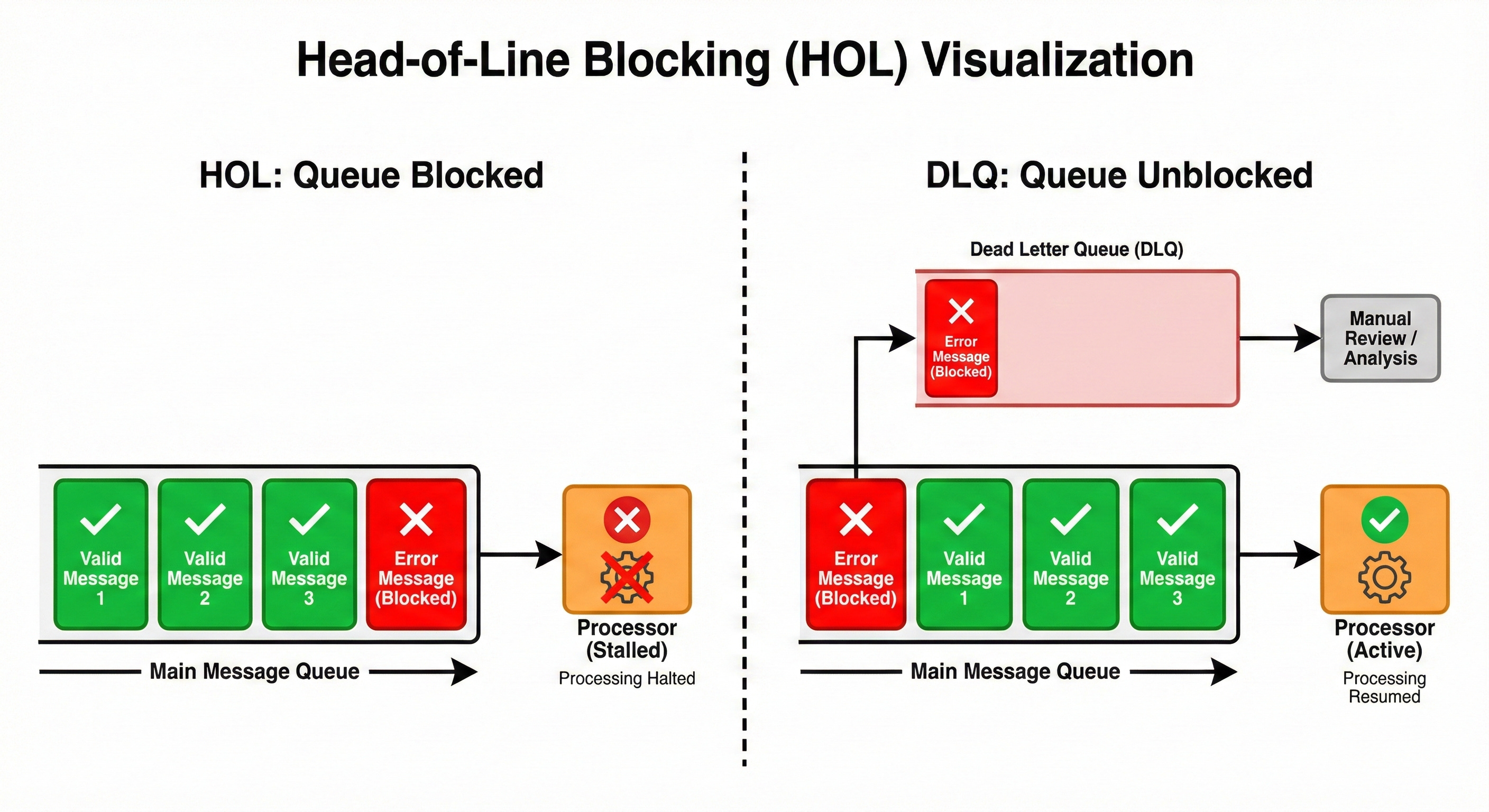
The consumer consumes computing resources continuously, retrying a task that will never succeed, while the actual throughput of the system drops to zero.
Keep reading with a 7-day free trial
Subscribe to System Design Nuggets to keep reading this post and get 7 days of free access to the full post archives.