
System Design Basics: Spotting and Fixing the Single Point of Failure
Learn what a Single Point of Failure is and why it threatens system reliability. Understand how to design systems that stay online when components fail.

Modern digital services are expected to be available twenty-four hours a day, seven days a week.
When a user opens an application, they expect it to load immediately. They do not care about the complexity of the code, the status of the database, or the maintenance schedule of the data center. They simply require the service to function.
However, achieving this level of continuous uptime is incredibly difficult.
Software systems are complex chains of dependencies.
If a major e-commerce platform crashes during a high-traffic event, the company loses revenue every second the system is down.
If a banking application becomes unresponsive, it erodes user trust instantly.
These catastrophic outages are rarely caused by the entire system failing at once.
Instead, they are often caused by the malfunction of a single component on which the entire system relies. This architectural weakness is known as a Single Point of Failure.
Understanding this concept is the first step in transitioning from writing code to designing systems. It requires a shift in mindset from focusing on features to focusing on reliability.
Defining the Single Point of Failure
A Single Point of Failure (SPOF) is any component of a system that, if it fails, causes the entire system to stop functioning.
In a computing environment, a system is composed of many distinct parts. These include physical hardware like servers and routers, as well as software components like databases and application services. These parts must communicate with each other to process a user request.
If a system architecture is designed in a linear fashion, every component represents a potential Single Point of Failure.
Consider a basic web application setup.
A user sends a request to a web server.
The web server processes the logic and queries a database.
The database returns the information, and the server sends it back to the user.
In this linear chain, there is no backup plan. If the web server crashes, the site is down. If the database becomes corrupt, the site is down.
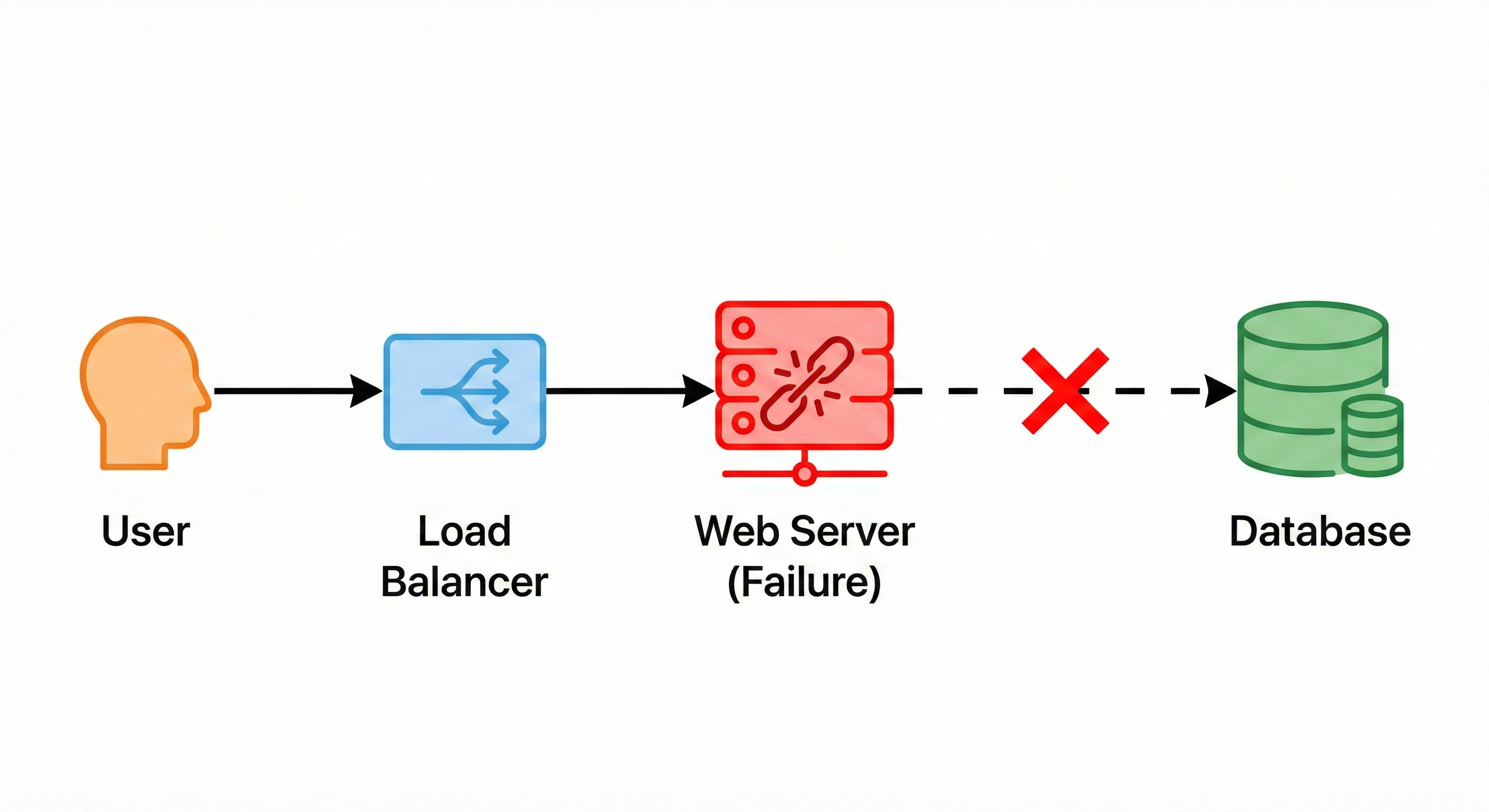
Even if the network cable connecting the server to the internet is cut, the site is down. The reliability of the entire application is limited by the reliability of its weakest link.
Keep reading with a 7-day free trial
Subscribe to System Design Nuggets to keep reading this post and get 7 days of free access to the full post archives.