
System Design Basics: Event-Driven vs Request-Driven Architecture
A complete comparison of event-driven and request-driven architectures. Find out which design is best for scalability, reliability, and performance.

This blog compares event-driven and request-driven architectures, highlighting their differences in communication style, pros and cons, and ideal scenarios for using each approach.
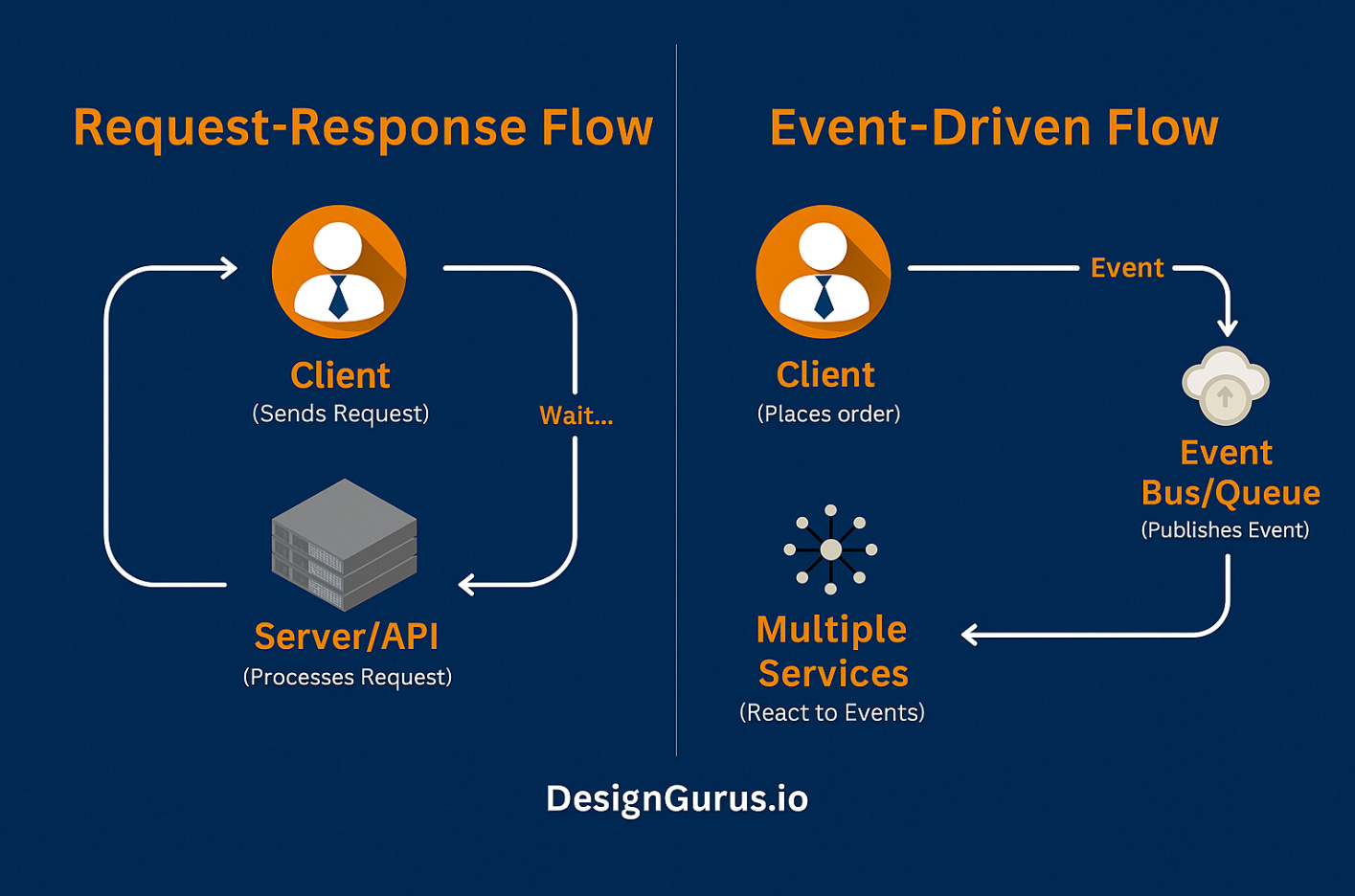
Imagine you click “Buy Now” on an online store and wonder how all the services behind the scenes coordinate your order.
One approach is straightforward: the Order service calls the Payment service, waits for confirmation, then calls the Shipping service, and so on.
This is the essence of a request-driven architecture, a series of direct calls and responses.
The other approach feels like posting on social media, you share once, and whoever is interested reacts in their own way and time.
In this case, the Order service simply emits an “Order Placed” event into the system and moves on, while the Payment, Shipping, and Notification services each react to that event on their own time.
That’s the event-driven architecture in action.
Both styles aim to get the job done but in very different ways.
Let’s break down what each approach means, their strengths and weaknesses, and how to choose the right one for your needs.
Request-Driven Architecture (Synchronous Requests)
Request-driven architecture is the traditional, straightforward approach where one component sends a request to another and waits for a response.
Typically implemented via RESTful APIs or RPC calls, this involves a synchronous communication pattern – the caller is blocked until the callee replies.
In essence, it’s a direct request/response model: a client (or service A) makes a request to a server (service B) and expects an immediate answer. This creates a clear, linear flow of control and a dependency chain between services.
Often, one service might act as an orchestrator, calling multiple services in sequence to fulfill a higher-level operation (for example, an Order service calling Inventory, Payment, and Notification services one after the other).
Pros of Request-Driven Architecture
Simplicity & Predictability
It’s easy to understand and implement.
The flow of actions is explicitly controlled by the code, which makes it straightforward to trace and debug a request through the system.
By looking at the orchestrator or call sequence, you can determine exactly what happens first, second, and so on.
Immediate Feedback
The caller gets a response right away (within the same interaction), so the result of an operation is known instantly.
This is great for user-facing features – for instance, a user knows immediately if their login succeeded or if a payment was processed.
Strong Consistency
Because each step is executed in a controlled, sequential manner, it’s easier to maintain strict data consistency across services.
Transactions or validations can be done in-line.
For example, you can ensure a payment is confirmed before an order is marked successful.
This architecture provides the necessary control and guarantees when your application demands strict consistency.
Mature Ecosystem
Request-driven systems (like REST APIs) have a rich ecosystem of tools, frameworks, and best practices.
From API gateways to load balancers and monitoring tools, a lot of infrastructure is built around synchronous request/response communication, which can speed up development.
Cons of Request-Driven Architecture
Tight Coupling & Single Points of Failure
Services in a request-driven design are directly dependent on each other’s availability.
If one service in the chain is slow or down, it can stall or break the entire flow.
Often there is a central orchestrator service; if that goes down, the whole process fails.
This tight coupling makes the system less resilient – a failure in one component propagates immediately to others.
Scalability Bottlenecks
Synchronous calls can become bottlenecks under heavy load.
Every request occupies resources waiting for responses.
If downstream services take too long to respond or a surge of requests comes in, users might experience increased latency or timeouts.
In fact, while request-driven communication is simple, it can lead to bottlenecks if services take too long to respond, affecting the overall performance.
Scaling such architectures often requires careful load balancing and replication of services to handle peak loads, which can be complex.
Reduced Flexibility for Changes
Because components call each other directly, any changes in one service (like altering an API contract) require coordinated updates in its consumers.
For instance, if a service’s REST API changes, all clients of that API must be updated in lockstep.
This tight integration can slow down independent development and deployment of services, meaning the system is not as loosely coupled as it could be.
No Automatic Recovery
If a request fails (say one service in the chain was unavailable), retry and recovery have to be explicitly handled.
There’s no built-in mechanism to queue or replay failed requests beyond maybe client-side retries, which adds complexity for ensuring reliability.
Common Use Cases for Request-Driven Approach
Request-driven architecture shines in scenarios where immediate results and simplicity are paramount.
Some typical use cases include:
User Interactions Requiring Instant Feedback
For example, user login or registration flows are often request-driven.
When a user submits credentials, the auth service checks them and returns success or failure right away – this immediate response is crucial for a good user experience.
Synchronous Transactions
Operations like payment processing in an e-commerce app benefit from a request-driven approach.
The system can ensure a payment is authorized and confirmed before proceeding to the next step, maintaining accuracy and allowing the user to get an instant confirmation (or error) for their transaction.
Standard Web APIs and CRUD Operations
Traditional create-read-update-delete actions (e.g. fetching a user profile or updating a record) are often implemented with direct RESTful requests.
A client (like a web app) requests some data and gets it immediately.
This direct approach is sufficient for many CRUD APIs where the pattern is a simple request and response for a single operation.
Microservices with Orchestrated Workflows
In microservice architectures, if a workflow is relatively simple or requires strict ordering, one service might orchestrate by calling others synchronously (sometimes using techniques like the Saga pattern with compensating transactions, though Saga can also be event-driven).
For instance, a booking service might call payment and then reservation services in sequence.
This works as long as each step needs to complete immediately and rollback logic is manageable if a step fails.
Event-Driven Architecture (Asynchronous Events)
In an event-driven architecture (EDA), components communicate by publishing and reacting to events rather than calling each other directly.
This model is asynchronous: a service (producer) emits an event into an event stream or message broker without waiting, and one or many other services (consumers) will receive that event and process it, usually on their own timeline.
There’s no direct reply to the producer; instead, the system is driven by the occurrence of events (e.g., “OrderPlaced”, “UserSignedUp”, “PaymentProcessed”).
Because of this, services are loosely coupled – the event producer doesn’t need to know which service will handle the event, or even if any service is listening.
It’s often compared to a choreographed dance: each dancer (service) knows their role and how to react when a certain music cue (event) plays, with no central instructor telling everyone what to do.
This is the opposite of the request-driven “orchestrator” style – there’s no single component directing traffic.
Typically, event-driven systems use an event bus or message broker (like Apache Kafka, RabbitMQ, AWS SNS/SQS, etc.) to transport events from producers to consumers.
Pros of Event-Driven Architecture
Loose Coupling & Flexibility
Producers and consumers of events are decoupled and operate independently.
A service that publishes an event doesn’t have to know or depend on the consumers.
This means services can be added, removed, or modified without affecting the others, as long as they adhere to the event formats.
Such loose coupling allows each component to evolve independently and increases the system’s agility. It also enhances resilience – if one service is down, it doesn’t prevent others from continuing to send or process events (the events can be handled once that service comes back).
High Scalability & Throughput
Event-driven systems are built for scalability.
Since everything is asynchronous, a sudden surge of events can be buffered in the event stream and consumers can process them at their own pace.
Components can scale horizontally (spin up more instances consuming from the queue) to handle higher load without impacting other parts of the system.
The decoupled nature also means each service can scale independently – e.g., if your notification service needs to handle a million events, you can scale it up without touching the order service.
Overall, EDA supports high volumes of events without significantly impacting performance of the producers.
Parallel and Real-time Processing
One event can trigger multiple actions in parallel.
For example, when an “OrderPlaced” event is published, it could concurrently kick off inventory update, payment charging, and a confirmation email service.
The order service just emits the event and doesn’t wait; all those tasks happen simultaneously by different listeners.
This fan-out capability is great for real-time updates. It enables reactive systems – as soon as something happens, all interested services are notified and respond almost immediately, which is ideal for things like live notifications, streaming analytics, or IoT sensor processing.
Fault Tolerance & Resilience
Because of the event queue/broker, if a consumer service goes down temporarily, events can wait in the queue until it’s back up.
The producer isn’t affected by the consumer’s downtime – it keeps on publishing events.
When the consumer recovers, it can resume processing events (potentially even replay missed events) to catch up.
This decoupling means the system degrades more gracefully: parts of it can fail without bringing the whole system down immediately.
You can also design consumers to be idempotent (safe to reprocess events), further improving reliability in the face of duplicates or retries.
Cons of Event-Driven Architecture
Increased Complexity & Harder Debugging
An event-driven system can be tricky to design and reason about.
Without a central orchestrator, there’s no single place where you can read the whole workflow.
Understanding the sequence of events that led to a certain outcome often requires piecing together logs from multiple services.
Tracing a bug is harder because the flow is non-linear – events might be handled out of order or in parallel.
Teams must invest in good observability (logging, distributed tracing, monitoring) to keep track of what’s happening across the event bus.
Eventual Consistency
In an event-driven world, data consistency is typically eventual – changes propagate through events and there can be a delay before all parts of the system reflect a state change.
You can’t assume immediate confirmation of an action across all services.
For instance, when a user updates their profile, an event is emitted; other services (billing, notifications, etc.) will update their data upon receiving that event, which might happen a few milliseconds or seconds later.
This is acceptable in many cases, but if your domain requires that everything is in sync instantly, this model adds complexity.
You often need strategies for ensuring consistency, such as issuing events with versioning, using compensation transactions, or periodically reconciling data.
Immediate strong consistency is harder to guarantee – event-driven systems require strategies for eventual consistency rather than locking everything in a single transaction.
Operational Overhead & Learning Curve
Adopting EDA comes with the overhead of running and managing message brokers or event streams.
Developers also need to learn to think in async patterns (which can be a paradigm shift if they’re used to REST/RPC).
Designing idempotent consumers, handling duplicate or out-of-order events, and managing event schemas add extra work. It’s a more sophisticated architecture that requires careful design up front.
As a result, the initial setup and learning curve are higher.
If not done carefully, it’s easy to end up with spaghetti event flows that are hard to maintain.
Lack of Global Transaction Support
Ensuring atomicity (all-or-nothing behavior) across multiple services is challenging.
In a request-driven approach, a service can call others and roll back if something fails (or use distributed transaction protocols).
In an event-driven system, multiple services might pick up an event and do different things; if one of those actions fails, the architecture doesn’t provide a straightforward way to undo the others.
Techniques like the Saga pattern or compensating events can mitigate this, but they add complexity.
Designing reliable error handling and data rollback in EDA can be complex, which is something architects need to carefully plan for.
Common Use Cases for Event-Driven Approach
Event-driven architecture is well-suited for scenarios where decoupling and asynchronous processing are desired.
Examples include:
Multi-step Workflows with Decoupled Services
A classic example is order processing in an e-commerce system.
When an order is placed, instead of one service calling others in sequence, the system publishes an “OrderPlaced” event.
Inventory, Payment, Shipping, and Notification services each subscribe to this event and handle their part (reserve stock, charge credit card, arrange shipment, send email) asynchronously.
This makes the system more flexible and resilient – if the notification service is down, the order still goes through (the email will send when that service recovers).
Real-time Notifications and Updates
Many applications that send updates to users in real time use event-driven design.
For instance, a social media platform might emit events like “NewPostCreated” or “UserFollowed” and various services (feeds generator, email notifier, recommendation engine) react to those events.
Similarly, messaging apps and notification systems broadcast events to deliver messages or alerts without requiring a direct request for each recipient.
This ensures that as soon as something happens, all interested parties are informed through events.
Streaming Data and Analytics Pipelines
Systems that handle continuous streams of data – such as log aggregators, metrics dashboards, or IoT sensor networks – leverage EDA. Each incoming data point can be treated as an event that gets processed by a pipeline of services (filtering, aggregating, storing, analyzing) in near real-time.
For example, in a monitoring application, events might represent readings from sensors or user activities; multiple consumers (analytics calculators, alert triggers) can consume those events to update dashboards or trigger alarms instantly.
The asynchronous nature allows these pipelines to scale and handle bursts of data elegantly.
Microservices Needing Loose Coupling
In a large microservices architecture, using events for inter-service communication can reduce direct dependencies.
For scenarios like inter-service communication or broadcasting state changes, an event bus helps services remain independent.
For instance, a User service could emit an “UserUpdated” event and various other services (profile, analytics, marketing) can update their data accordingly, without the User service having to call each one individually.
This pattern keeps the system modular and each service focused only on its own responsibilities.
Choosing Between Event-Driven and Request-Driven
Neither architectural style is inherently “better” than the other – it truly depends on your application’s requirements and constraints.
Here are some guidelines to help decide:
Need for Immediate Response vs. Asynchrony:
If your system requires an immediate response to a user or strict, synchronous processing (for example, a payment transaction or form validation), a request-driven approach is often the safer bet.
The user or caller gets confirmation right away, and you have easy control over success/failure paths in real time.
On the other hand, if you can afford a bit of delay and want to decouple parts of the system, event-driven may shine.
For cases where eventual consistency is acceptable and you want to enable parallel processing (say, updating various services after a user action without making the user wait for all of them), event-driven architecture is more appropriate.
Consider the nature of the task: user-facing critical interactions lean toward request-driven, whereas background processing and cross-service updates lean toward events.
Scalability and Volume
Anticipate the load.
Will your application need to handle a high volume of events or bursty traffic?
Event-driven systems naturally handle spikes by queuing events and processing when able, making them suitable for high-throughput scenarios.
If you expect to scale up certain services independently or process many things in parallel, EDA provides that flexibility.
Conversely, if your traffic is moderate or predictable and each request is relatively self-contained, a request-response model might suffice without the overhead of an event pipeline.
Complexity and Team Expertise
Be mindful of the complexity your team can manage.
Event-driven architectures, while powerful, introduce more moving parts (message brokers, asynchronous logic, eventual consistency issues).
If your team is new to this or the project needs to be built very quickly, starting with a simple request-driven design can reduce initial complexity.
Many systems begin with direct synchronous calls because they’re easier to develop and test, then evolve to include more events as needed.
If you have the expertise and the problem calls for it (for example, you need the resilience and scaling of events), adopting event-driven from the start could be worth the complexity.
Coupling and Independence
Consider how independently you want to deploy and evolve services.
Tight coupling in request-driven systems can become a pain when services need to change frequently or be deployed separately.
If you prioritize loose coupling and independent deployability for microservices, leaning towards events can help achieve that.
If your use case inherently requires a lot of synchronization and shared transactions, the benefits of loose coupling might be outweighed by the complexity it introduces.
Hybrid Approach
In reality, many systems use a mix of both architectures. It’s not an all-or-nothing choice.
You might design your core user interactions as request-driven (for simplicity and speed), but use events for secondary processes like logging, notifications, or data syncing.
For example, a web application could handle a user’s form submission via a direct request (so the user immediately knows it succeeded), and that process could also publish an event to notify other services of the update.
This way, you get the best of both worlds.
In practice, hybrid approaches often emerge as systems grow, offering the benefits of both worlds.
Don’t be afraid to start with one model and introduce the other where it makes sense.
Many modern architectures use event-driven patterns for certain subsystems (e.g., using an event queue for processing tasks in the background) while still offering synchronous APIs to clients for convenience.
FAQs
Q: What is the difference between event-driven and request-driven architecture?
Event-driven uses asynchronous events where services react independently, while request-driven uses synchronous calls where one service waits for another’s response.
Q: When should I use event-driven vs request-driven architecture?
Use event-driven for scalability, loose coupling, and background processing. Use request-driven when you need strict consistency and immediate user feedback.
Q: Can an application mix both approaches?
Yes, many modern apps use a hybrid. Core interactions may be request-driven, while background tasks and notifications run on event-driven systems.
Conclusion
Choosing between event-driven and request-driven architecture comes down to the specific needs of your project.
If you need simplicity, immediate results, and clear control, request-driven might be your go-to.
If you need scalability, resilience, and can handle asynchronous processing, event-driven could unlock those advantages.
Often, a combination will serve you best.
By understanding the key differences – synchronous vs asynchronous communication, tight vs loose coupling, immediate vs eventual consistency – you can make an informed decision or blend approaches to build a robust system.
Keep in mind that the choice is not just a technical one; it should also factor in your business requirements, team skill set, and long-term maintainability.