
Scalability vs Reliability vs Availability: System Design Trade-offs Explained
Understand scalability, reliability, and availability in system design. Discover why you can’t maximize all three and how to balance them effectively.

This blog unpacks scalability, reliability, and availability – three critical pillars of system design. It defines each one, explores how they differ (with real examples), and discusses the trade-offs involved in balancing them when designing robust systems.
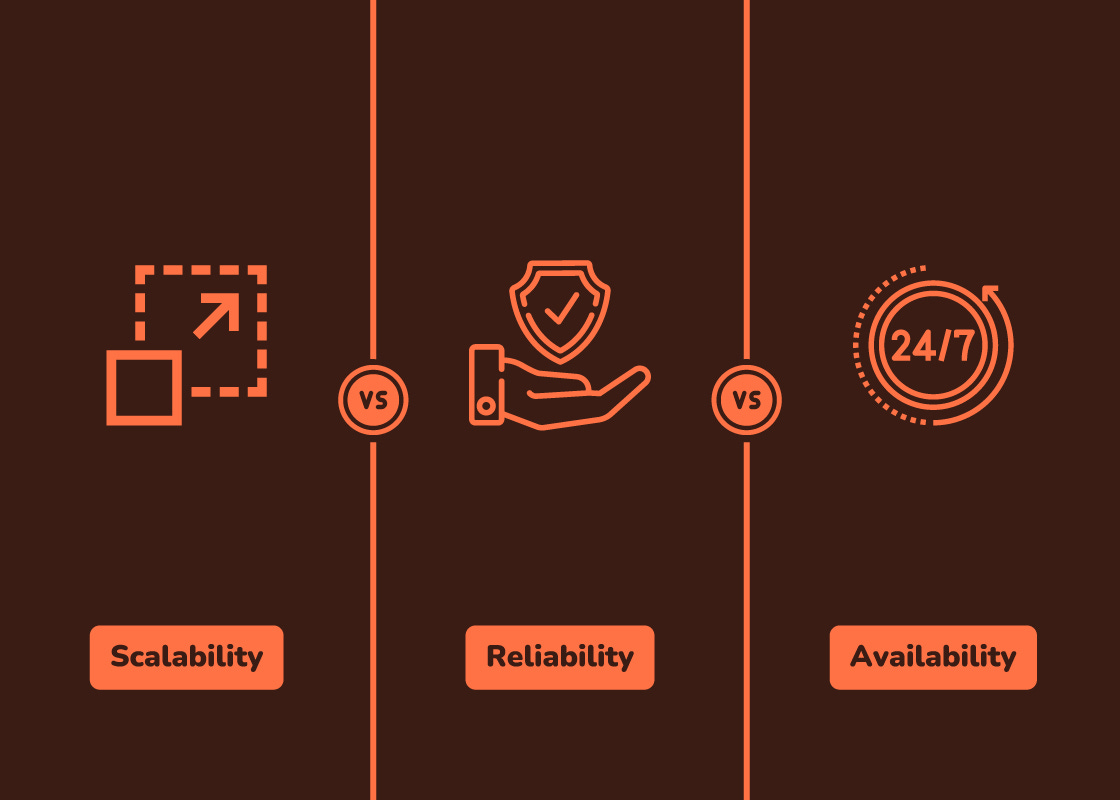
Imagine you’re building the next big social app.
You want it to handle explosive growth without breaking a sweat, never go down, and always give correct results.
Sounds ideal, right?
In reality, engineering is a balancing act.
Designing systems is often about juggling competing priorities.
Boosting one aspect (say, adding heavy redundancy for availability) might add complexity or cost that impacts others.
This blog covers three such priorities – scalability, reliability, and availability – and how to balance them.
Scalability vs Reliability vs Availability: What Do They Mean?
Let’s clarify each term with simple examples:
Scalability
This is a system’s ability to grow smoothly as demand increases.
A scalable design can handle more users, data, or traffic by adding resources without a drop in performance.
Think of a restaurant that can open more checkout counters or hire extra chefs during rush hour – it keeps serving more customers without long delays.
In tech, scalability often involves strategies like horizontal scaling (adding more servers) or vertical scaling (using bigger servers) to accommodate growth.
Reliability
Reliability is about consistency and correctness.
A reliable system performs its intended function accurately every time, even under stress or after long runs. It’s the confidence that when the system is up, it’s working properly.
For example, a reliable car starts every morning and gets you to work without unexpected breakdowns.
In software, think of a calculator app that never gives you the wrong answer – it’s dependable. Reliability means fewer failures and errors over time; it’s often quantified by metrics like Mean Time Between Failures (MTBF) or low error rates.
Availability
Availability is about uptime – the percentage of time a system is operational and accessible.
A highly available service is there whenever users need it, typically measured in those famous “nines” (e.g. 99.99% uptime).
Think of a 24/7 supermarket that’s always open; even at 3 AM, you can walk in and shop.
Similarly, an available system is up and running round the clock.
Importantly, availability doesn’t guarantee correctness – a site could be up but certain features might be broken.
For instance, your website loads but the checkout button fails – it’s “available” but not reliable.
In short, scalability is about handling growth, availability is about minimizing downtime, and reliability is about doing things right without failure.
All three are key quality attributes of robust systems, and great system design finds a balance based on what the product needs.
Why You Can’t Max Out Everything (Trade-offs Explained)
In an ideal world, every system would scale infinitely, never fail, and never go down.
In practice, there are inherent trade-offs – improving one aspect can affect the others.
Let’s look at a few scenarios:
Scalability vs. Reliability
Making a system massively scalable often adds complexity.
You might introduce distributed microservices, sharding, or caching layers to scale out.
But more moving parts mean more things that can break.
Reliability might suffer if components aren’t robust or if data consistency is relaxed for performance.
For example, to scale a database, we might use replication and eventual consistency – this scales reads and keeps the service available, but sometimes different nodes return slightly stale data, impacting strict reliability.
On the flip side, adding heavy fault-tolerance (like complex failover logic, data replication, transaction guarantees) can make the system harder to scale.
Reliability vs. Availability
These two seem similar, but they differ.
Sometimes you might choose one over the other.
A banking system might prefer reliability (data correctness) over availability, taking short downtimes to ensure consistency.
Many web applications, however, prefer to stay online (availability) even if some minor features degrade.
A common approach is “fail gracefully” – degrade non-critical features but keep core services up. This way, you maintain availability even if reliability dips.
Distributed systems theory (like the CAP theorem) also highlights this trade-off – in a network partition, you must choose consistency (reliability) or availability.
Scalability vs. Availability
Scaling aggressively can sometimes jeopardize short-term availability.
For example, auto-scaling is great, but when new instances spin up there can be brief hiccups.
Highly scalable architectures (distributed nodes across regions) can isolate failures and improve availability, but they also introduce more points of failure.
Over-scaling or frequent scaling events may even cause instability.
The solution: gradual rollouts, health checks, and graceful degradation to avoid downtime during scale events.
You can’t have infinite scalability, 100% reliability, and 100% availability all at once without some compromises.
System design is about deciding what matters most for your goals and making informed trade-offs.
An e-commerce site might prioritize availability (so customers can always buy), while a banking system might prioritize reliability.
How to Balance and Improve All Three
Here are some practical strategies to balance these pillars:
Redundancy & Fault Tolerance: Add redundancy to avoid single points of failure. Multiple servers across zones, load balancers, and failover systems boost both availability and reliability. Be mindful though – redundancy adds cost and complexity.
Scaling Strategies with Caution: Use gradual rollouts, pre-warm new servers, and health checks. Plan capacity with some headroom. This ensures scalability without hurting availability or reliability.
Graceful Degradation: Plan for failures. If a service struggles, disable non-critical features but keep core services running. This keeps availability high and preserves reliability of core functions.
Monitoring and Auto-Healing: Monitor error rates and latencies, then auto-recover failing services. Detecting and fixing problems quickly boosts both reliability and availability.
Know Your Priorities: Decide what matters most for your product. A video platform may tolerate small glitches for high availability, while a financial system prioritizes reliability over uptime. There’s no universal answer – context matters.
By applying these approaches, you can design systems that scale, stay online, and rarely fail.
Improving one aspect doesn’t mean ignoring the others – the best systems push the limits of all three wisely.
Conclusion
Scalability, reliability, and availability are the pillars of system design.
They determine whether your system can grow, whether it runs correctly, and whether it’s there when needed.
But they sometimes conflict.
Great system design is about balance: strengthening the pillar that matters most while making conscious trade-offs on the others.
By mastering these concepts, you can build systems – and ace interview questions – that truly stand the test of real-world demands.
Check out Grokking the System Design Interview and Grokking the Advanced System Design Interview courses by DesignGurus.io for learning system design concepts deeply.
FAQs
Q1. What is the difference between reliability and availability in system design?
Availability means a system is up and reachable (uptime percentage), while reliability means it consistently works correctly without failures. A system may be available but unreliable if features are broken. Ideally, you want both.
Q2. How do you balance scalability and reliability when designing a system?
Use modular architecture, redundancy, and graceful degradation. Scaling out adds capacity (scalability), while redundancy and health checks boost reliability. Avoid unnecessary complexity and prioritize based on application needs.
Q3. Why can’t a system be infinitely scalable, 100% reliable, and 100% available at the same time?
Because improving one usually affects the others. Reliability may reduce scalability due to overhead. Massive scalability introduces failure points, hurting reliability or availability. The goal is balance: meet business needs (like 99.99% uptime) rather than unattainable perfection.