
Replication vs Sharding: A Beginner’s Guide
Learn the difference between replication and sharding in simple terms. A guide covering how databases scale, when to use each strategy, and how they work together.

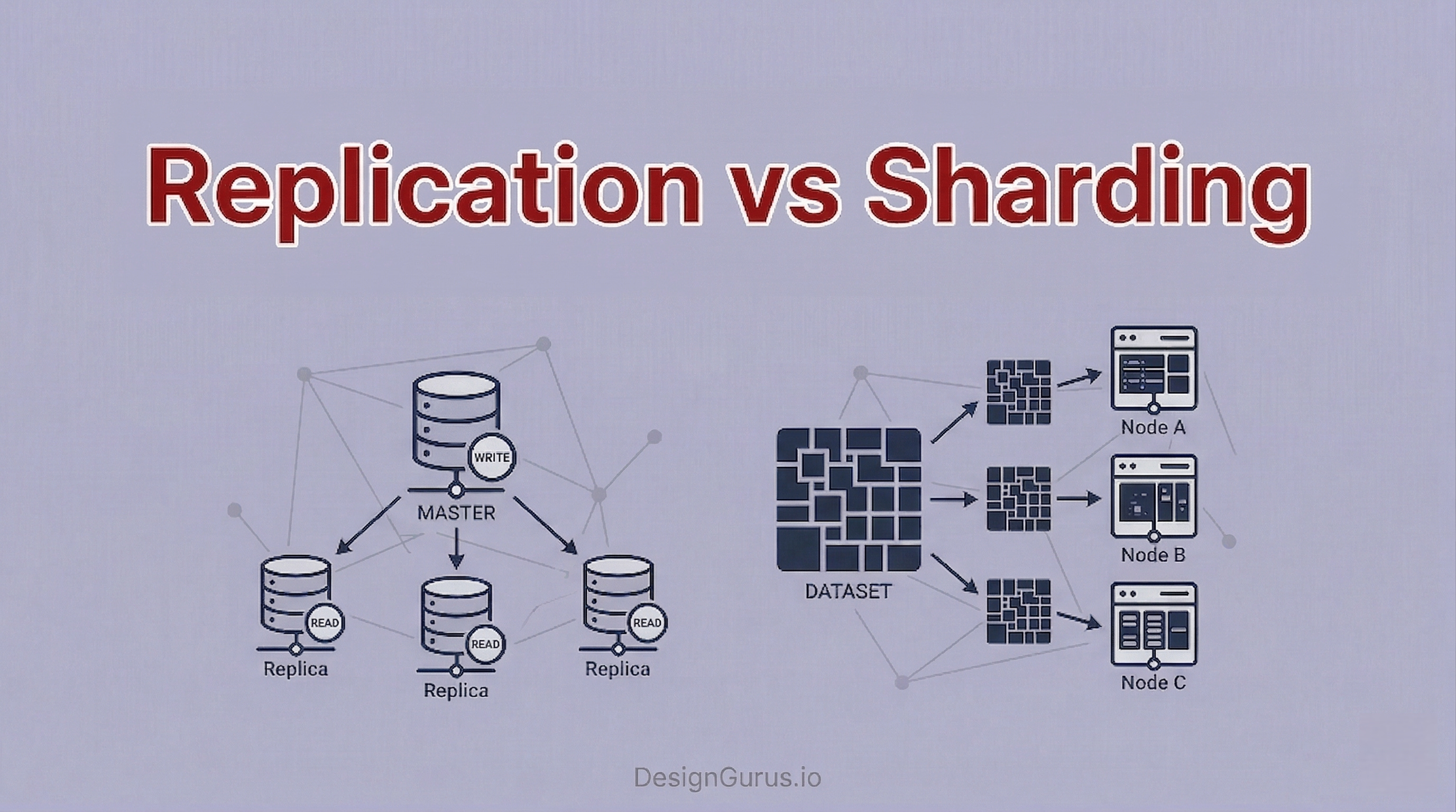
In this post, we will cover:
Why single databases eventually fail
How replication copies your data
How sharding splits your data
When to use which strategy
Combining both for real systems
Every application starts small. One server. One database. A handful of users.
Everything works fine, and honestly, you don’t think much about what happens behind the scenes.
Then something shifts. Traffic grows.
The database starts getting thousands of read and write requests every second. Queries that used to take milliseconds now take full seconds.
The application slows down, users get frustrated, and suddenly that single database becomes the weakest link in the entire system.
This is the exact moment where most engineers realize they need a strategy. Not just “throw more hardware at it,” but a real, thoughtful approach to scaling a database.
And that is where replication and sharding come into the picture.
These two concepts are foundational to distributed systems. They show up in almost every system design interview. They power the databases behind every large-scale product you use daily.
And yet, for beginners, the difference between them can feel blurry and confusing.
This post is going to fix that. By the end, you’ll know exactly what each one does, how it works under the hood, and when to pick one over the other.
The Core Problem: A Single Database Has Limits
Before jumping into solutions, let’s get clear on the problem.
A single database server has a ceiling. It can only handle so many connections at once. It has a finite amount of memory, CPU, and disk I/O. When your application crosses that ceiling, two bad things happen:
Performance degrades. Queries slow down because the server is overloaded.
Availability drops. If that one server crashes, your entire application goes down. There is no backup. No fallback. Nothing.
So we need to move beyond a single machine.
But how?
That is exactly the question replication and sharding answer, and they answer it in very different ways.
What Is Replication?
Replication means keeping copies of the same data on multiple database servers. Think of it as creating duplicates. Every replica (copy) holds the same dataset.
The idea is straightforward: instead of one server handling everything, you have several servers that all contain the same information.
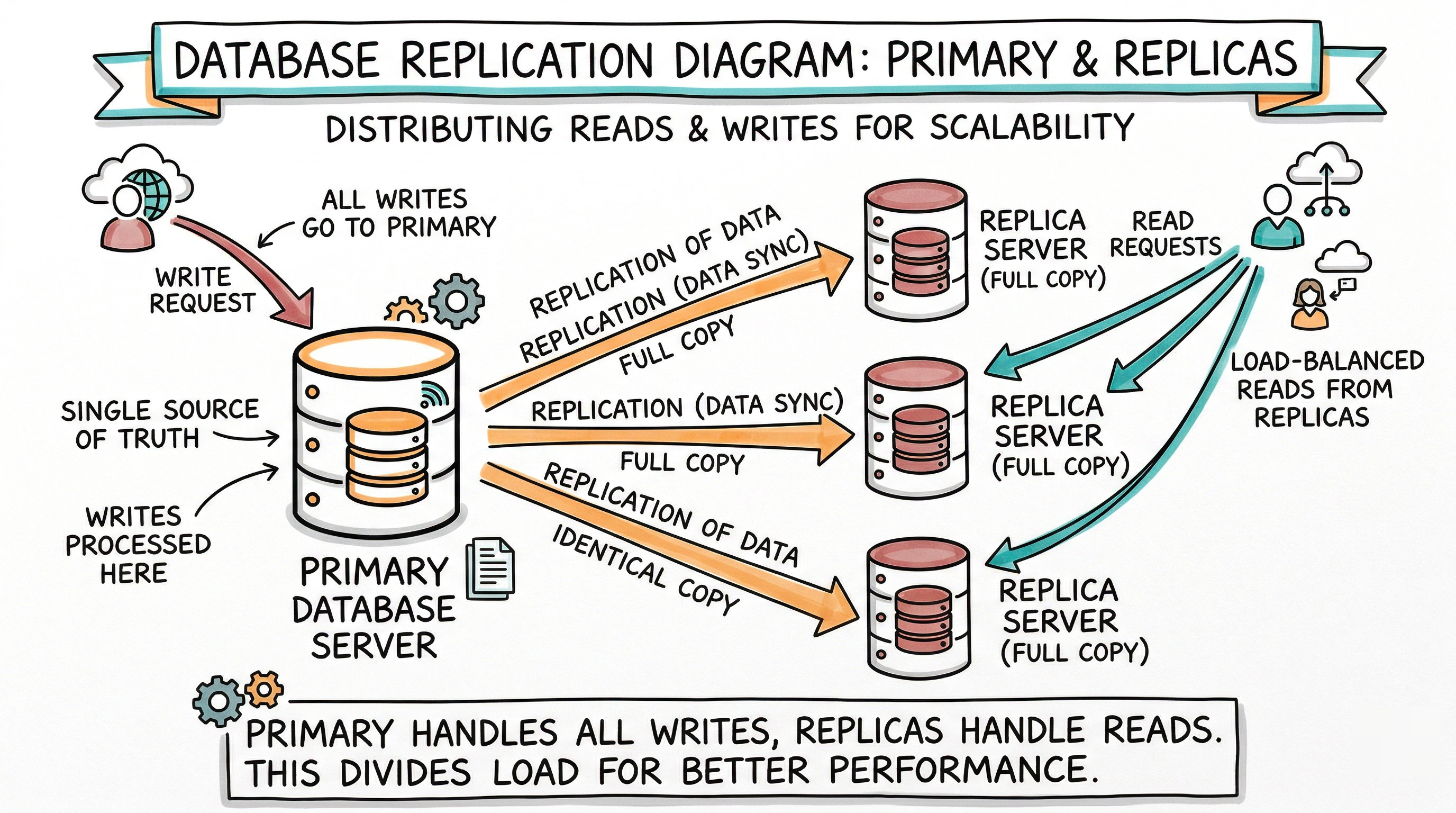
How Does Replication Work Behind the Scenes?
There is usually one server designated as the primary (also called the leader or master).
This is the server that handles all the write operations, meaning any time data is created, updated, or deleted, it goes through the primary.
Then there are one or more replicas (also called followers or secondaries). These servers receive copies of every change that happens on the primary.
The process of sending those changes is called replication, and it can happen in two ways:
Synchronous replication: The primary waits until the replica confirms it has received and written the data before telling the client “done.” This is safer but slower.
Asynchronous replication: The primary writes the data and immediately responds to the client. The replica gets updated shortly after. This is faster but carries a small risk: if the primary crashes before the replica catches up, some recent data could be lost.
What Does Replication Actually Solve?
It solves two big problems:
1. Read scalability. If your application does way more reading than writing (which is true for most apps), you can spread those read requests across all the replicas. Instead of one server handling 10,000 read queries per second, you now have five servers each handling 2,000. The load is distributed.
Keep reading with a 7-day free trial
Subscribe to System Design Nuggets to keep reading this post and get 7 days of free access to the full post archives.