
Polling vs Webhooks Explained with Examples: Which One Should You Choose?
Learn polling vs webhooks with real-world examples. Compare pros, cons, and use cases to choose the best method for event-driven systems.

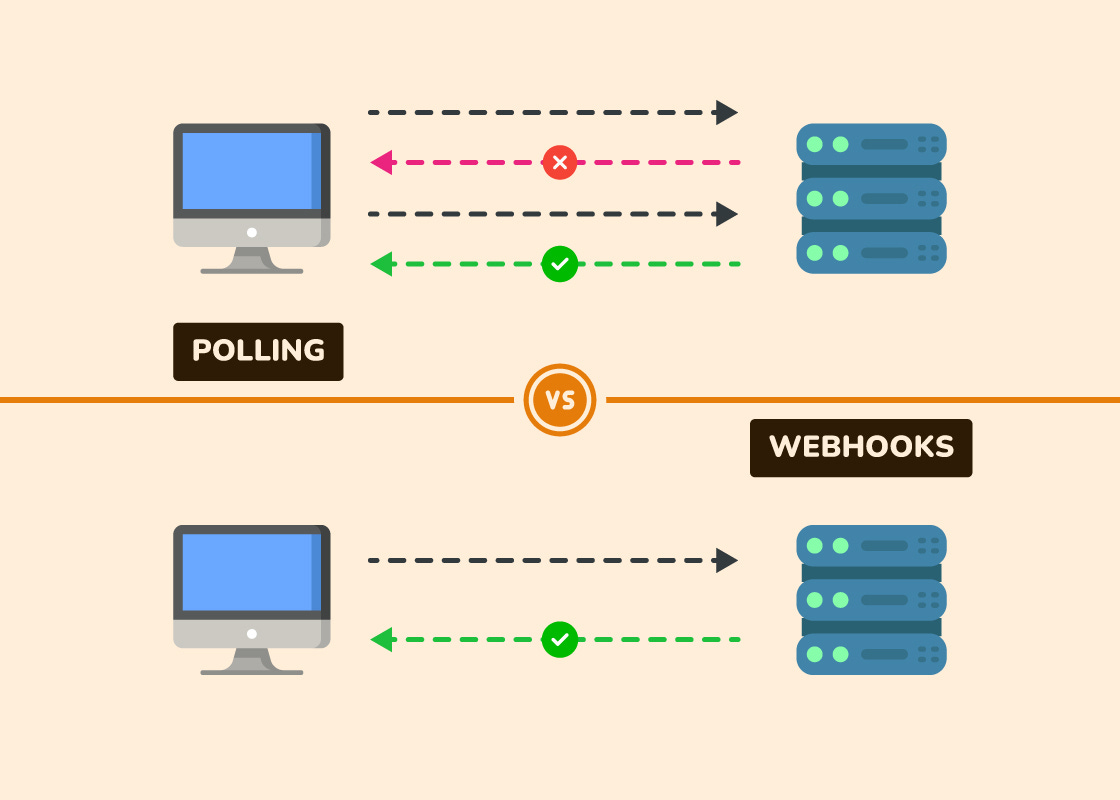
Applications can get event updates in two ways: polling or webhooks. This post explains each approach, its pros and cons, and how to choose between them.
Imagine you’re waiting for a package.
You could keep checking your doorstep every few minutes (that’s polling), or wait for the doorbell to ring when it arrives (that’s a webhook).
Both approaches will eventually get you the delivery, but one is proactive, and the other is reactive – each comes with its own trade-offs.
In software system design, the choice between polling and webhooks is similar.
The decision you make can impact your system’s efficiency and complexity. Let’s explore what each approach involves, its pros and cons, and when to choose one over the other.
What is Polling?
Polling is a technique where a client application repeatedly checks with a server for new data or events at regular intervals.
Essentially, the client asks, “Anything new yet?” on a schedule (say every 30 seconds or every 5 minutes). If there’s new information, the server returns it; if not, the server replies that nothing has changed.
You can adjust the polling frequency: shorter intervals give fresher data (but more requests), whereas longer intervals reduce requests at the cost of possibly outdated data.
Polling is simple and works with nearly any service, but it has some downsides:
Disadvantages of Polling
Not Real-Time: Polling can’t guarantee immediate updates. For example, if you poll once a minute and an event happens right after a poll, you won’t catch it until the next poll. Polling more frequently reduces the lag, but it still can’t achieve true real-time updates like a push notification.
Inefficient at Scale: Polling wastes resources when there are no new updates, often sending many requests that return nothing. Over time and with many clients, this flood of empty requests can strain the server and even hit rate limits.
What is a Webhook?
A webhook is a mechanism where the server sends a notification to the client as soon as a certain event occurs, without the client having to ask for it.
In practice, the client registers a URL (an HTTP endpoint) with the server, and when the specified event happens, the server makes an HTTP POST request to that URL with the relevant data. It’s like giving the server your phone number and saying, “Call me when there’s an update.” The moment the event happens, the server “calls” (sends a request to) the client with the data.
Advantages of Webhooks
Immediate Updates: Webhooks provide data in near real-time. As soon as the event happens on the server side, a notification is sent to the client. Your application can react almost instantly – great for time-sensitive events like payment confirmations or alerts.
Efficient & Scalable: Webhooks send data only when there’s an event, avoiding the wasted work of constant checks. This makes much better use of bandwidth. It also scales naturally, since the server only works when there’s an actual event (no constant idle queries).
Disadvantages of Webhooks
Complex Setup & Security: To use webhooks, you need to have a web-accessible endpoint (URL) where you can receive the data. You have to secure this endpoint with HTTPS, validation tokens, etc., which is more complex than making outgoing API calls.
Reliability Concerns: If your webhook endpoint goes down or is unreachable when an event occurs, you might miss the notification. Not all systems retry failed webhooks, so a network hiccup could mean a missed event.
When to Use Webhooks vs When to Use Polling
Choosing between polling and webhooks depends on your specific use case. Each approach shines in different scenarios.
Here are some guidelines to help you decide:
When to Use Webhooks
You need real-time updates: If your application or feature benefits from instant knowledge of events (for example, receiving a payment confirmation or a user completing a form), webhooks are ideal. This way, your system is notified immediately, which is crucial for time-sensitive actions.
Events are infrequent or unpredictable: If the events you care about happen at irregular intervals (say, a particular status update that might only happen a few times a day), polling constantly would be wasteful. A webhook will simply notify you when it happens, saving those needless checks.
When to Use Polling
Ultra-frequent updates: If data changes very frequently (e.g. thousands of events per minute), a continuous stream of webhook calls could overwhelm your system. In that case, polling at intervals (batching updates each time) can be more manageable.
Data freshness isn’t critical: If a slight delay is acceptable (say your app only needs hourly updates or nightly syncs), polling is sufficient.
Webhooks not available: If the service or API you need to integrate with doesn’t support webhooks, then polling is your only option by default. It might not be as efficient, but it’s reliable in that it will work with any system that can be queried.
Conclusion
There’s no one-size-fits-all – the best choice depends on your situation.
Polling works anywhere and is easy to implement, but it can be inefficient and adds delay. Webhooks are fast and efficient but need server support and setup.
Often, the optimal solution is to use webhooks wherever possible, and fall back to polling where necessary, so your system stays responsive without wasting resources.
Learn more about system design concepts with Grokking the System Design Interview course by DesignGurus.io.
FAQs
Q: What is the difference between polling and webhooks?
Polling is a method where the client periodically sends requests to the server to check for new data, whereas a webhook is a mechanism where the server pushes new data to the client as soon as an event occurs. Polling is client-driven (pulling updates on a schedule) and webhooks are server-driven (pushing updates in real-time).
Q: When should I use polling instead of webhooks?
Use polling when real-time updates aren’t essential or when updates happen very frequently. Polling is suitable if some delay is acceptable or if the service doesn’t support webhooks. It’s also useful for quick prototypes where implementing a webhook receiver isn’t worth the effort.
Q: Are webhooks more efficient than polling?
Yes, in most cases webhooks are more efficient than polling. Webhooks send data only when an event happens, avoiding the constant empty checking of polling and saving bandwidth and processing. However, webhooks do require server support and a reliable client endpoint, so if those aren’t available (or if events are extremely frequent), polling can be a practical fallback.