
Why Netflix's System Design Interview Feels Like a Design Review (And How to Prepare for It)
Google wants depth. Meta wants scale. Amazon wants Leadership Principles. Netflix wants production experience, honest reasoning, and the ability to make decisions without asking permission.

What This Guide Covers
Why Netflix’s system design interview feels nothing like Google, Meta, or Amazon
The conversational format: no whiteboard, no framework recitation, just engineering discussion
What Netflix evaluates: trade-off reasoning, production experience, long-term thinking, and cultural alignment
The domain-specific question bank: streaming, recommendations, CDN, resilience, and observability
The Culture Memo signal that filters candidates before technical depth even matters
A preparation strategy built specifically for Netflix’s unusual format
Netflix’s system design interview will catch you off guard if you prepare the way you prepare for Google or Meta.
There is no shared whiteboard.
There is no structured “define requirements, draw boxes, discuss trade-offs” arc that other companies follow.
There is often no diagram at all.
Instead, a senior Netflix engineer drops you into what feels like a real engineering discussion.
They describe a problem their team is actually working on.
They ask how you would approach it.
They push back on your decisions.
They ask “why not this other approach?”
They want to see whether you can reason through a real problem in real time, not whether you can perform a rehearsed framework.
This format rewards engineers who have actually built and operated systems at scale. It punishes engineers who have only studied system design from textbooks and YouTube videos.
The signal Netflix is looking for is not “can this person draw a clean architecture diagram?” It is “would I want this person in the room when we are making a hard technical decision?”
This guide covers exactly what Netflix evaluates, how their process differs from every other big tech company, and how to prepare for the most conversational system design interview in the industry.
The Netflix Interview Process
Netflix’s process is team-specific. Each hiring team runs its own process, customized to their domain.
There is no company-wide standard loop the way Google or Amazon has. That said, the general structure for senior software engineers (L5+) follows a consistent pattern.
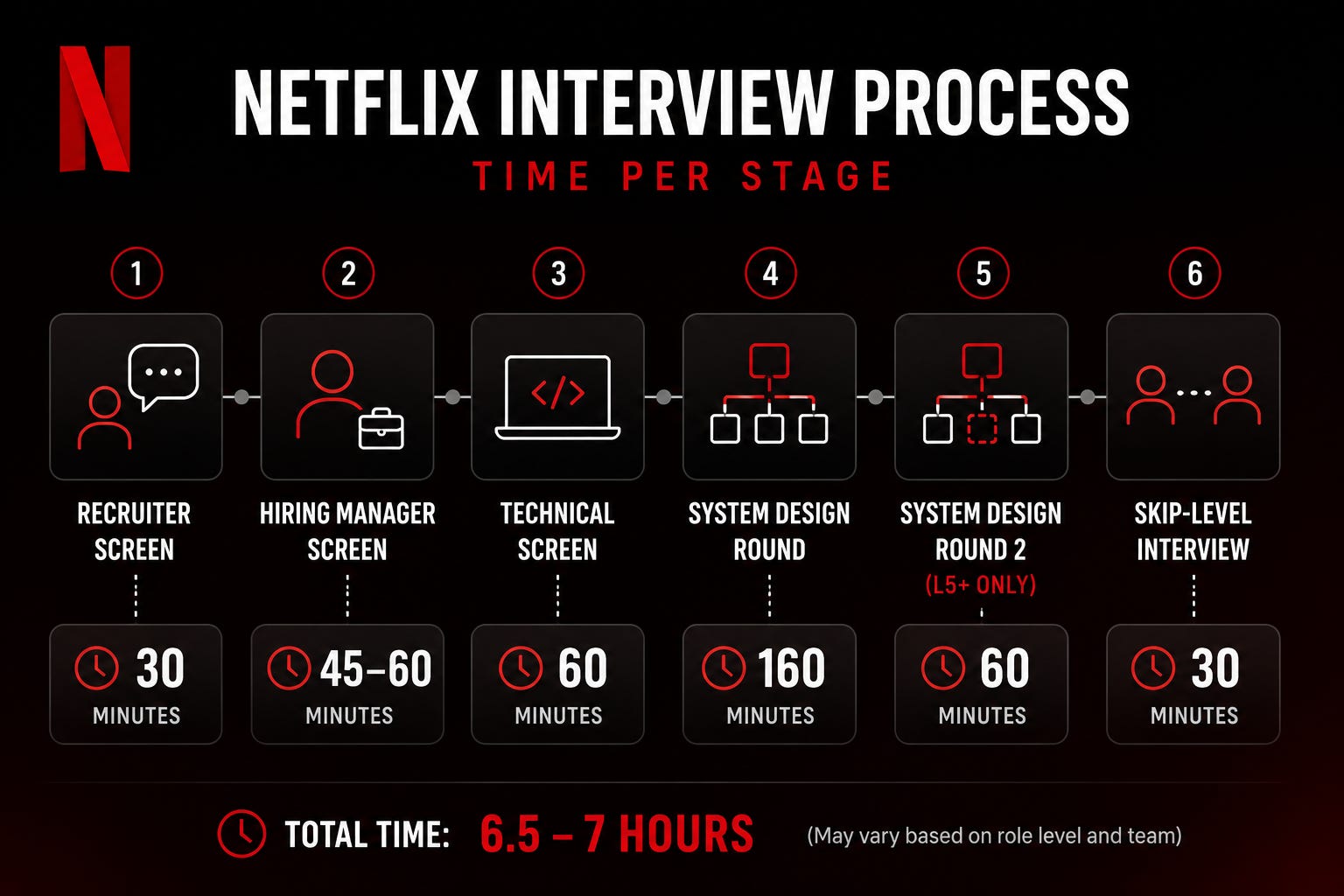
Recruiter Screen (30 minutes)
Unlike most recruiter screens, this one is a real interview.
The recruiter asks about the Netflix Culture Memo.
Which principles resonated with you?
Which surprised you?
Which gave you pause?
If you mention a principle like “radical candor,” expect an immediate follow-up: “Give me a concrete example of a time you gave difficult feedback to a senior colleague.”
This is the first filter. Netflix’s culture is extreme.
Unlimited PTO, no expense policies, top-of-market all-cash compensation, and the expectation that every employee operates with full autonomy.
The recruiter is assessing whether you genuinely align with this culture or are just saying what you think they want to hear.
Hiring Manager Screen (45-60 minutes)
A deep conversation with the manager you would actually report to. This is not behavioral fluff.
The manager probes your past projects, technical decisions, domain expertise, and engineering judgment.
They are deciding: “Would I trust this person to own a critical system on my team?”
Expect questions like:
“Tell me about a system you built that you are proud of. Now tell me what you would do differently.”
“Describe a technical decision you made that was controversial. How did you handle the disagreement?”
Technical Screen (60 minutes)
A live coding session with a senior engineer, typically conducted in CoderPad or a similar shared environment.
Netflix has moved away from abstract algorithmic puzzles toward practical engineering problems.
You are more likely to build a rate limiter, implement a metadata cache, or design a data pipeline than solve a classic LeetCode puzzle.
The code must be production quality.
Clean naming.
Error handling. Edge cases.
Netflix evaluates code the way they would evaluate a pull request from a teammate.
System Design Round(s) (60 minutes each)
This is the focus of this guide.
L4 candidates typically get one system design round.
L5 and above get two.
Each round is 60 minutes with a senior or staff engineer from the team.
Skip-Level Interview (30 minutes)
A conversation with a senior director or executive. This round focuses entirely on dissent.
“Tell me about a time you disagreed with a decision and could not convince others to change it.”
You will be asked for multiple examples.
By the third, you may be reaching for smaller situations, and the interviewer will help: “Even a disagreement on a pull request counts.”
Netflix values engineers who have strong opinions but can commit to a direction they disagreed with. This round tests that directly.
The No-Downlevel Policy
Netflix does not downlevel.
If you are interviewing for an L5 (senior) position and do not meet the L5 bar, you are rejected. You are not offered an L4 position. This makes the interview higher stakes than Google or Amazon, where a strong L4 performance during an L5 loop might still result in an offer.
How the System Design Round Actually Works
Forget everything you know about structured system design interviews.
Netflix’s format is different in three fundamental ways.
There Is No Whiteboard
Most candidates who interviewed at Netflix in 2025-2026 report completing their system design rounds without any shared diagramming tool.
One candidate drew on paper to organize their own thinking, then walked the interviewer through it verbally.
Another did not diagram at all.
This means your preparation must emphasize verbal explanation over visual presentation.
Can you describe a system architecture clearly using only words?
Can you walk someone through a data flow without pointing at boxes and arrows?
If your system design practice has always involved drawing on a whiteboard, you need to practice without one.
The Questions Are Domain-Specific
Netflix does not ask “Design Twitter” or “Design a URL shortener.” They ask questions tied to their actual product and infrastructure.