
Meta System Design Interview Prep: The 2026 Process, AI Coding Round, and Question Bank
Preparing for Meta's infrastructure system design round? Understand the 45-minute format, common distributed systems questions, and what interviewers actually look for in 2026.

This blog covers:
Meta’s infrastructure interview structure
System design vs product architecture
2026 interview process changes
Common infrastructure questions asked
Strategies to clear the round
Meta’s infrastructure-focused system design round is a 45-minute collaborative architecture session evaluated on four competencies, like problem navigation, solution design, technical excellence, and communication, where candidates must design distributed systems at billions-of-users scale.
The round has grown more demanding since 2025: an AI-assisted coding round now accompanies the loop, E6+ candidates face low-level infrastructure questions like “Design Memcached” or “Design Kafka,” and hiring bars have tightened amid selective headcount management.
This guide synthesizes the latest information from former Meta interviewers, engineering blog resources, candidate reports, and major prep platforms to give a comprehensive picture of what the infrastructure round looks like right now.
How the Interview Loop Is Structured Today
Meta’s software engineering interview pipeline follows a well-defined sequence: CodeSignal online assessment → recruiter screen → technical phone screen → onsite loop → team matching → offer.
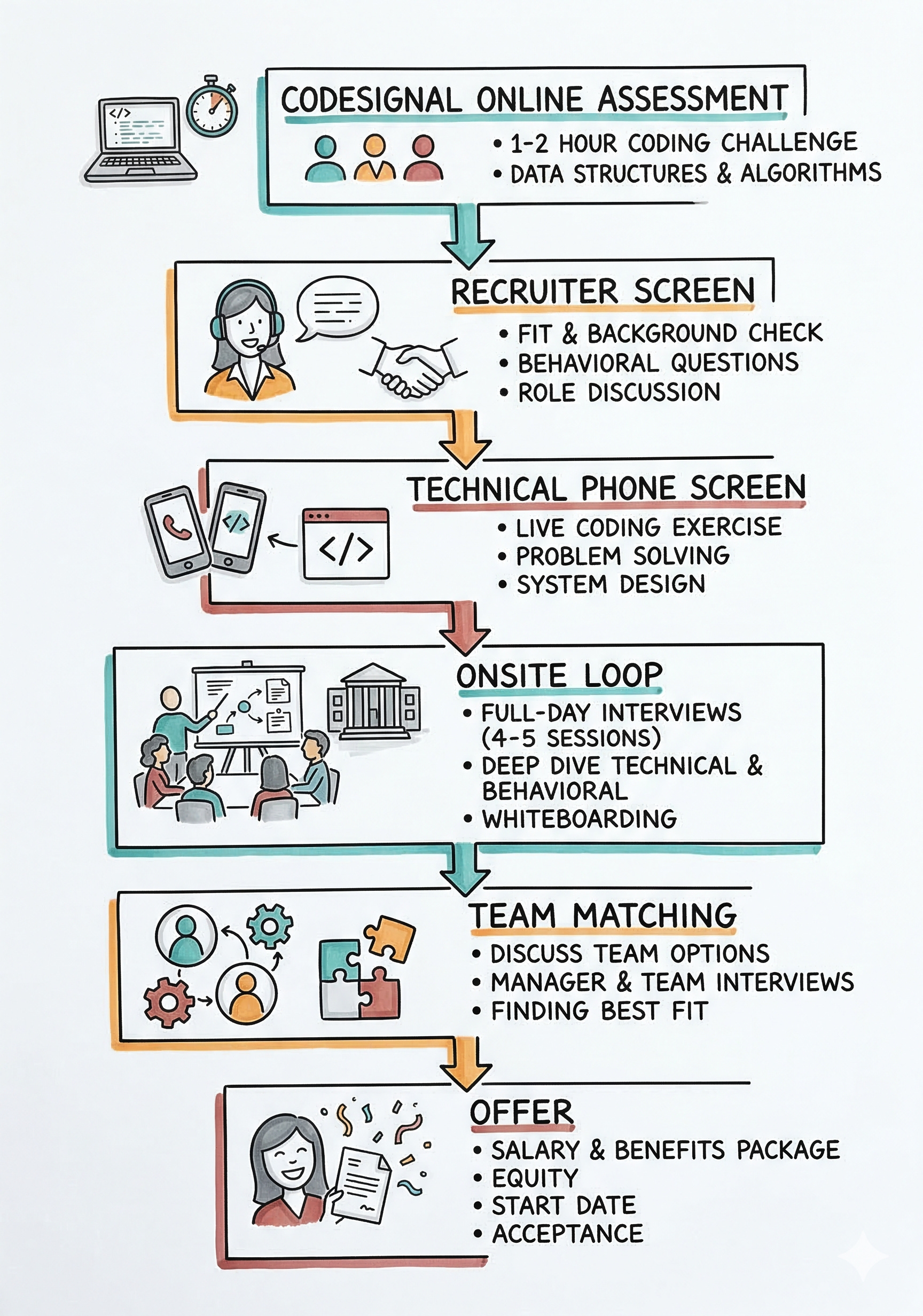
The CodeSignal OA, introduced in 2025, is a 90-minute proctored session with video and microphone monitoring. It presents a single complex problem divided into four progressive stages, for example, designing an in-memory database rather than traditional LeetCode puzzles.
The onsite loop for E5 (Senior) candidates typically includes two coding rounds (one now AI-assisted), one system design or product architecture round, and one behavioral round; four rounds total.
E6 (Staff) candidates face five rounds: one standard coding, one AI-assisted coding, two system design rounds (architecture + design), and one behavioral round, plus a Leadership Assessment interview between the phone screen and onsite.
For E7+ and M1, there is only one coding round (AI-assisted), with multiple system design rounds carrying even more weight.
Each system design round lasts 45 minutes, but the effective design window is roughly 35 minutes after introductions and closing Q&A.
Candidates use Excalidraw for virtual whiteboarding. No code writing is required. It’s a purely architectural discussion structured as a collaborative conversation, not a one-way presentation.
A critical structural detail: system design and behavioral interviewers have the most influence on both the hire/no-hire decision and the candidate’s level determination.
For Staff-level and above, passing both system design rounds is mandatory; failure on one is typically disqualifying, though a rare “mulligan” retake may be offered if other rounds were strong.
Infrastructure Design vs. Product Architecture: What Changes
Meta splits its design interview into two tracks based on the role and candidate background.
The recruiter assigns you to one track, sometimes offering a choice based on your resume and experience.
The System Design interview targets SWE-Infrastructure (backend) candidates and focuses on backend distributed systems at massive scale.