
Stop Just Drawing Kafka: Message Queues Explained for System Design Interviews
The Message Queue Guide That Covers What Tutorials May Skip: Delivery Guarantees, Ordering, Backpressure, Consumer Groups, and the Decisions That Actually Matter at Scale


There is a moment in almost every system design interview where the candidate adds a message queue to their design.
They draw a box labeled Kafka or RabbitMQ, connect it with arrows, and say something about decoupling. The interviewer nods and asks a follow-up.
What delivery guarantee does that queue provide?
What happens if a consumer crashes mid-processing?
How do you handle a message that keeps failing?
What happens when the consumer falls behind and the queue fills up?
At this point, candidates who named the queue without understanding it begin to struggle. They knew the word and knew that queues belong in certain designs, but the follow-up questions reveal that the understanding stops at the surface.
The queue was named as a pattern to include rather than as a mechanism that has specific, consequential behaviors they could reason about and defend.
This is the gap this guide closes. Not which queue technology to choose, but what message queues are, how they actually work, what guarantees they provide and do not provide, the patterns they enable, and the failure modes that make them interesting under questioning.
By the end, naming a queue in a design should feel like the beginning of a conversation rather than the end of one.
Why Message Queues Exist
The need for message queues arises from a fundamental tension in distributed systems between producers of work and consumers of work.
Understanding this tension precisely is what makes the queue’s purpose feel necessary rather than arbitrary.
The Synchronous Communication Problem
In a synchronous system, when service A needs service B to do something, A calls B directly and waits for the response. This is simple to implement, simple to reason about, and correct as long as B is available, fast, and able to keep up with the rate at which A makes requests.
The problems appear when any of those conditions fail.
When B is slow, A is blocked waiting.
If A is handling a user request, the user waits for however long B takes.
A video encoding service that takes thirty seconds to process an upload, a report generation service that takes five seconds, or an email delivery service that takes two seconds all make the user wait unnecessarily if called synchronously. The work does not need to happen before the response to the user. It just needs to happen eventually.
When B is unavailable, A’s call fails and A must decide what to do. Retry immediately and risk overwhelming B when it recovers. Drop the work and lose it. Keep it in memory and hope A does not crash before B recovers.
None of these are satisfying, and all of them are fragile.
When A produces work faster than B can consume it, there is nowhere for the excess to go in a synchronous system. B gets overwhelmed, its response time degrades, A starts timing out, and the whole system degrades together.
There is no buffer, no shock absorber, no way to smooth out the mismatch.
A message queue solves all three problems by introducing a durable buffer between A and B. A places a message in the queue and continues immediately. B reads from the queue at its own pace.
The queue holds the messages durably so they are not lost if either side goes down.
This single change, interposing a durable buffer between producer and consumer, transforms the relationship between them in ways that matter deeply at scale.
What Decoupling Actually Means
Decoupling is the word that gets attached to message queues in most explanations, but it is worth being precise about what decoupling actually provides.
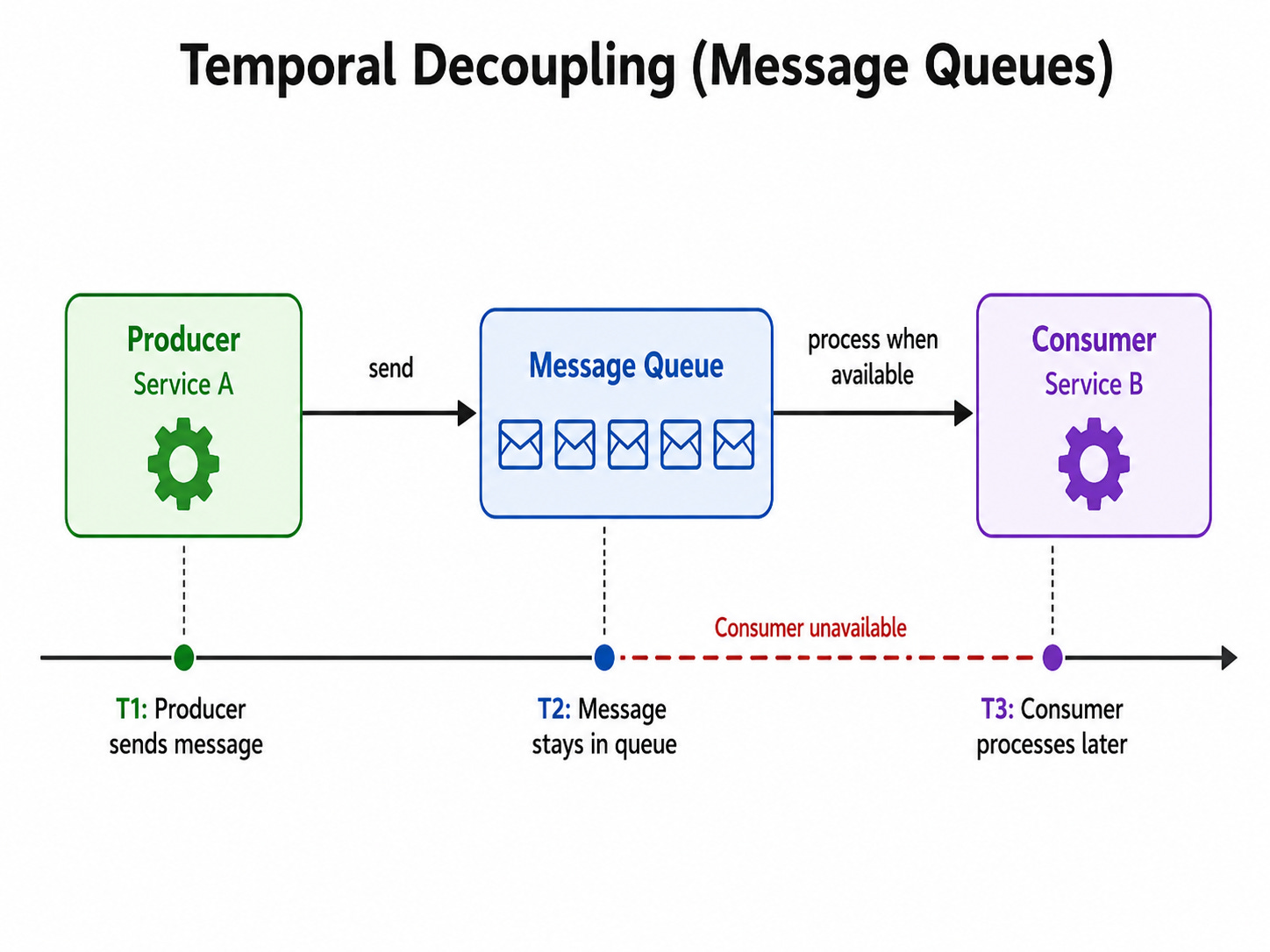
Temporal decoupling means the producer and consumer do not need to be running at the same time. The producer can put messages in the queue when the consumer is offline. The consumer processes them when it comes back. Without a queue, both must be available simultaneously. With a queue, availability requirements are separated.
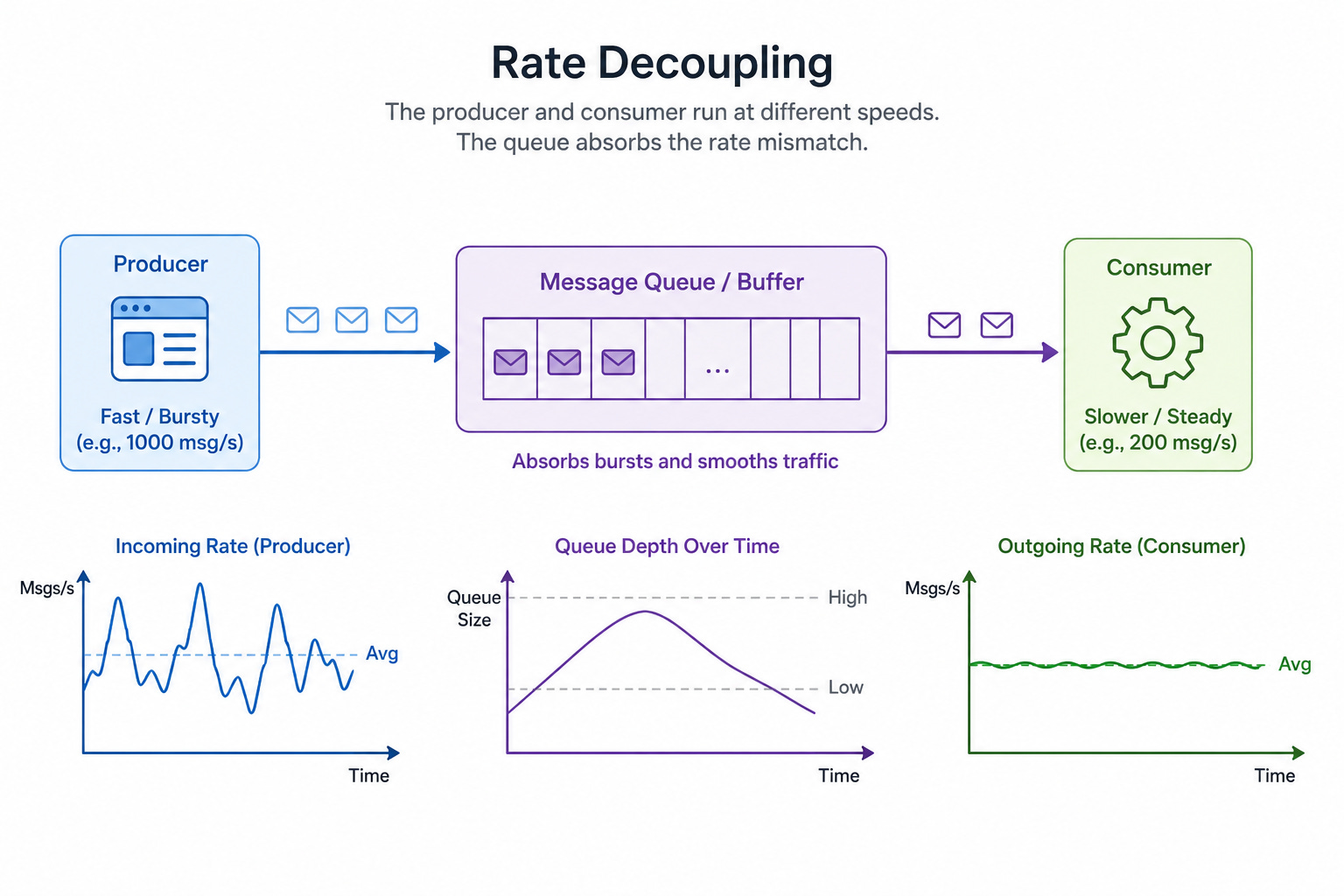
Rate decoupling means the producer and consumer do not need to operate at the same speed. The producer can burst at ten times its average rate and the queue absorbs the excess. The consumer processes at a steady rate that matches its capacity. Without a queue, the consumer must be able to handle the producer’s peak rate or the producer must slow down to match the consumer’s rate. With a queue, each operates at its natural rate and the queue handles the difference.
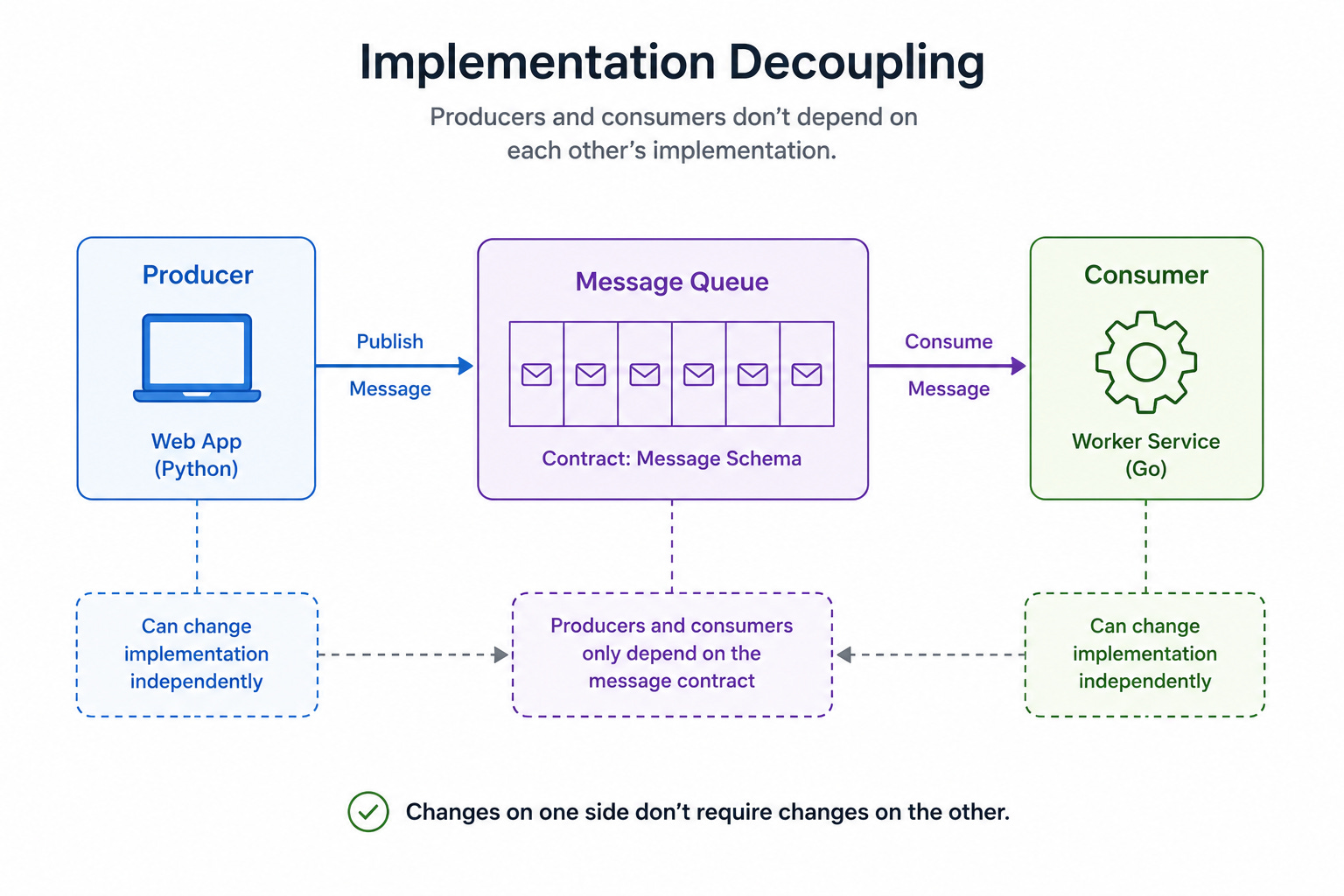
Implementation decoupling means the producer does not need to know which consumer handles its messages, how many consumers there are, or how they process the messages. It puts a message in the queue and its job is done. Consumers can be changed, replaced, scaled up, or added without the producer knowing or caring. This is what allows systems to evolve without tight coupling between components.
How a Message Queue Works
Understanding what a queue does is easier than understanding how it does it. The internals matter because they determine the guarantees the queue can make and the failure modes that exist.
The Basic Mechanics
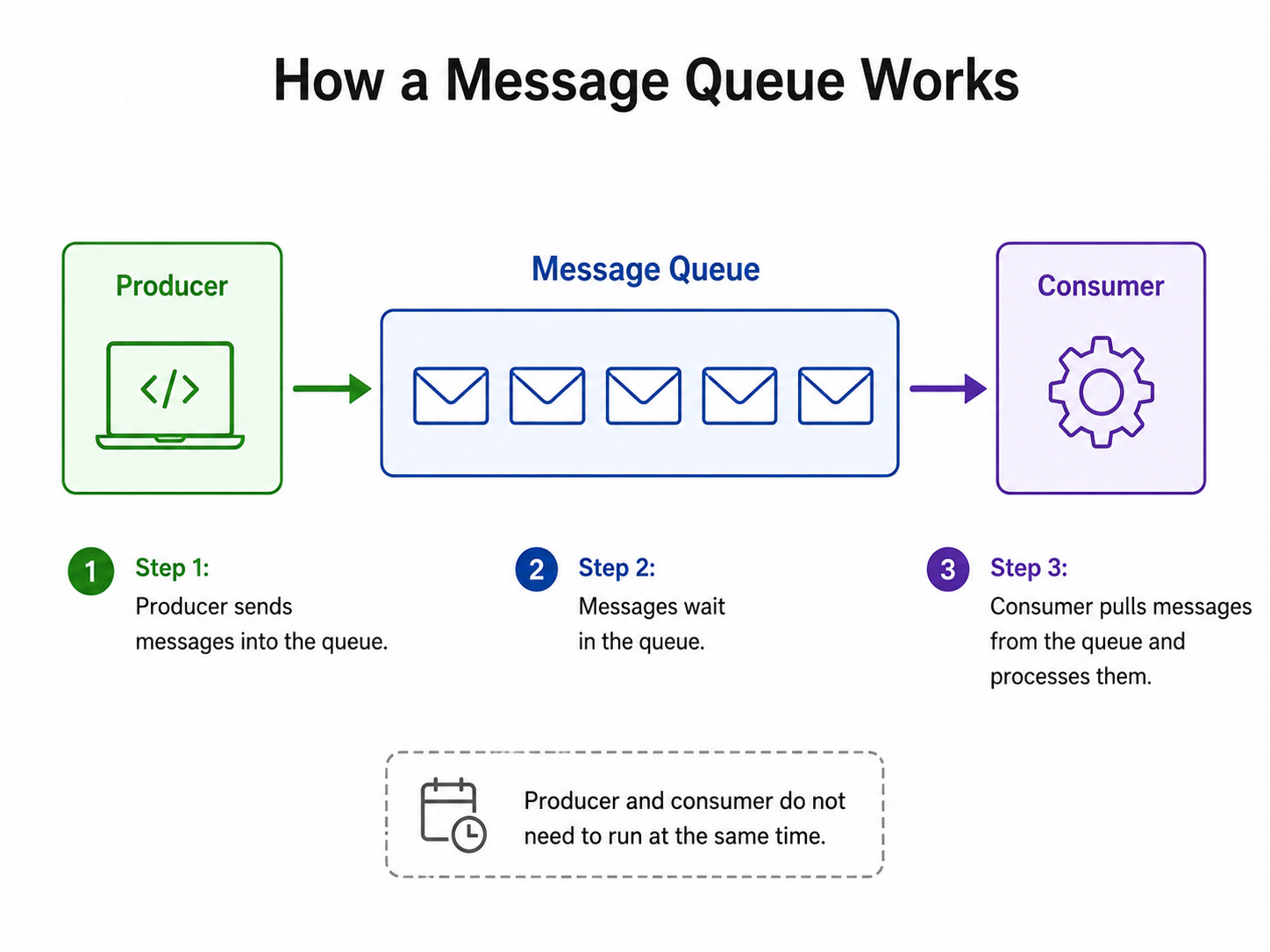
A message queue at its simplest is a durable store for messages with two operations: put a message in (produce) and take a message out (consume).
The queue accepts messages from producers and holds them until consumers are ready.
Consumers pull messages from the queue, process them, and acknowledge successful processing.
The queue deletes acknowledged messages and retains unacknowledged ones.
The acknowledgment mechanism is what makes queues reliable.
When a consumer pulls a message, the queue does not immediately delete it. Instead it marks it as in-flight, meaning it has been given to a consumer but not yet confirmed as processed.
If the consumer acknowledges the message, the queue deletes it.
If the consumer crashes or does not acknowledge within a timeout period, the queue makes the message available again for another consumer to pick up.
This mechanism ensures that a message is never lost due to consumer failure.
The consumer might fail after pulling the message but before processing it, or fail during processing, or fail after processing but before acknowledging. In all these cases, the queue retains the message and delivers it again. This is the foundation of at-least-once delivery.
Message Storage and Durability
For a queue to guarantee that messages are not lost if the queue itself fails, messages must be stored durably. Different queue systems achieve this differently.
Some queues store messages in memory for speed and flush to disk periodically. This is fast but risks losing messages written since the last flush if the machine crashes.
Some queues write to disk synchronously before acknowledging a write, which is slower but guarantees durability.
Some queues replicate messages across multiple machines before acknowledging, providing durability even if one machine fails completely.
The durability model determines what the queue can honestly guarantee.
A queue that stores messages only in memory cannot guarantee they survive a crash.
A queue that writes synchronously to replicated storage can guarantee they survive almost any failure short of a complete data center loss. Understanding which model a specific queue uses is part of understanding what it actually guarantees.
The Log-Based Queue
Traditional queues delete messages after they are consumed.
Log-based queues, of which Kafka is the most widely known, take a fundamentally different approach.
Messages are appended to an ordered, immutable log and retained for a configurable period, regardless of whether they have been consumed.
Consumers track their position in the log using an offset, a number indicating which message they have read up to. The consumer controls this offset.
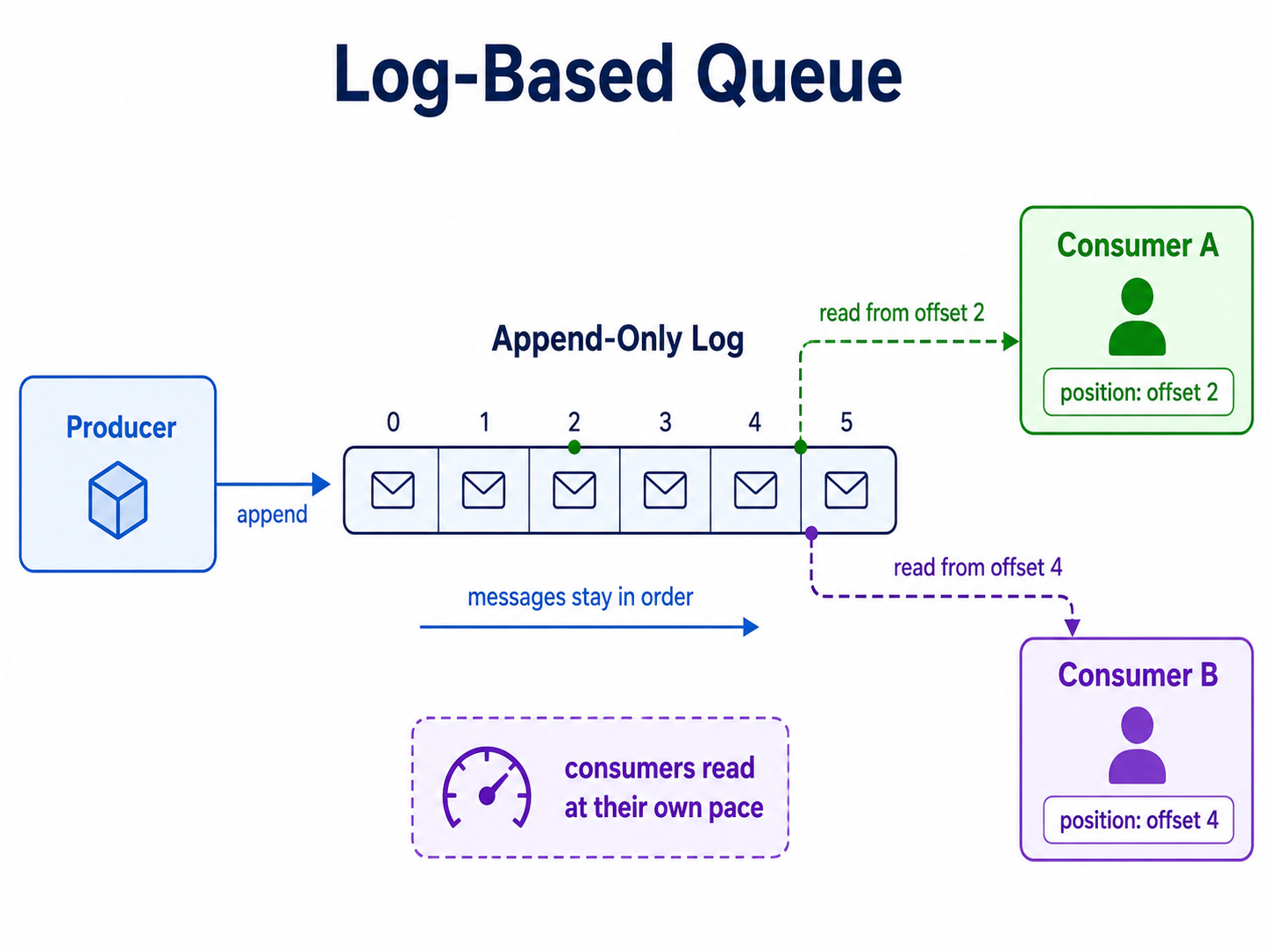
Multiple independent consumers can read from the same log at different positions simultaneously without interfering with each other, because reading does not remove anything.
A consumer can reset its offset to replay messages from an earlier point in the log.
A new consumer can start from the beginning of the log and process all historical messages.
This is a fundamentally different model from a traditional queue and enables use cases that traditional queues cannot support: multiple independent consumers each processing the full stream, replay of historical messages when a new service is added or a bug is found, and event sourcing where the log is the primary record of what happened.
The trade-off is that the log retains messages regardless of consumer progress, which means storage must be sized for the retention period rather than just the current backlog. And because the log is append-only, updating or deleting a specific message requires publishing a new message that supersedes the old one.