
Message Queue vs Database: Why You Should Stop Using DB Tables for Messaging
Message queue vs database explained. Learn why DB tables fail as queues, the drawbacks of polling, and how real message queues ensure scalability and reliability.

This article compares using a message queue vs using a database to send messages between services. You’ll learn why queues often beat database tables for messaging – covering features like automatic retries, message ordering, decoupling of services, and common scenarios where queues shine.
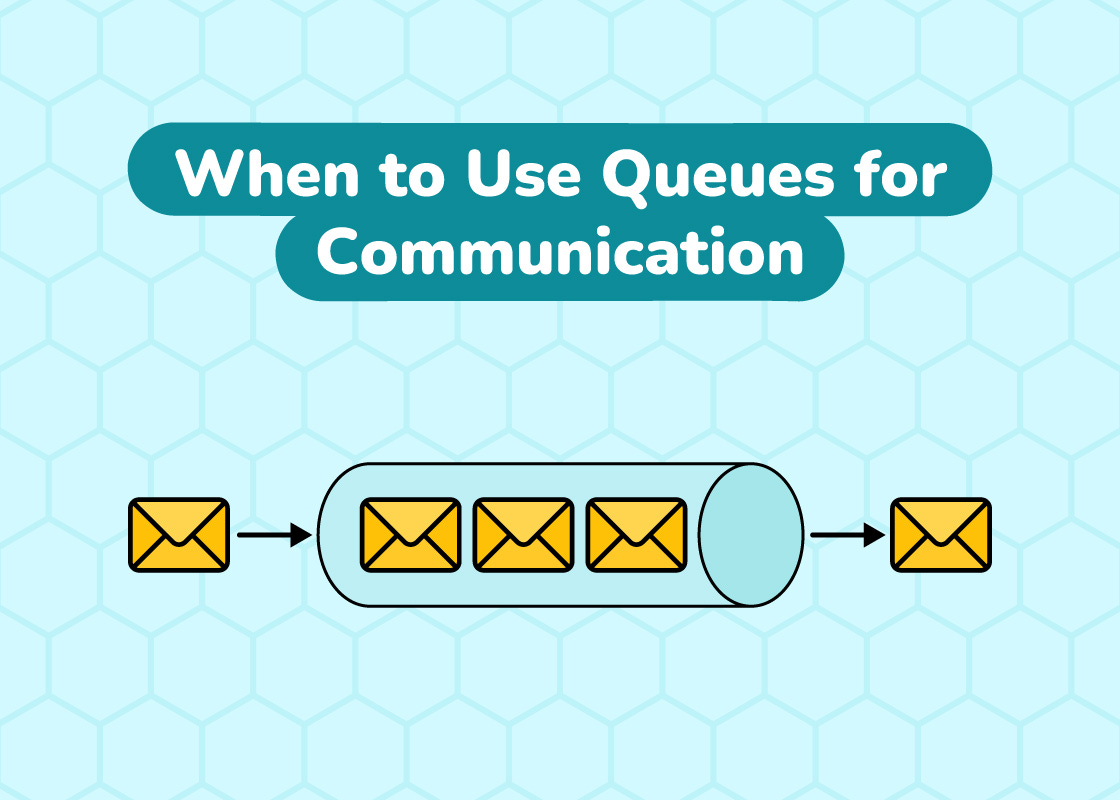
Have you ever wondered if you could avoid setting up a message queue by using your existing database to pass messages between application components?
It’s a tempting idea for simplicity, especially if you’re already comfortable with databases.
For example, one could insert a “to-do” record in a database table and have another process poll for new records to simulate a job queue.
However, as your system grows, this approach can lead to performance issues and complex failure-handling logic.
In this blog, we’ll break down why dedicated message queues are usually a better fit for service-to-service communication than using a database as a makeshift queue.
We’ll explore how queues provide built-in retries, preserve ordering, decouple services, and discuss when it’s appropriate to use each approach.
The Problem with Using a Database as a Queue
At first glance, using an existing database for messaging seems straightforward – after all, databases persist data and multiple processes can access them.
But this approach has several drawbacks:
Constant Polling & Load: Unlike a queue, a database won’t notify a consumer when a new “message” arrives. Your application has to constantly query (poll) the table for new entries. This adds extra load and latency, as the database is repeatedly hit even when no new messages are present. Under heavy use, this frequent polling can bog down the database.
Concurrency and Locking: With multiple consumers reading from the same table, you must implement mechanisms to avoid two workers picking up the same message. This often means adding status flags (e.g. NEW, PROCESSING) and using transactions or locks on rows. Managing these locks is tricky – you might encounter race conditions, deadlocks, or timing issues that slow down throughput. All this concurrency complexity has to be handled with custom code in your application.
Manual Clean-up: After processing a “message” row, your code needs to delete it or mark it as handled. If you don’t, the table will grow indefinitely, eventually impacting query performance. Implementing a clean-up strategy (and ensuring no active process re-processes a deleted message) adds more burden on the developers.
Reinventing Reliability: Databases don’t have built-in message acknowledgement or retry mechanisms for transient failures. If a worker crashes halfway through handling a message, the system needs to decide what to do – e.g. reset the row’s status to NEW so another worker can retry it. You’ll likely end up writing logic to handle retries and failures (perhaps moving rows to a separate “dead letter” table after too many attempts). Essentially, you re-implement features that message queues provide out-of-the-box.
Performance Bottlenecks: Databases are optimized for storage and structured queries, not high-speed message throughput. As message volume grows, a database queue table can become a bottleneck – high insert/read rates contend for resources with other database operations. Moreover, using database locks to coordinate consumers limits parallelism. In short, you’d be lucky to process a few hundred a second with a DIY database queue, whereas a real queue can handle thousands per second smoothly.
In summary, while you can use a database as a queue, it introduces a lot of extra work and potential issues.
It’s no surprise that some engineers consider the “database-as-queue” approach an anti-pattern, since you often end up solving problems that dedicated queue systems have already solved for you.
Why Message Queues Are Better for Communication
Dedicated message queue systems (like RabbitMQ, Apache Kafka, Amazon SQS, etc.) are purpose-built for asynchronous communication.
They manage the delivery of messages between producers and consumers, and come with many features that a DIY database solution would struggle to match.
Here are key advantages of using a message queue for service communication:
Decoupling & Flexibility
Message queues decouple the sender and receiver in both space and time.
The producer just pushes a message to the queue and doesn’t need to know anything about who consumes it or when.
The consumer can be on a different system, written in a different language, and process the message whenever it’s ready.
This asynchronous, decoupled interaction means components can operate and scale independently.
In a microservices or distributed architecture, such loose coupling is gold – services communicate via the queue without direct integration or shared databases.
Automatic Retries & No Lost Messages
Good message queues provide delivery guarantees. They use acknowledgments: a consumer tells the queue “I got the message and processed it” – only then does the queue remove it.
If a consumer crashes or fails to acknowledge, the broker requeues the message for another consumer to retry.
This means the system can recover from failures gracefully – no message is lost if a worker goes down mid-task, the message will be delivered again.
Many queue systems also support dead-letter queues (DLQs) to catch messages that keep failing so they can be reviewed or retried later.
All of this happens automatically, so you get reliable, at-least-once delivery without writing the logic yourself.
Ordering Guarantees
Need your messages in order?
Many queues inherently preserve FIFO (first-in-first-out) ordering of messages or offer options to ensure ordering when it matters.
With a database approach, implementing strict ordering across multiple consumers is difficult – you’d have to coordinate carefully or stick to one consumer.
Queues, on the other hand, can guarantee order or allow message partitioning such that order is maintained per key (as Kafka does).
If processing in sequence is important (say, processing events for a particular user in order), a message queue is well-equipped for that scenario.
Scalability & Throughput
Message queues are designed to handle high volumes and bursty traffic.
You can scale by simply adding more consumer instances reading from the queue – the broker will load-balance messages to them.
No need to worry about two nodes picking the same item; the queue ensures each message goes to a single consumer.
Under the hood, queues avoid the heavy table-scanning and locking that databases would need for the same throughput.
In practice, a properly configured queue system can process thousands of messages per second across many servers, whereas a database would start to choke far earlier under equivalent load.
This makes queues ideal for building scalable, high-performance architectures.
Simplified Development & Maintenance
Perhaps one of the biggest wins is that using a queue offloads a lot of complexity from your application code.
The message broker handles concurrency, scheduling, and cleanup of messages.
You don’t have to write code to poll repeatedly or manage transaction edge cases – the queue takes care of it.
This leads to cleaner and more maintainable code.
As one expert succinctly put it, while it might seem trivial to use a database as a queue at first, you eventually end up having to solve all of the problems the queue designers have already solved for you.
By using a proven messaging system, you leverage battle-tested solutions for delivering messages reliably.
In short, you use the right tool for the job and avoid reinventing the wheel.
When to Use a Message Queue (Common Scenarios)
Message queues are powerful, but when exactly should you use one?
Here are some common scenarios where queues are the go-to solution:
Background processing: If you have tasks that don’t need to run immediately within a user request, put them on a queue. For example, sending welcome emails, generating PDFs/reports, or resizing uploaded images. The web application can enqueue a message and return a response to the user quickly, while a background worker processes the task from the queue.
Microservices communication: In a microservices architecture, services often need to notify each other or request work asynchronously. A message queue enables an event-driven approach: one service publishes an event (like “Order Placed”) to the queue, and one or many other services can consume that event and react. The services remain loosely coupled – they don’t call each other directly or rely on the same database schema. This makes the system more resilient.
Traffic buffering and load leveling: Queues act as a buffer between producers and consumers. If you suddenly receive a spike of requests or jobs, the queue will accumulate them and let your consumers work through the backlog at a steady rate. This prevents overloading the consumers or database.
Cross-system integration: Queues are also useful when integrating heterogeneous systems or third-party services. If System A and System B are managed by different teams (or even using different tech stacks), a queue provides a neutral way to exchange data without sharing direct database access.
Are There Times You’d Use a Database for Messaging?
You might be thinking: are databases ever okay for simple queues?
The answer is yes – in some very simple cases.
If you have a single application or a monolithic system, already using a database, with very low throughput and minimal concurrency, then using a database table as a queue can work fine.
For example, a small internal tool that processes a few jobs per minute could get by with inserting jobs in a table and polling them.
In such cases, introducing a message broker might be overkill.
However, you should be cautious.
What starts simple can grow more complex over time. Many teams start with a database queue and later find themselves facing the issues we described (scaling problems, complex retry logic, etc.).
If there’s any chance your needs will increase, it’s usually best to go with a message queue from the start or plan to switch to one sooner rather than later.
Conclusion
In the big picture, message queues offer a robust solution for service communication.
They provide reliability, scalability, and decoupling that a traditional database cannot easily match when it comes to passing messages or tasks between processes.
By using a queue, you let your system handle spikes gracefully, retry work automatically, and keep services independent and resilient.
On the other hand, using a database as a queue can bog you down with manual handling and limit how far you can scale.
For most systems beyond the toy stage, a message queue is well worth the initial setup effort.
FAQs
Q1: Why use a message queue instead of a database for communicating between services?
A message queue is purpose-built for asynchronous communication, offering features like automatic retries, acknowledgments, and load balancing that a database doesn’t provide natively. With a queue, you get reliable delivery (no lost messages if a service is down) and better throughput as your system scales. In contrast, using a database as a queue requires constant polling and complicated locking logic, which become bottlenecks and points of failure as traffic grows.
Q2: When should you use a message queue?
Use a message queue when you need to decouple components and handle tasks asynchronously. Common situations include processing background jobs (emails, reports, notifications), integrating microservices or distributed systems via events, and smoothing out traffic spikes by buffering work.
Q3: Can a database be used like a message queue?
Yes, you can use a database as a basic queue, but it’s generally not recommended for anything beyond very low volumes. Using a DB table for messaging means your consumers must continually query the table and manage concurrency with locks. Dedicated message queues are optimized for this purpose – they push messages to consumers in real-time, handle acknowledgments and retries automatically, and scale much more effectively.