
How Staff Engineers Answer System Design Questions Differently
A Detailed Comparison of How a Mid-Level and a Staff Engineer Answer the Same System Design Question, and What Actually Separates Them

Two engineers can be asked the exact same system design question and produce answers that look superficially similar yet earn completely different ratings.
One is rated as a strong mid-level performance.
The other is rated as a strong staff performance.
The diagrams may even resemble each other.
What separates them is not the boxes on the whiteboard but everything that surrounds those boxes.
This is one of the most misunderstood aspects of leveling.
Many engineers assume that a staff-level answer is simply a more technically advanced version of a mid-level one, with more components, more exotic patterns, and deeper knowledge of distributed systems. They prepare by trying to learn more, expecting that additional knowledge will lift their answer to the next level. It rarely does, because the gap between L4, the mid-level engineer, and L6, the staff engineer, is not primarily a gap in knowledge.
The gap is a gap in judgment, ownership, and the breadth of what the candidate considers. An L4 answer optimizes for producing a correct, working design.
An L6 answer optimizes for making the right decision for the organization and demonstrating that the candidate can be trusted to own it. These are different goals, and they produce different answers at nearly every phase of the interview.
This article traces, in detail, what actually changes between an L4 and an L6 system design answer. It walks through the phases of an answer and shows the concrete differences at each one, from how requirements are handled to how the design evolves to the non-technical dimensions that staff engineers weave in.
The goal is to make the abstract idea of leveling concrete enough to act on.
A Quick Word on What L4 and L6 Mean
The labels differ between companies, but the substance is consistent.
An L4 engineer is a solid mid-level contributor. They can take a reasonably well-defined problem and build a sound solution, and they are competent and reliable. They often work within decisions and direction set by others.
An L6 engineer, usually called a staff engineer, operates two levels higher and in a fundamentally different mode. They are handed large, ambiguous problems with little direction and are expected to figure out what matters, make the key decisions, and drive the work to a good outcome. Their influence reaches across teams, and they are trusted to shape technical direction rather than only execute it.
The level between them, L5 or senior, sits in the middle, expected to bring depth and drive but not yet the broad organizational judgment of staff.
Comparing L4 and L6 directly, two levels apart, makes the differences sharp and easy to see.
The contrast is not subtle. It shows up in almost every part of the answer.
The Core Shift: From Solving the Problem to Owning the Decision
Before the specific changes, one underlying shift explains all of them. At L4, the candidate is solving the problem.
At L6, the candidate is owning the decision.
Solving the problem means taking the question as given and producing a design that works.
The L4 candidate treats the interview as a task to complete correctly. Their attention is on the system itself, on getting the architecture right and making it function at the required scale.
Owning the decision means treating the problem as something to be defined, scoped, and decided, with full responsibility for the consequences.
The L6 candidate treats the interview as a decision they are accountable for.
Their attention extends beyond the system to the choices around it, the alternatives, the costs, the risks, the teams who will build and maintain it, and the business it serves. They are not just building something correct. They are making a judgment they could defend to an organization.
Every difference below flows from this shift.
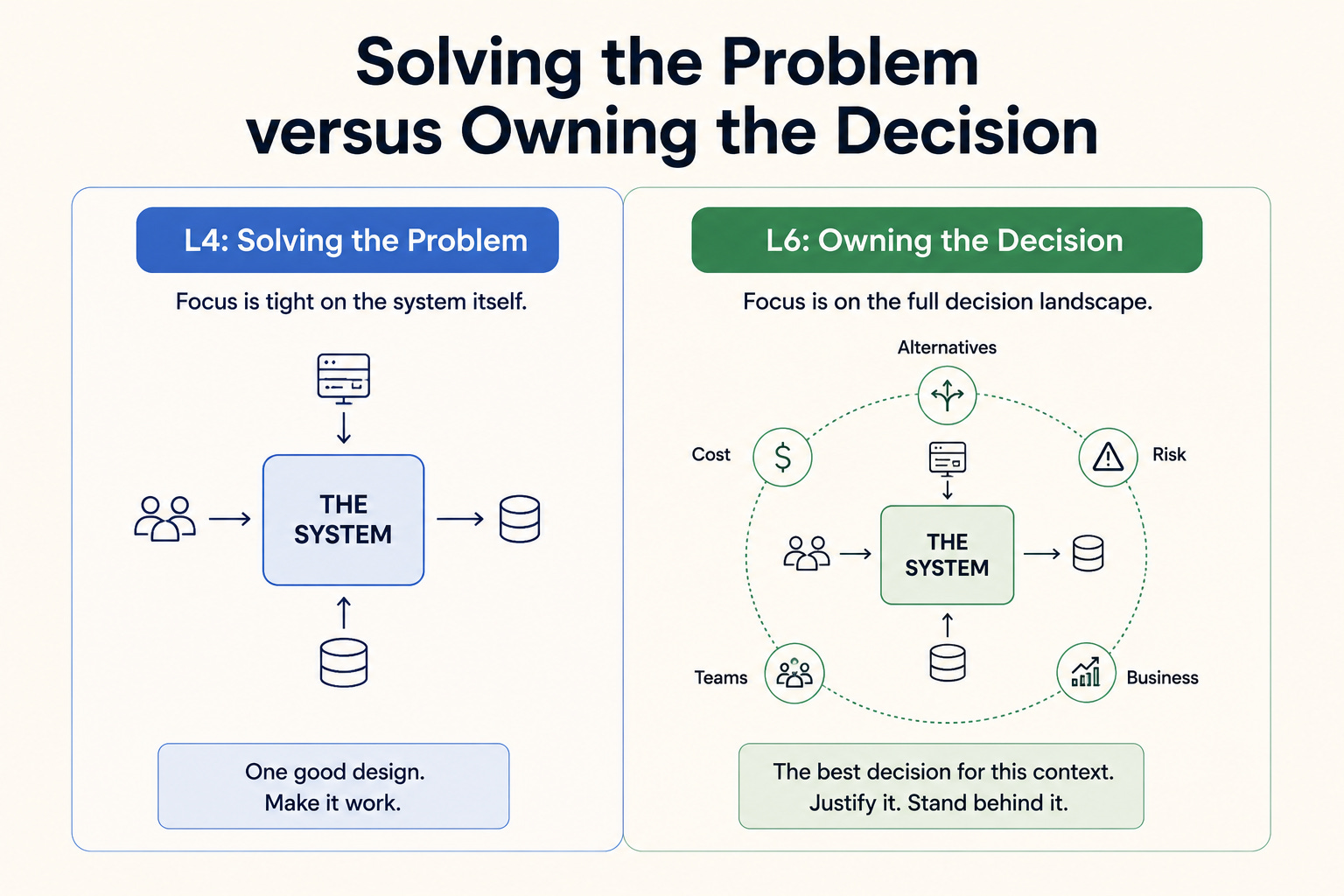
When a candidate moves from solving to owning, their requirements gathering changes, their design changes, their depth changes, and the dimensions they consider expand.
Understanding this shift is the key to understanding everything that follows.
Change 1: Requirements, From Understanding to Shaping
The first difference appears immediately, in how the candidate handles requirements. Both levels ask clarifying questions, but they ask them with different intent.
The L4 candidate asks questions to understand the problem. They want to know what the system should do so they can build it correctly.
Asked to design a notification system, they confirm the channels, the expected volume, and the basic features, then accept those answers and move on.
This is competent and appropriate for their level.
The L6 candidate asks questions to shape the problem. They are not just gathering information; they are defining what the problem actually is and what success means.
Asked to design the same notification system, they probe deeper.