
System Design Interview Question: Designing Uber in 45 Mins
Find out the complete 14-step process for designing Uber/Lyft in system design interviews. Covers an architecture that connects riders with drivers in real-time.

Here is a step-by-step system design for a ride-hailing platform like Uber or Lyft.
1. Problem Definition and Scope
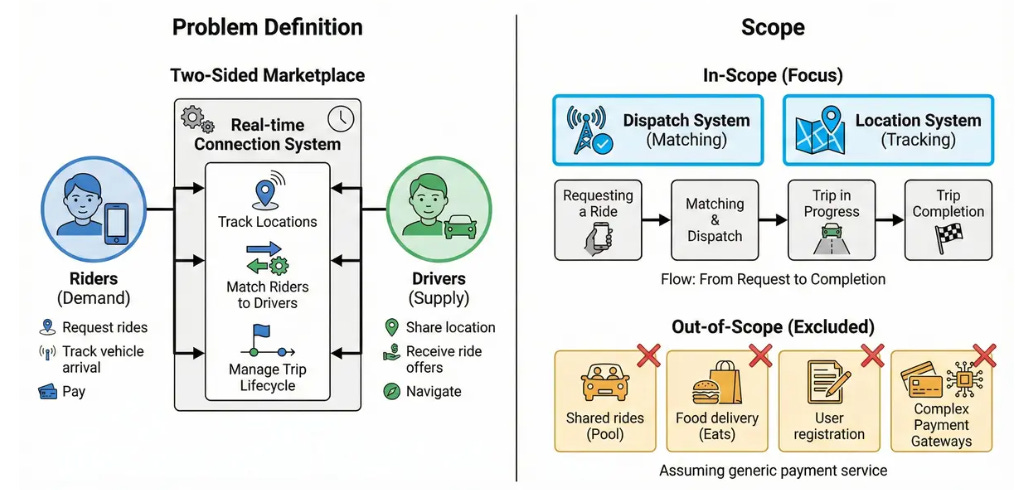
We are designing a two-sided marketplace that connects Riders (demand) with Drivers (supply) in real-time. The system must track driver locations, match riders to nearby drivers, and manage the trip lifecycle.
Main User Groups:
Riders: Request rides, track vehicle arrival, and pay.
Drivers: Share location, receive ride offers, and navigate.
Scope:
We will focus on the Dispatch System (Matching) and Location System (Tracking).
We will cover the flow from “Requesting a Ride” to “Trip Completion.”
Out of Scope: Shared rides (Pool), Food delivery (Eats), User registration, and complex Payment Gateways (we assume a generic payment service).
2. Clarify functional requirements
Must Have:
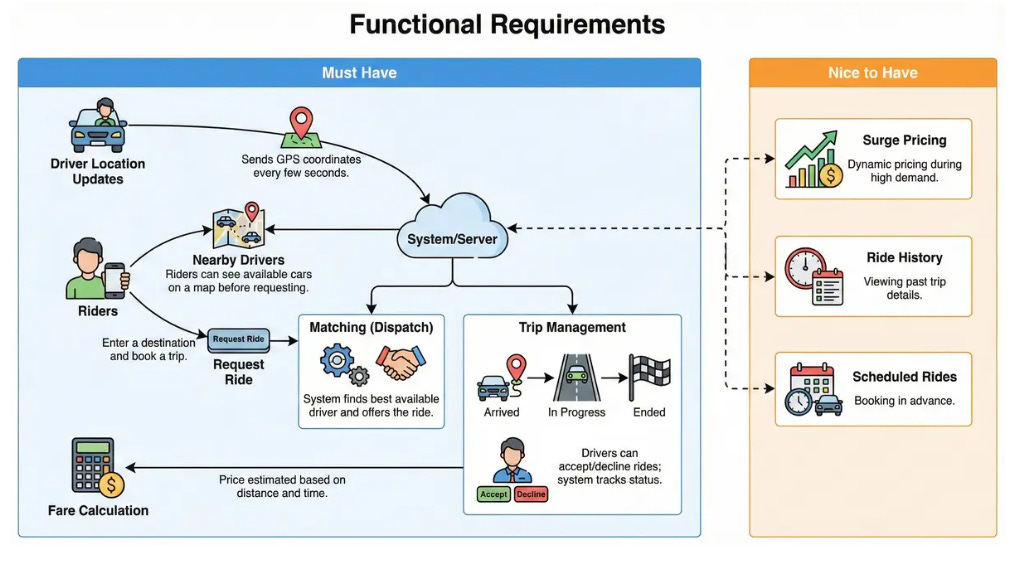
Driver Location Updates: Drivers send GPS coordinates every few seconds.
Nearby Drivers: Riders can see available cars on a map before requesting.
Request Ride: Riders can enter a destination and book a trip.
Matching (Dispatch): The system finds the best available driver and offers the ride.
Trip Management: Drivers can accept/decline rides; system tracks status (Arrived, In Progress, Ended).
Fare Calculation: Price is estimated based on distance and time.
Nice to Have:
Surge Pricing: Dynamic pricing during high demand.
Ride History: Viewing past trip details.
Scheduled Rides: Booking in advance.
3. Clarify non-functional requirements
Scale:
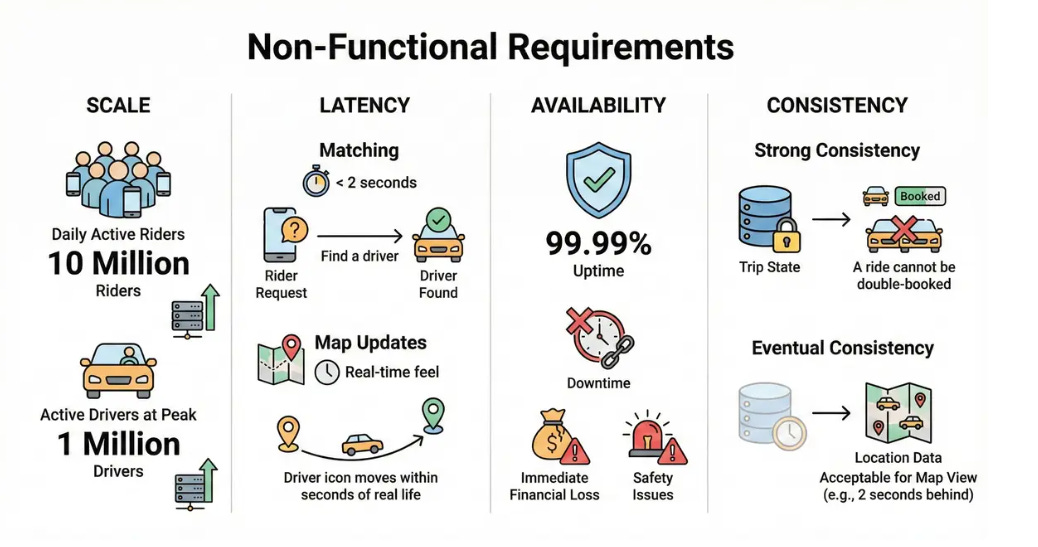
10 Million Daily Active Riders.
1 Million Active Drivers online at peak.
Latency:
Matching: < 2 seconds to find a driver.
Map Updates: Real-time feel (driver icon moves within seconds of real life).
Availability: 99.99%. Downtime causes immediate financial loss and safety issues.1
Consistency:
Strong Consistency: Required for Trip State (a ride cannot be double-booked).
Eventual Consistency: Acceptable for Location Data (if the map view is 2 seconds behind, it’s acceptable).
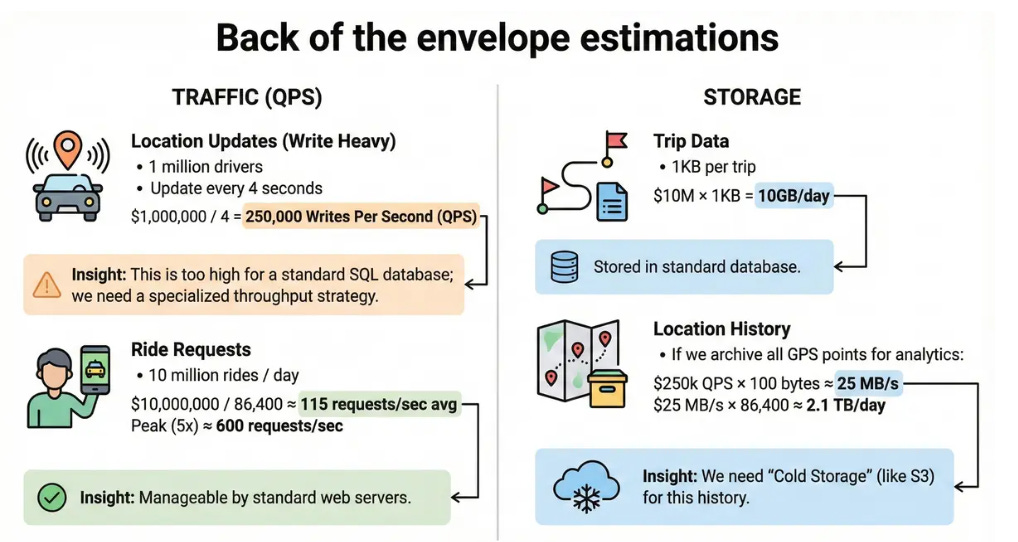
4. Back of the envelope estimates
Traffic (QPS):
Location Updates (Write Heavy):
1 million drivers.
Update every 4 seconds.
1,000,000 / 4 = 250,000 Writes Per Second (QPS).
Insight: This is too high for a standard SQL database; we need a specialized throughput strategy.
Ride Requests:
10 million rides / day.
10,000,000 / 86,400 ≈ 115 requests/sec avg.
Peak (5x) ≈ 600 requests/sec.
Insight: Manageable by standard web servers.
Storage:
Trip Data: 1 KB per trip. 10 M x 1 KB = 10 GB/day.
Location History: If we archive all GPS points for analytics:
250k QPS x 100 bytes ≈ 25 MB/s.
25 MB/s x 86,400 ≈ 2.1 TB/day.
We need “Cold Storage” (like S3) for this history.
5. API design
We use WebSockets for the high-frequency location stream and REST for transactional actions.
1. Update Location (Driver -> Server)
Protocol: WebSocket
Payload: { “lat”: 37.77, “lng”: -122.41, “status”: “available” }
Response: ACK
2. Request Ride (Rider -> Server)
Method: POST /v1/trips
Body: { “pickup_lat”: ..., “pickup_lng”: ..., “dest_lat”: ..., “service_type”: “standard” }
Response: { “trip_id”: “t123”, “status”: “matching”, “eta”: 5 }
3. Accept Ride (Driver -> Server)
Method: POST /v1/trips/{trip_id}/accept
Body: { “driver_id”: “d456” }
Response: 200 OK or 409 Conflict (if ride is no longer available).
4. Trip Status Update
Method: PATCH /v1/trips/{trip_id}
Body: { “status”: “picked_up” }
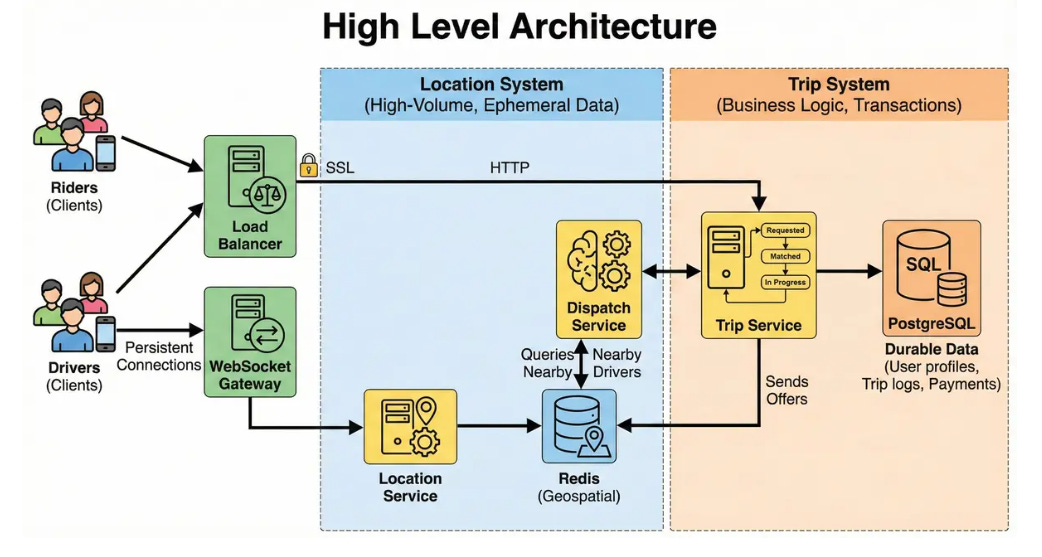
6. High-level architecture
We separate the system into two distinct parts: the Location System (handles high-volume, ephemeral data) and the Trip System (handles business logic and transactions).
Components:
Load Balancer: Routes HTTP requests and terminates SSL.2
WebSocket Gateway: Maintains persistent connections with millions of drivers.
Location Service: Ingests the 250k QPS stream. Updates the cache.
Redis (Geospatial): Stores the current location of every active driver.
Dispatch Service: The “Brain.” It queries Redis to find nearby drivers and sends offers.
Trip Service: Manages the state machine (Requested -> Matched -> In Progress) and writes to SQL.
PostgreSQL: Stores durable data (User profiles, Trip logs, Payments).
7. Data model
1. Primary Database (PostgreSQL)
Used for critical data requiring ACID guarantees.
Trips Table:
trip_id (PK)
rider_id (FK)
driver_id (FK) - Nullable initially
status (Enum: REQUESTED, MATCHING, IN_PROGRESS, COMPLETED, CANCELLED)
pickup_loc, dropoff_loc
fare
created_at, updated_at
Keep reading with a 7-day free trial
Subscribe to System Design Nuggets to keep reading this post and get 7 days of free access to the full post archives.