
How Much System Design Is “Enough” for a Junior Engineer
Don't get overwhelmed by complex system design. Learn the essentials for junior engineers: Client-Server architecture, SQL vs. NoSQL, Horizontal Scaling, Caching strategies, and Load Balancing.

This blog covers:
Defining junior engineer design expectations
Explaining core architectural components
Simplifying scalability and data flows
Navigating technical trade-offs effectively
The transition from an academic environment or a coding bootcamp to a professional engineering role involves a significant shift in perspective.
In a learning setting, the focus remains primarily on syntax, algorithmic efficiency, and getting a specific piece of logic to execute correctly. The scope is often limited to a single machine or a local environment.
However, professional software development operates on a different scale. It involves distributed systems where code runs across multiple servers, interacts with various databases, and serves thousands of concurrent users.
This shift creates a gap in knowledge regarding system design and architecture.
Many entry-level candidates feel overwhelmed by the vast array of technologies and architectural patterns listed in job descriptions.
There is a common misconception that a junior engineer must possess the ability to architect complex, global-scale systems from scratch. This leads to unnecessary stress and a lack of focus on the fundamentals that actually matter.
The industry expectation for a junior role is not mastery of distributed consensus or advanced sharding strategies. The expectation is functional literacy in the core components that make up a web application.
Defining the Expectation
System design is the process of defining the architecture, components, modules, interfaces, and data for a system to satisfy specified requirements.
For a junior engineer, the definition of “enough” knowledge centers on the ability to understand how these parts fit together.
The goal is to move beyond viewing software as isolated scripts. An engineer must understand that every line of code executes within a hardware environment that has physical limitations.
A junior engineer demonstrates competence by acknowledging these realities.
The requirement is to trace the path of a user’s request from the interface to the storage layer and back.
If a candidate can draw a simple diagram connecting a client, a server, and a database, and explain how data flows between them, they have met the baseline requirement. The focus should be on the breadth of the basic components rather than the depth of specific implementation details.
The Client-Server Model
The most critical architectural pattern to understand is the Client-Server model.
This is the structural foundation of the web and most distributed applications.
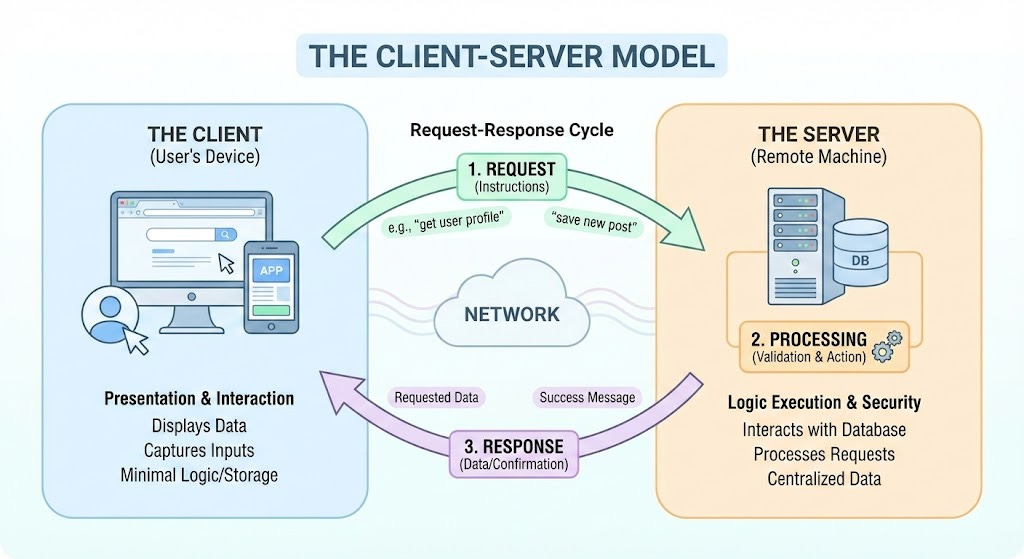
The Client
The client is the entry point for the user. It is the program that runs on the user’s device, such as a web browser or a mobile application.
The client is responsible for presentation. It displays data to the user and captures inputs. It typically does not process heavy business logic or store permanent data.
The Server
The server is a computer or a program running on a remote machine. It listens for requests from the client. When it receives a request, it executes the necessary logic, enforces security rules, and interacts with the database.
The Request-Response Cycle
The interaction between the client and the server happens through a request and a response.
Request: The client sends a message over the network. This message contains instructions, such as “get the user profile” or “save this new post.”
Processing: The server receives the message. It validates the request and performs the action.
Response: The server sends a message back to the client. This message contains the requested data or a confirmation of success.
Understanding this separation is vital. It highlights that the client and server are distinct entities that communicate over a network.
This introduces the possibility of communication failure, which is a key concept in system design.
Application Programming Interfaces (APIs)
The rules that govern the communication between the client and the server are defined by the API.
An API acts as a contract. It specifies exactly what requests the server can accept and exactly what the response will look like.
Keep reading with a 7-day free trial
Subscribe to System Design Nuggets to keep reading this post and get 7 days of free access to the full post archives.