
System Design Interview: Designing a File Synchronization Service (Dropbox)
Master the architecture of Dropbox & Google Drive. Learn how Block-Level Deduplication, SHA-256 Hashing, & Delta Sync enable instant file transfers. Understand the Metadata vs. Block Store separation.

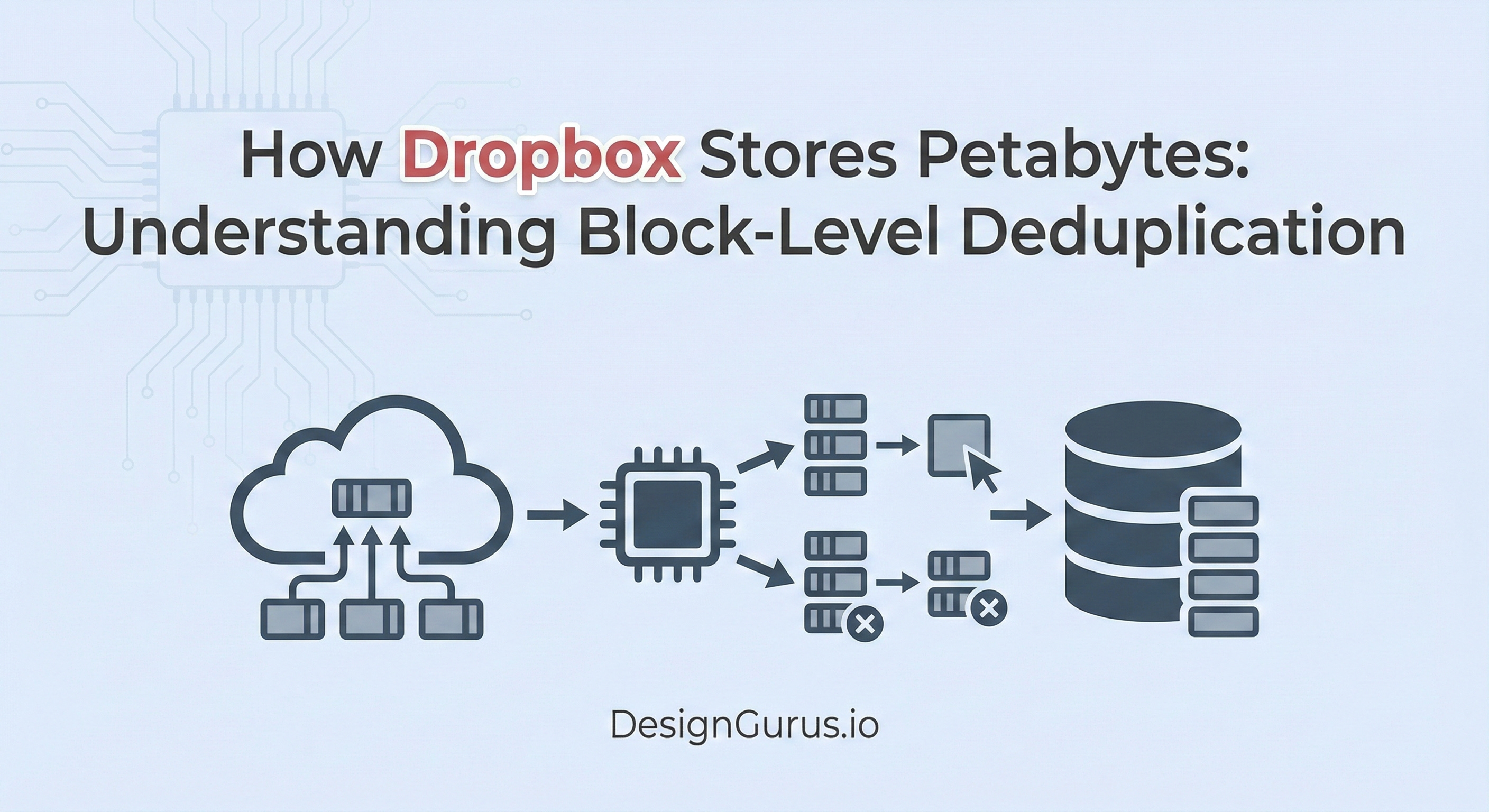
Digital storage is one of the most deceptively complex challenges in modern computing.
On the surface, the premise seems simple: a user drags a file into a folder, and it appears in the cloud.
For a small application with a hundred users, this is straightforward. You accept the file, write it to a disk, and you are done.
However, when you scale this logic to hundreds of millions of users, the engineering reality shifts dramatically.
We live in an era where 4K video, massive software binaries, and high-resolution design assets are the norm.
If a cloud storage provider simply stored every byte of data exactly as it was uploaded, the infrastructure costs would be astronomical. The network congestion would make the service unusable.
To build a system capable of syncing petabytes of data efficiently, engineers cannot simply buy more hard drives. They must design smarter software. They rely on a concept called deduplication. Specifically, Dropbox and similar systems utilize a technique known as Block-Level Deduplication.
This architecture is the backbone that allows for instant file sharing and efficient storage management.
This guide will walk you through the mechanics of this system, explaining how files are broken down, how uniqueness is identified, and how a distributed system avoids storing the same data twice.
The Core Problem: Redundancy at Scale
Before we analyze the solution, we must understand the specific bottleneck that this architecture solves.
In a massive distributed system, data redundancy is not an accident; it is a guarantee. Consider a scenario where a popular movie trailer is released.
Let’s say this file is named “Batman.mp4” and has a file size of exactly 2GB.
User A downloads this file and saves it to their Dropbox folder. The sync engine on their laptop reads the file and uploads the 2GB of data to the server. The server writes 2GB to its physical storage.
Keep reading with a 7-day free trial
Subscribe to System Design Nuggets to keep reading this post and get 7 days of free access to the full post archives.