
Google System Design Interview: What Changed, What They Ask, and How to Pass
Learn what Google's system design interview looks like in 2026. Discover real questions, scoring criteria, and a proven 4-week prep plan for beginners.

This blog will explore:
Google’s updated 2026 interview format
Real system design questions asked
Five scoring dimensions explained simply
How to prepare in four weeks
Google’s system design interview (SDI) remains one of the most demanding technical assessments in the industry, and it has undergone significant changes since 2024.
The biggest shift: Google is returning to in-person interviews in 2026 to combat AI-assisted cheating, while simultaneously introducing a new pre-interview screening tool (the Google Hiring Assessment) and increasingly weaving AI/ML system design questions into the loop.
The core format, a 45-minute collaborative deep dive into a single complex design problem, remains intact, but the evaluation bar, question trends, and process mechanics have all evolved.
This guide synthesizes insights from ex-Google interviewers (with 200+ interviews conducted), recent candidate reports, and top prep platforms to give you every advantage.
The Format: 45 minutes, one problem, five phases
Each Google SDI round lasts 45 minutes and centers on a single open-ended design problem (e.g., “Design YouTube” or “Design Google Maps”).
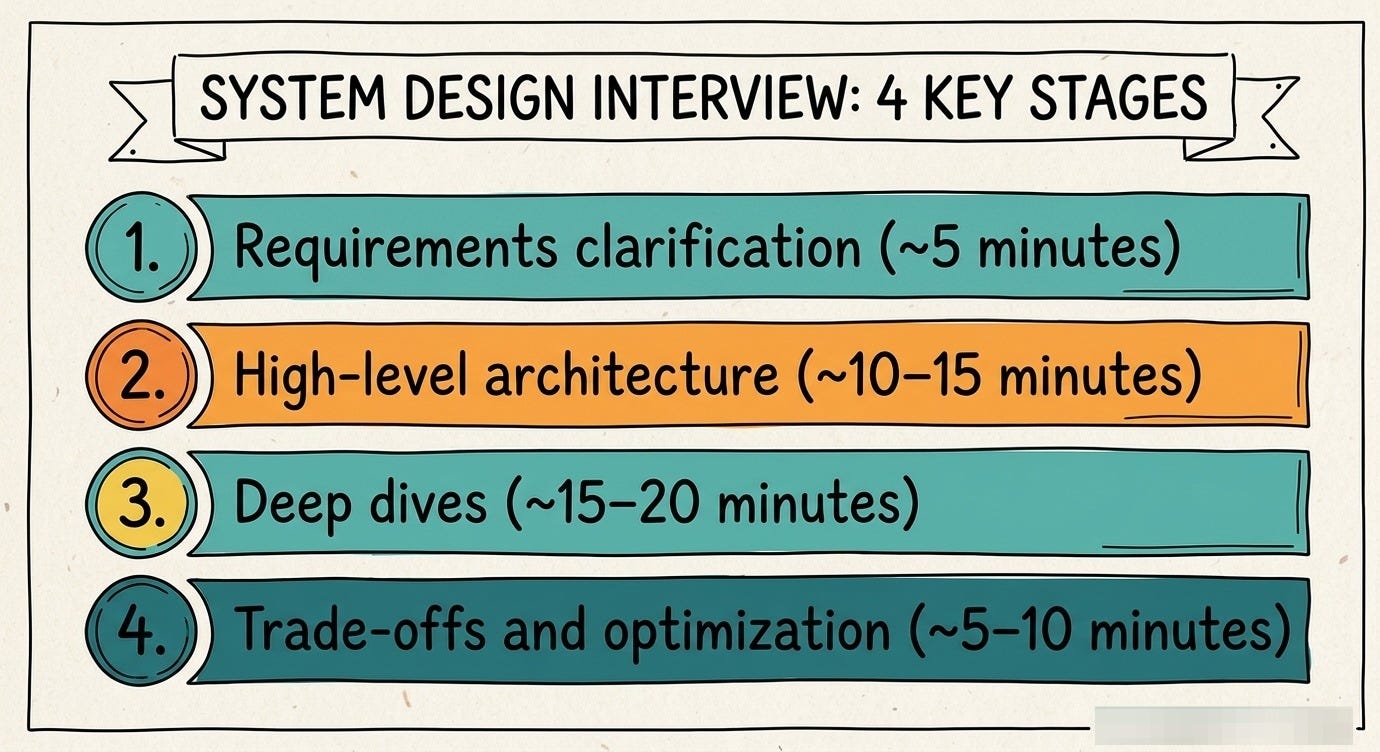
The interview follows a predictable arc:
Requirements clarification (~5 minutes) opens the session. You ask targeted questions about functional requirements, non-functional requirements (latency, availability, consistency), scale, and constraints. Ex-Google interviewer Miguel F. (17 years at Google, 200+ interviews) emphasizes that spending these first minutes defining scope is non-negotiable.
High-level architecture (~10–15 minutes) follows. You sketch major components like load balancers, application servers, databases, caches, message queues, and explain data flow end-to-end. Google interviewers use shared Google Docs (now with syntax highlighting in some regions) or physical whiteboards for onsite rounds.
Deep dives (~15–20 minutes) consume the interview’s core. The interviewer probes 1–2 specific areas: database sharding strategy, cache eviction logic, consistency model trade-offs, or fault tolerance mechanisms. This is where level expectations diverge sharply; L5 candidates discuss scaling and data flow, while L6+ candidates must demonstrate mastery of distributed consensus, operational concerns, and production reliability.
Trade-offs and optimization (~5–10 minutes) and a brief wrap-up round out the session. Interviewers often introduce new constraints mid-interview, “Now assume traffic doubles overnight”, to test adaptability.
The number of SDI rounds depends on level.
L3 candidates face no system design. L4 engineers sometimes choose between three coding rounds or two coding rounds plus one SDI.
L5 (Senior) gets one mandatory SDI round. L6+ (Staff and above) face two to three SDI rounds of increasing complexity.
The full onsite loop typically includes 4–5 rounds total: 2–3 coding, 1+ system design, and 1 “Googleyness & Leadership” behavioral round.
What Changed in 2024–2026: In-person Returns and AI Enters the Loop
The most consequential process change arrived in early 2025: Google is reintroducing at least one in-person interview round for software engineering candidates.
A second major addition is the Google Hiring Assessment (GHA), a personality and situational judgment test (no coding) now required for all candidates, including L6 Staff engineers, before live interviews.
Keep reading with a 7-day free trial
Subscribe to System Design Nuggets to keep reading this post and get 7 days of free access to the full post archives.