
Event-Driven Architecture 101: Decoupling Systems for Scale
Master Event-Driven Architecture with Apache Kafka. Learn the limitations of synchronous REST APIs, understand Kafka internals like Topics, Partitions, and Offsets, and ensure reliability.

Software architectures often evolve from simple, singular applications into complex networks of interacting services.
In the early stages of development, direct communication between components is efficient and easy to manage.
However, as a system expands to handle higher loads and more complex business logic, this direct interaction creates rigid dependencies.
A failure in one service can propagate through the entire network, causing a total system outage.
To solve these scalability and reliability challenges, engineers adopt Event-Driven Architecture. This approach fundamentally shifts how data moves through a system, prioritizing asynchronous information sharing over direct command execution.
The Limitations of Synchronous Systems
Traditional software design often relies on synchronous communication.
In this model, one service sends a request to another service and pauses its execution while waiting for a response. This pattern mimics a standard function call in programming. It is intuitive and easy to trace.
However, this model introduces tight coupling.
If Service A calls Service B, Service A cannot function without Service B. This dependency creates a chain.
If a transaction requires calls to four different services, the latency of the transaction becomes the sum of all four calls. Furthermore, the reliability of the system drops significantly.
If any single service in that chain fails or times out, the entire operation fails.
High-traffic scenarios exacerbate these issues.
A sudden spike in user activity triggers a massive number of simultaneous requests.
If the downstream services cannot handle the volume, they become overwhelmed and crash. The synchronous nature of the system means the upstream services will also stall, consuming resources while waiting for responses that will never arrive. This phenomenon is known as cascading failure.
Understanding Event-Driven Architecture
Event-Driven Architecture (EDA) addresses these limitations by decoupling the services.
In an event-driven system, services do not send requests to specific destinations. Instead, they emit “events.”
An event is a data record indicating that a state change has occurred. It is a historical fact. For example, “Order Placed” or “User Registered” are events.
The service that creates the event is called the Producer.
The Producer sends this event to a central intermediary. It does not know which services will read the event, nor does it wait for a response. Its responsibility ends once the event is successfully dispatched.
Other services, known as Consumers, listen to the intermediary.
When an event appears, the Consumer reads it and executes its own logic. This might involve updating a local database, sending an email, or triggering another process.
This architecture breaks the temporal dependency between services.
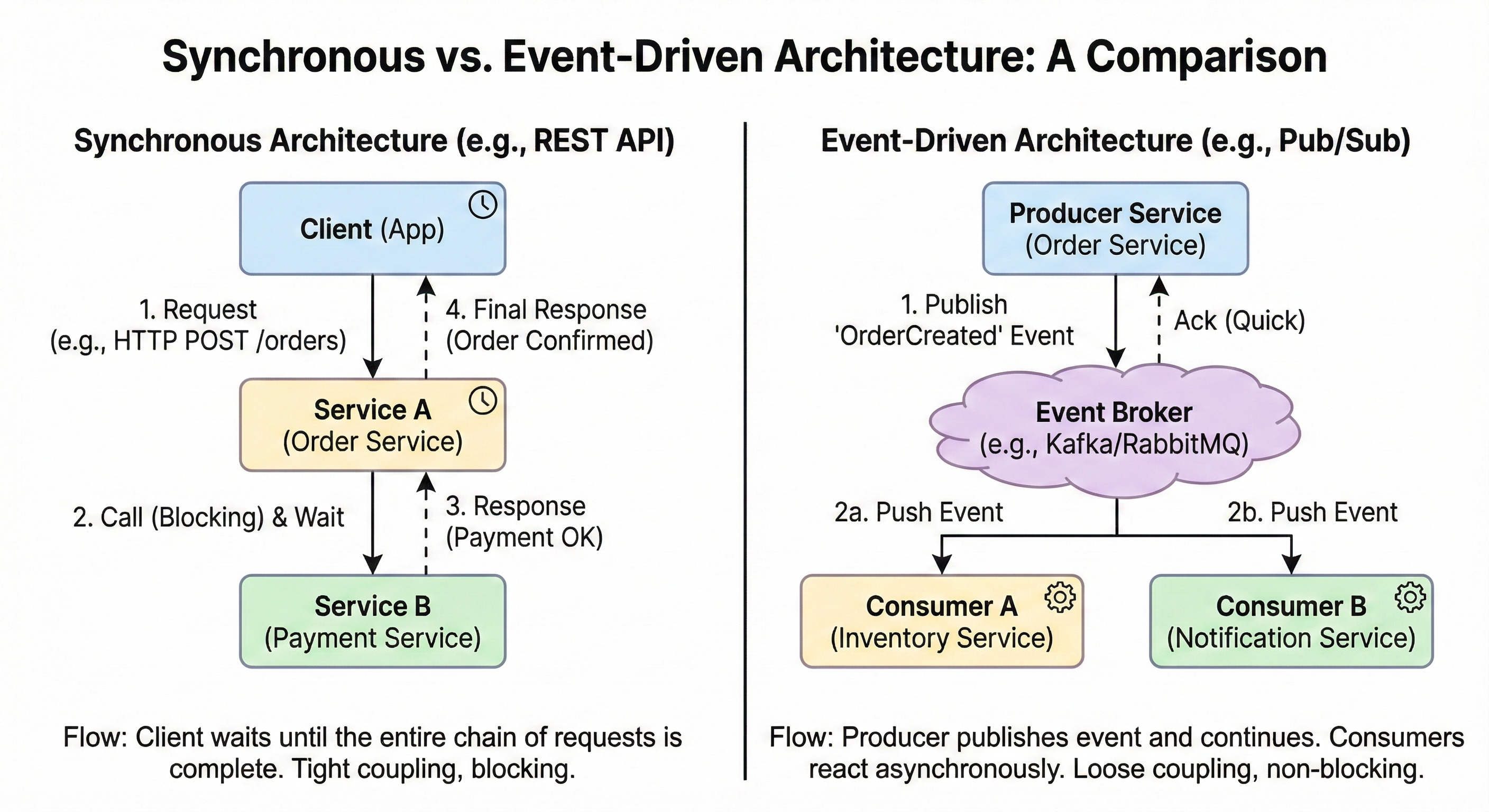
The Producer and Consumer do not need to be online at the same time. The Producer can generate events at a high speed, and the Consumer can process them at its own pace.
If the Consumer goes offline for maintenance, the events simply accumulate in the intermediary until the Consumer returns.
Apache Kafka: The Backbone of EDA
The most widely adopted tool for implementing this architecture is Apache Kafka. While often categorized as a message queue, Kafka is technically a distributed event streaming platform.
Keep reading with a 7-day free trial
Subscribe to System Design Nuggets to keep reading this post and get 7 days of free access to the full post archives.