
Event-Driven Architecture: Choreography vs. Orchestration
Compare the structural differences of request-response models versus publish-subscribe models in system design.

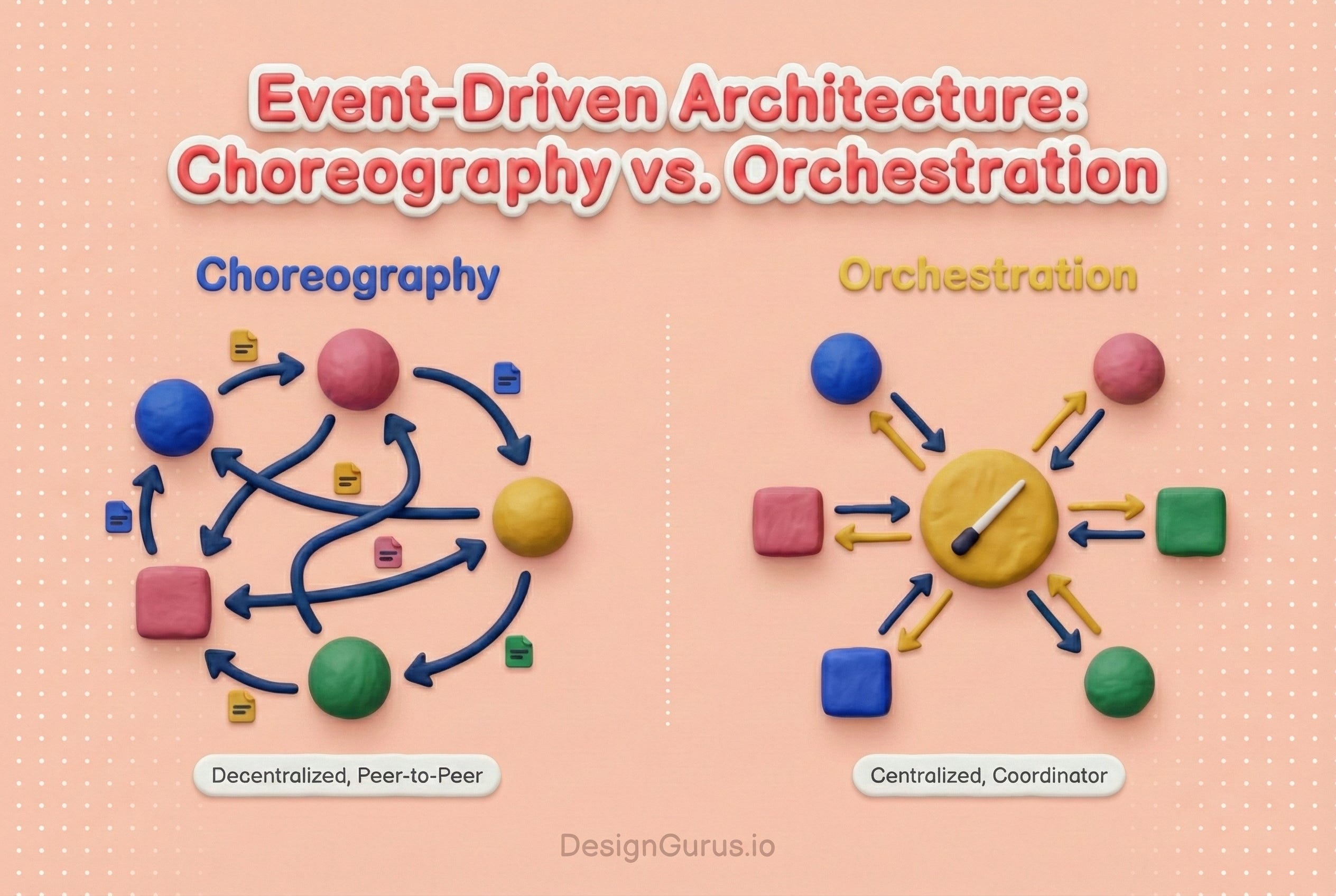
Modern software architecture has evolved from single, monolithic applications into distributed networks of independent services. While this shift enables teams to scale and deploy code faster, it introduces a fundamental challenge: data consistency.
In a traditional application using a single database, a business process is atomic.
If a user performs an action that requires multiple updates, the database ensures that either all updates happen, or none of them do.
If an error occurs halfway through, the database automatically rolls back the changes, leaving the system in a clean state.
In a distributed system, this safety net does not exist. A single business process might span three different services, each with its own private database.
If the first service succeeds but the second service fails, the system enters an inconsistent state.
The first database cannot “roll back” because it does not know the second database failed.
To solve this, engineers must design a mechanism to coordinate these distributed actions. There must be a clear strategy for how services communicate, how the workflow advances, and, most importantly, how the system recovers when something goes wrong.
The two primary patterns for managing this coordination are Orchestration and Choreography.
Understanding the distinction between these two approaches is critical. The choice impacts not only the code complexity but also the observability, scalability, and reliability of the entire platform.
The Core Mechanisms
Before comparing the patterns, it is necessary to define the basic modes of communication used in distributed systems.
The difference between Orchestration and Choreography is largely defined by whether the services communicate via Commands or Events.
Commands (Imperative)
A command is a direct instruction. Service A sends a message to Service B that explicitly states, “Perform Action X.”
Intent: The sender wants a specific result.
Dependency: The sender must know the identity and location of the receiver.
Expectation: The sender usually expects a response (success or failure) to know if the instruction was carried out.
Events (Declarative)
An event is a statement of fact. Service A broadcasts a message that states, “Action X has happened.”
Intent: The sender is simply notifying the system of a state change.
Dependency: The sender does not know who receives the message.
Expectation: The sender does not wait for a response. It assumes interested parties will react if necessary.
Orchestration relies heavily on Commands. Choreography relies heavily on Events.
Orchestration: The Central Coordinator
Orchestration is a centralized approach to workflow management.
In this architecture, a specific service is designated as the Orchestrator (or Workflow Engine). This service owns the business logic for the entire process. It is responsible for instructing other services on what to do and when to do it.
How It Works Behind the Scenes
In an orchestrated workflow, the worker services (e.g., Payment Service, Inventory Service) are passive. They do not initiate actions on their own; they wait for instructions.
Trigger: The process begins when the Orchestrator receives a request.
State Management: The Orchestrator creates a persistent record of the transaction execution. It knows that the process involves Step 1, Step 2, and Step 3.
Command Execution: The Orchestrator sends a synchronous command to the first service (Service A).
Waiting: The Orchestrator waits for Service A to return a success response.
Progression: Upon receiving success, the Orchestrator updates its internal state and sends the next command to Service B.
Completion: This cycle continues until the workflow is finished.
If we apply this to a hypothetical “Order Processing” workflow: The Order Service (acting as the Orchestrator) receives a checkout request. It explicitly calls the Payment Service API. It waits for a 200 OK response.
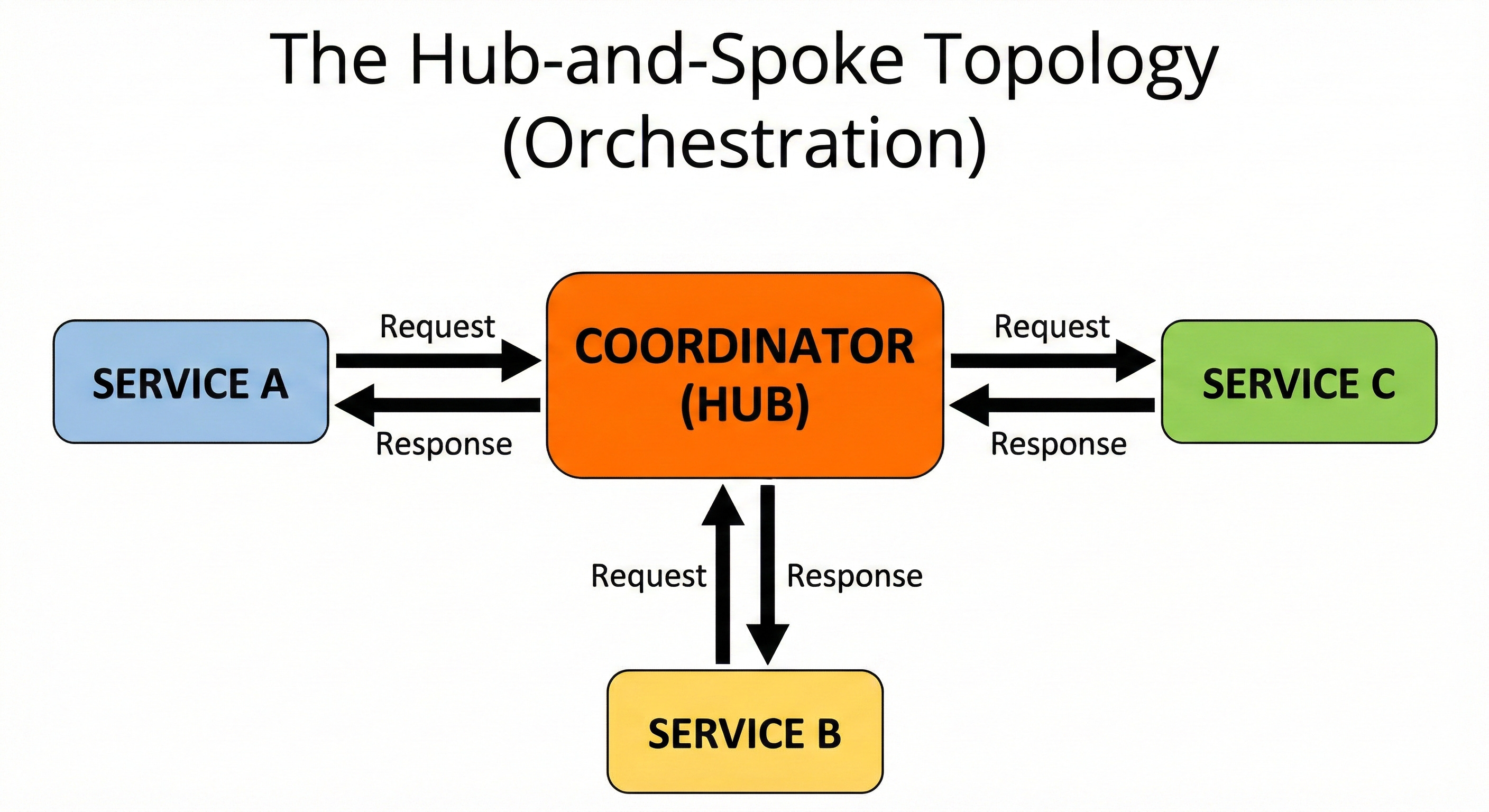
Then, it explicitly calls the Inventory Service API to deduct stock.
The logic “If Payment Success, Then Deduct Stock” lives entirely inside the Order Service.
Advantages of Orchestration
Centralized Visibility
The primary benefit of this pattern is clarity. Because the workflow state is managed in one place, monitoring the system is straightforward.
Keep reading with a 7-day free trial
Subscribe to System Design Nuggets to keep reading this post and get 7 days of free access to the full post archives.