
How to Keep Data Consistent Across Serverless Functions (Without Database Locks)
Master the complexities of distributed transactions without relying on traditional central database locks for modern system design.

Building highly scalable software introduces severe architectural hurdles regarding data accuracy.
When an application separates computing logic into tiny isolated pieces, maintaining a unified state becomes exceptionally difficult. The primary issue occurs when a single operation requires updating multiple independent storage systems simultaneously.
If a network drops unexpectedly during this process, the software enters a severely fractured state. One component successfully records new information, while another component remains stuck with outdated information.
This silent data corruption destroys application reliability over time. Resolving these partial failures without relying on centralized holding mechanisms is the most complex hurdle in modern engineering.
Understanding how to synchronize scattered information is absolutely critical for building resilient cloud infrastructure.
Without this foundational knowledge, scalable applications will inevitably suffer from catastrophic data fragmentation.
The Illusion of Single Database Safety
In traditional software design, applications operate as a single unified block of code.
This block connects directly to one massive central database. When the software needs to update multiple tables of information, it relies on a built in safety mechanism.
This mechanism is called a database transaction.
A database transaction ensures that a group of data updates either succeeds completely or fails completely. There is absolutely no middle ground allowed.
This strict all or nothing rule is part of a framework known as ACID properties.
ACID stands for Atomicity, Consistency, Isolation, and Durability.
When a transaction begins, the database engine physically locks the specific rows of data being modified.
No other part of the software can touch those rows until the transaction finishes.
If any single update inside the group fails, the database automatically cancels everything. It discards the temporary changes and perfectly restores the original data to maintain absolute accuracy.
Why Serverless Architecture Breaks Traditional Rules
Modern cloud engineering intentionally dismantles this centralized monolithic structure.
Developers split the application into hundreds of tiny independent scripts called serverless functions. These functions spin up on demand, execute a specific task, and immediately shut down.
To maintain total independence, these functions cannot share a single massive database.
Instead, every individual function connects to its own private database.
This complete physical separation removes the central database engine from the architecture entirely.
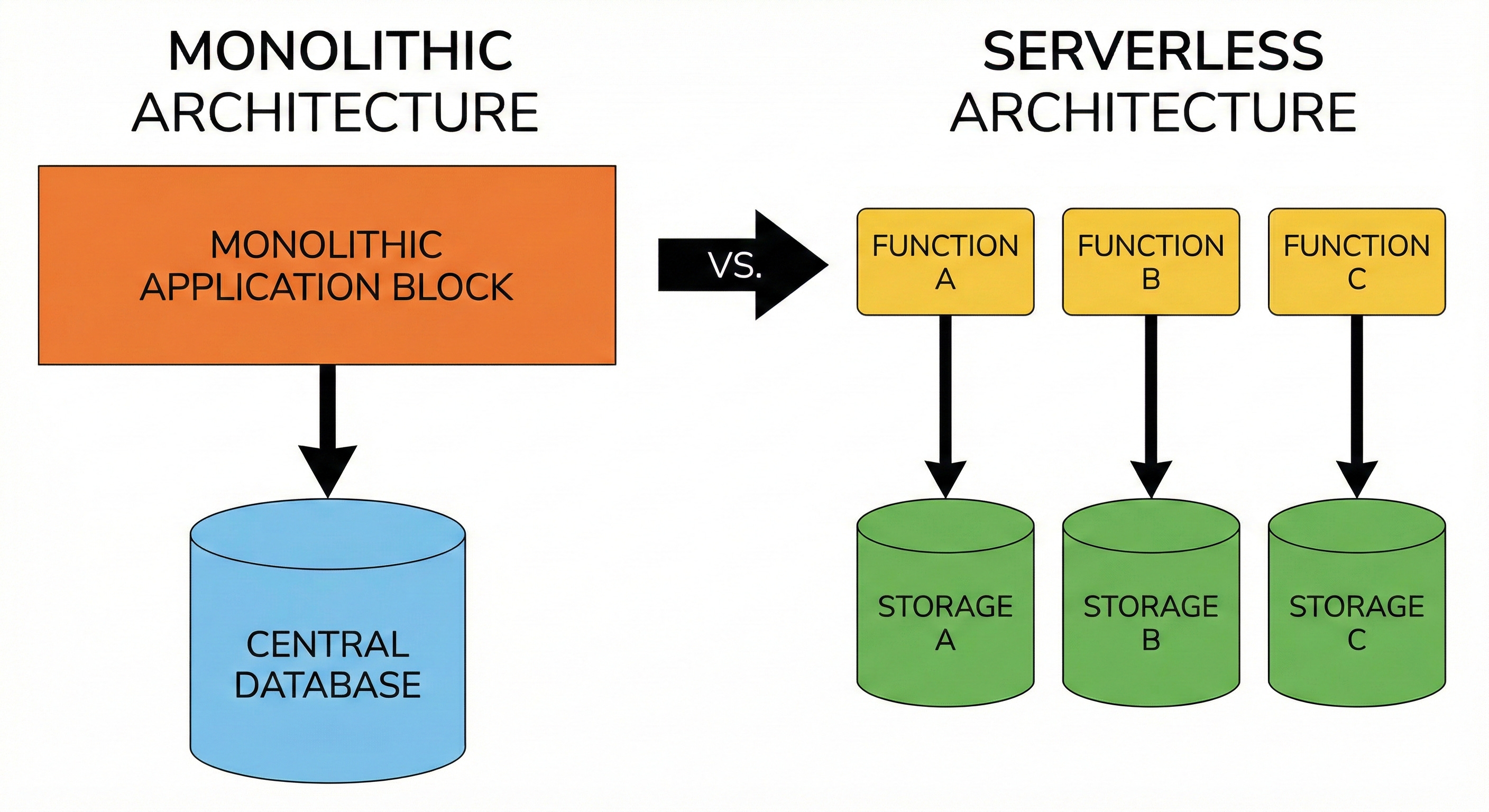
Without a central engine, the automatic safety mechanisms of traditional transactions disappear completely.
Historically, distributed systems tried to solve this using the Two Phase Commit protocol. This software protocol relies on a central coordinator to lock multiple remote databases simultaneously. The coordinator asks every separate database if it is ready to accept a new update.
If every database replies with a confirmation, the coordinator commands them all to save the data at the exact same moment.
This locking protocol completely fails in a serverless environment.
Serverless applications are designed to process thousands of simultaneous requests at massive speed.
If a system locks a database over a network while waiting for another service, traffic instantly backs up.
Furthermore, cloud providers enforce strict maximum time limits on serverless execution.
A function holding a network lock might simply time out and shut down, leaving the entire database permanently frozen.
Embracing Eventual Consistency
Because holding network locks causes catastrophic performance failures, engineers must adopt a completely different mindset. Developers must stop demanding immediate mathematical perfection across all databases.
Instead, the architecture must embrace eventual consistency.
Keep reading with a 7-day free trial
Subscribe to System Design Nuggets to keep reading this post and get 7 days of free access to the full post archives.