
Complete Proxy Server/VPN/Reverse Proxy Guide for System Design Interviews [2026 Edition]
Master the technical differences between forward proxies, reverse proxies, and encrypted tunnels to ace your next system design interview.


Unrestricted network traffic causes catastrophic failures for large software applications. Exposing backend databases directly to the public internet invites immediate malicious network attacks.
Hackers write automated scripts to constantly scan unprotected machines for open network vulnerabilities.
A single unexpected spike in legitimate web traffic also easily overwhelms an unprotected application.
Intermediary networking layers solve these severe structural vulnerabilities entirely. These dedicated servers sit perfectly between the local network and the public internet. They inspect every single data packet before securely forwarding it to the final destination.
Understanding how these servers route data remains strictly critical for building scalable software systems.
The Foundation of Network Communication
Before we explore complex architectural designs, we must understand how basic computers communicate. Every device connected to the internet requires a unique numerical identifier called an IP address.
This specific address allows other computers to know exactly where to send digital information. When a client device wants to access a website, it must know the destination address.
Data travels across the internet in small, formatted chunks called network packets.
A standard network packet contains the actual data payload and a routing header. The routing header clearly lists the source IP address and the destination IP address. In a basic direct connection, the client sends this packet straight to the destination server.
The destination server receives the packet and reads the exact source IP address. It processes the required data and sends a response back to that specific client address.
This direct communication model functions perfectly well for tiny local networks. However, this direct model completely fails when we attempt to build massive global applications.
The Problem with Direct Connections
Direct network connections lack the basic privacy and scalability required for modern software.
When a client connects directly, it exposes its physical network location to the public server. When a server accepts direct connections, it exposes its internal structure to the entire internet.
This mutual exposure creates massive security risks for both the user and the system.
A single backend server also has strict physical limitations regarding processing power and memory. It can only handle a specific number of direct connections before its hardware fails completely.
When traffic exceeds this physical limit, the server simply drops new connections and goes offline.
We prevent these devastating failures by introducing specialized intermediary servers into our network architecture.
Understanding Forward Proxy Servers
A forward proxy is a dedicated intermediary server that protects local client devices. It sits directly between a private local network and the massive public internet.
Instead of sending requests directly to a public website, client devices connect to the forward proxy.
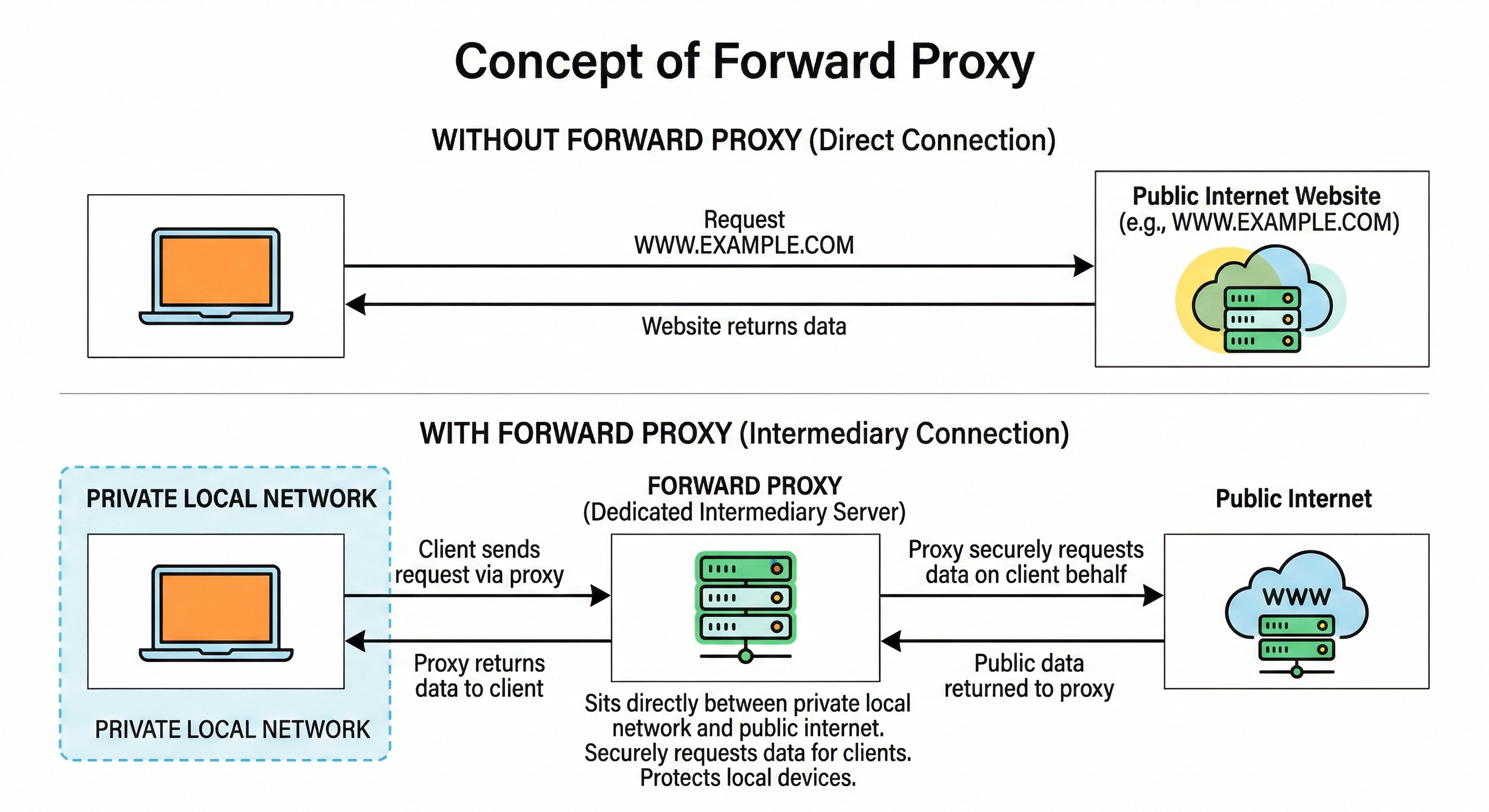
The forward proxy then securely requests the internet data on behalf of the client.
The Internal Mechanics of Forward Proxies
Let us examine exactly how a forward proxy handles a standard network request. The client device formats a standard data packet intended for a public web server.
The local network strictly routes this packet to the internal forward proxy server.
The forward proxy intercepts the packet and carefully inspects the external destination address.