
Amazon System Design Interviews: The LP Angle Nobody Mentions
Amazon system design interviews secretly test Leadership Principles in every round. Learn the LP angle most candidates miss and how to use it in 2026.

This blog covers:
Leadership Principles in system design
Hidden LP evaluation during interviews
Common mistakes that silently fail
Phase-by-phase LP integration framework
Most candidates fail Amazon’s system design rounds for reasons that have nothing to do with architecture. They draw flawless diagrams, nail the scalability discussion, and walk out confident, then get rejected with feedback citing “Ownership” or “Customer Obsession.”
The secret?
Amazon evaluates Leadership Principles in every single round, including system design.
There is no purely technical interview at Amazon.
Each interviewer is assigned 1–3 specific LPs to assess, and the system design interviewer is no exception.
Understanding this hidden evaluation layer is the single biggest edge you can gain in Amazon interview preparation.
Amazon’s System Design Loop in 2025 Isn’t What You Think
Amazon’s interview pipeline follows a well-established structure: an online assessment, a technical phone screen, and an on-site loop of four to five 55-minute interviews conducted virtually via Amazon Chime and Bluescape (their virtual whiteboard tool).
For SDE-2 (L5), expect at least one dedicated system design round.
For SDE-3 (L6), system design carries even more weight. L6 loops typically include five rounds: two coding, one system design, one object-oriented design or project deep-dive, and one Bar Raiser behavioral round.
But here’s what the format descriptions miss: Amazon doesn’t have a clean separation between “technical” and “behavioral” rounds. As experts guide, technically, there is no such thing as an ‘LP round.’ Amazon assesses you on their LPs throughout the entire interview loop.
Your system design interviewer will ask 1–2 explicit LP behavioral questions and simultaneously evaluate implicit LP signals throughout your technical discussion.
One critical structural element is the Bar Raiser, a senior Amazonian from outside the hiring team with veto power over the hiring decision.
A candidate with technical gaps but exceptional leadership signals can get hired.
The reverse is not true.
Every Design Decision Maps to a Leadership Principle
The power of understanding LP alignment isn’t about name-dropping principles during your interview; that reads as performative and inauthentic.
Instead, it’s about making design decisions that naturally demonstrate the thinking Amazon values.
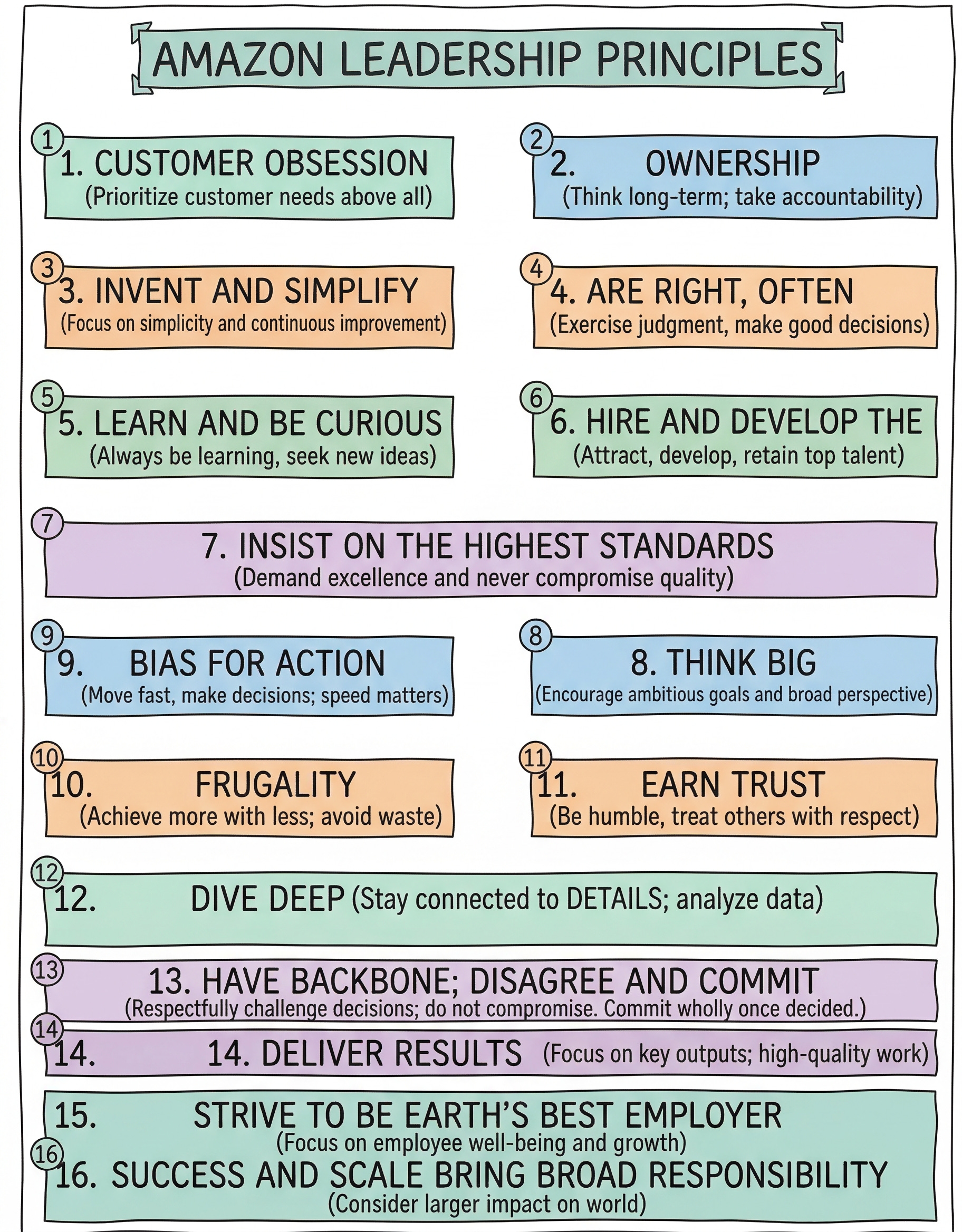
Here’s how six critical principles map directly to system design choices.
Customer Obsession surfaces in the first five minutes. Before drawing a single box, strong candidates ask: “Who are the users? What latency do they expect? Are we optimizing for reads or writes?” Candidates who skip requirement clarification and jump straight into architecture commit one of the most commonly cited mistakes, and simultaneously fail the most important LP.
Ownership is where most candidates unknowingly lose points. Amazon’s engineering culture runs on “you build it, you run it.” When you finish drawing your architecture and stop, you’ve left out half the design. Strong candidates close with monitoring, alerting, deployment strategy, and failure recovery.
Discussing CloudWatch dashboards tracking error rates, automated rollbacks for failed deployments, and on-call runbooks signals that you think like an Amazon engineer who owns the full lifecycle of their system.
Frugality shows up in every architectural choice. Amazon interviewers want to hear cost trade-off reasoning, not just performance optimization.
One pattern that interviewers reportedly love: data tiering; hot data in Redis, warm data in DynamoDB, cold data in S3. This single design pattern simultaneously demonstrates Frugality and Dive Deep.
Rather than proposing a uniformly expensive storage layer, you’re showing constraint-driven thinking.
As Amazon’s own LP definition states: “Constraints breed resourcefulness, self-sufficiency, and invention.”
Dive Deep and Think Big are what Amazon interviewers call “friendly foes.” An Amazon interviewer quoted on AboutAmazon.com explains: “You can dive so deep that you lose sight of the bigger picture. The tension between certain principles is completely intentional.”
Keep reading with a 7-day free trial
Subscribe to System Design Nuggets to keep reading this post and get 7 days of free access to the full post archives.