
A Guide to Engineering Careers in Big Tech [2026 Edition]
Crack the code of Big Tech career growth. Learn the difference between Senior, Staff, and Principal engineers, master the "Y-Shaped" path, and discover why System Design is the key to success.


Landing a job at a major tech company is a massive achievement, but it is only the entry fee.
Once you have the badge and the desk, you are immediately confronted with a confusing hierarchy of titles like “Staff,” “Principal,” and “Distinguished Engineer.” You quickly realize that the skills you used to pass the interview are not the same ones required to build a long-term career.
There is a terrifying realization that hits many engineers: knowing how to code does not mean you know how to build a career.
Many junior developers believe growth happens automatically; that if they write enough code and fix enough bugs, leadership roles will naturally follow. This is a misconception that leads to the “Invisible Ceiling.”
In Big Tech, the career path is not a straight line based on tenure. It is a complex branching system with different rules, expectations, and metrics for every single level.
Understanding this system is the difference between stagnating at the same level for five years or rising to become a technical leader who shapes software for millions of users. If you do not understand the map, you cannot climb the mountain.
This guide will break down exactly how these career paths work. We will look at what is expected at each stage and how the game changes as you level up.
Let’s get started.
The Core Concept: The Y-Shaped Career Path
Before we talk about levels, we need to talk about direction.
In most traditional industries, “moving up” means becoming a manager. You start doing the work, and eventually, you manage the people doing the work.
In Big Tech, it works differently. They use something called the Dual Track or the Y-Shaped Path.
Imagine the letter Y.
You start at the bottom.
As you grow, you reach a fork in the road.
The Left Path (Management)
You stop coding and start managing people. This is not a promotion. It is a career change. Your job becomes hiring, firing, and unblocking your team.3
The Right Path (Individual Contributor (IC))
You keep coding and designing systems. You do not manage people. This is the path for builders.
This is very important to understand. You do not have to become a manager to make more money or have more status. A Principal Engineer (high up on the IC track) often makes as much money as a Director. They are peers.
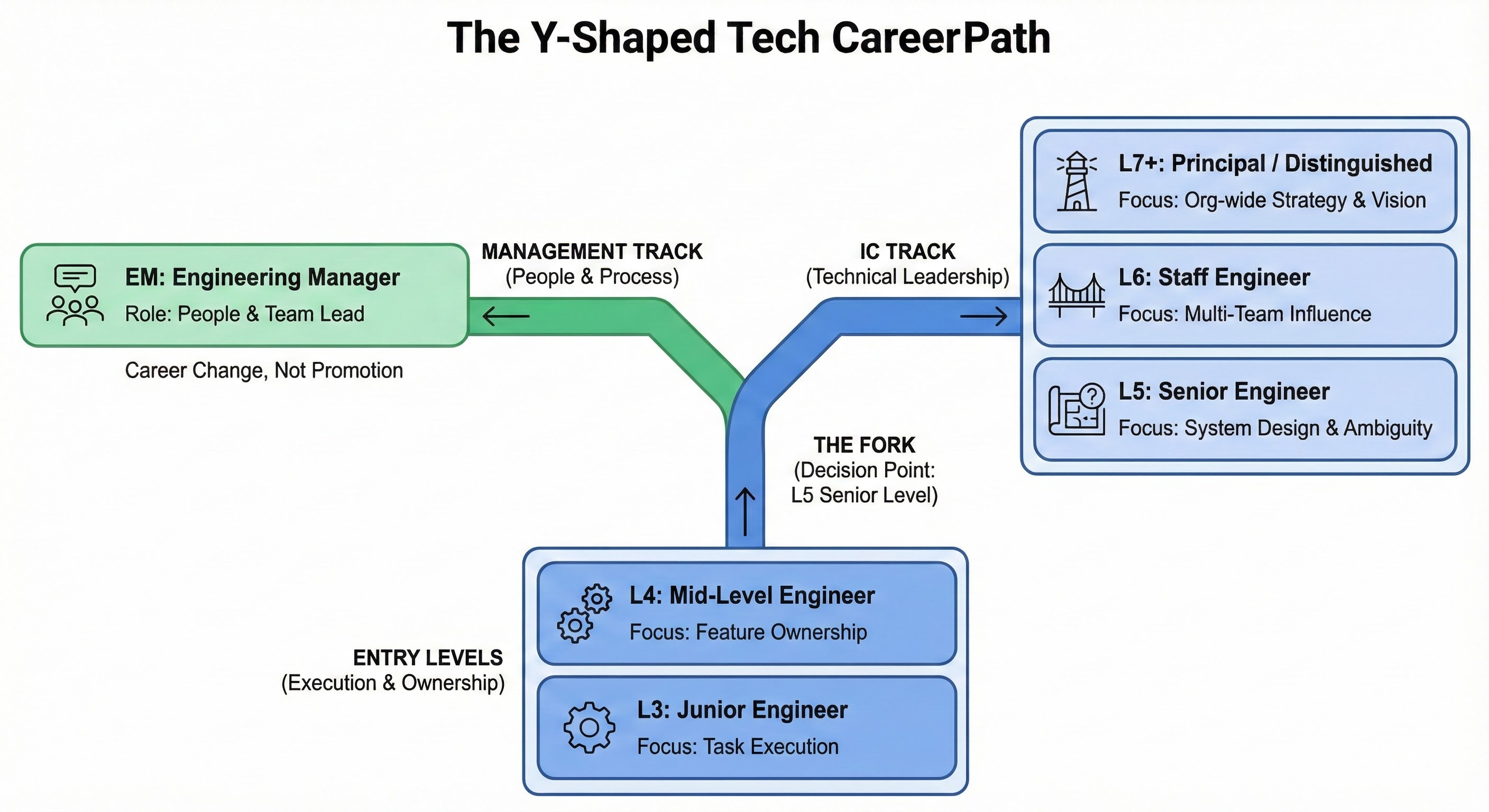
Let us explore the Individual Contributor (IC) track first. This is where everyone starts, and it is where most System Design knowledge is applied.
Level 1: The Junior Engineer (L3 / E3)
The Focus: Execution and Learning
When you join as a new grad or a junior, you are usually at Level 3 (Google/Meta terminology) or SDE I (Amazon terminology).
At this stage, nobody expects you to design a massive distributed system like Netflix or Instagram. They expect you to learn.
What the job looks like
Your manager or a senior engineer will give you a specific task. The task is well-defined. They might say:
“We need to add a button to this page that downloads a PDF. Here is the API that generates the PDF. Please connect them.”
Your job is to write the code that makes that button work. You need to write clean code. You need to write tests to make sure it does not break.
The Scope: Tasks
At this level, your scope is the task. You are given a ticket, and you close the ticket. You do not need to worry about how the database stores the order history. You do not need to worry about how the server handles a million users at once. You just need to make the button work.
The Challenge: The Ecosystem
The hardest part of being a junior engineer is not the coding itself. It is the environment.
Big Tech companies have massive internal tools. They have their own version of everything. You will spend months just figuring out how to build the code, how to test it, and how to deploy it.
How to level up
To move past this stage, you need to show independence.
If you get stuck, do you immediately ask for help?
Or do you try to debug it yourself first?
The goal here is to become someone who can finish a task without needing a babysitter.
Level 2: The Mid-Level Engineer (L4 / E4)
The Focus: Ownership and Independence
This is often considered the “workhorse” level of the industry. These engineers build the bulk of the product.
What the job looks like
You stop getting tasks. You start getting features.
