
4 Coding Projects That Will Get You Hired in 2026
Your portfolio is missing the point. Top-tier companies don't care about your To-Do list app. Here are the 4 'Proving Ground' projects that actually demonstrate engineering seniority.

There is a distinct moment in every developer’s journey where the path forward seems to vanish.
You have learned the syntax of a programming language.
You understand how loops, arrays, and functions work.
You might have even solved a hundred algorithmic puzzles on competitive coding platforms.
Yet, when you look at the requirements for a professional software engineering role, there is a massive disconnect.
You know how to reverse a string in place, but you are not sure how that helps you build a scalable web service. This is the implementation gap.
It is the void between knowing computer science theory and possessing the practical engineering skills required to build software that works in a production environment.
Interviewers at top-tier technology companies are not just looking for people who can memorize syntax. They are searching for candidates who understand how software components interact, how data flows through a system, and how to handle complexity.
The best way to demonstrate this is not by memorizing more trivia, but by building projects that force you to solve engineering problems.
In this guide, we will explore four specific project types that act as proving grounds for your skills. We will look at why these projects matter, the core concepts they teach, and exactly what happens behind the scenes when you build them.
1. The In-Memory Key-Value Store
Many junior developers rely heavily on established databases without understanding how they actually store and retrieve data.
Building your own simplified version of a key-value store is an excellent way to demystify data persistence.
The Concept
A key-value store is a database that uses a simple method to store data. It stores a value (such as a username) and associates it with a specific key (such as a user ID).
When you want that information back, you provide the key, and the system returns the value.
This project forces you to deal with Data Structures and Memory Management.
You cannot simply use a list or an array to store everything because searching through a list becomes slower as you add more data.
You need a way to find data instantly, regardless of how many items are in the database.
Behind the Scenes
To build this, you will likely implement a HashMap.
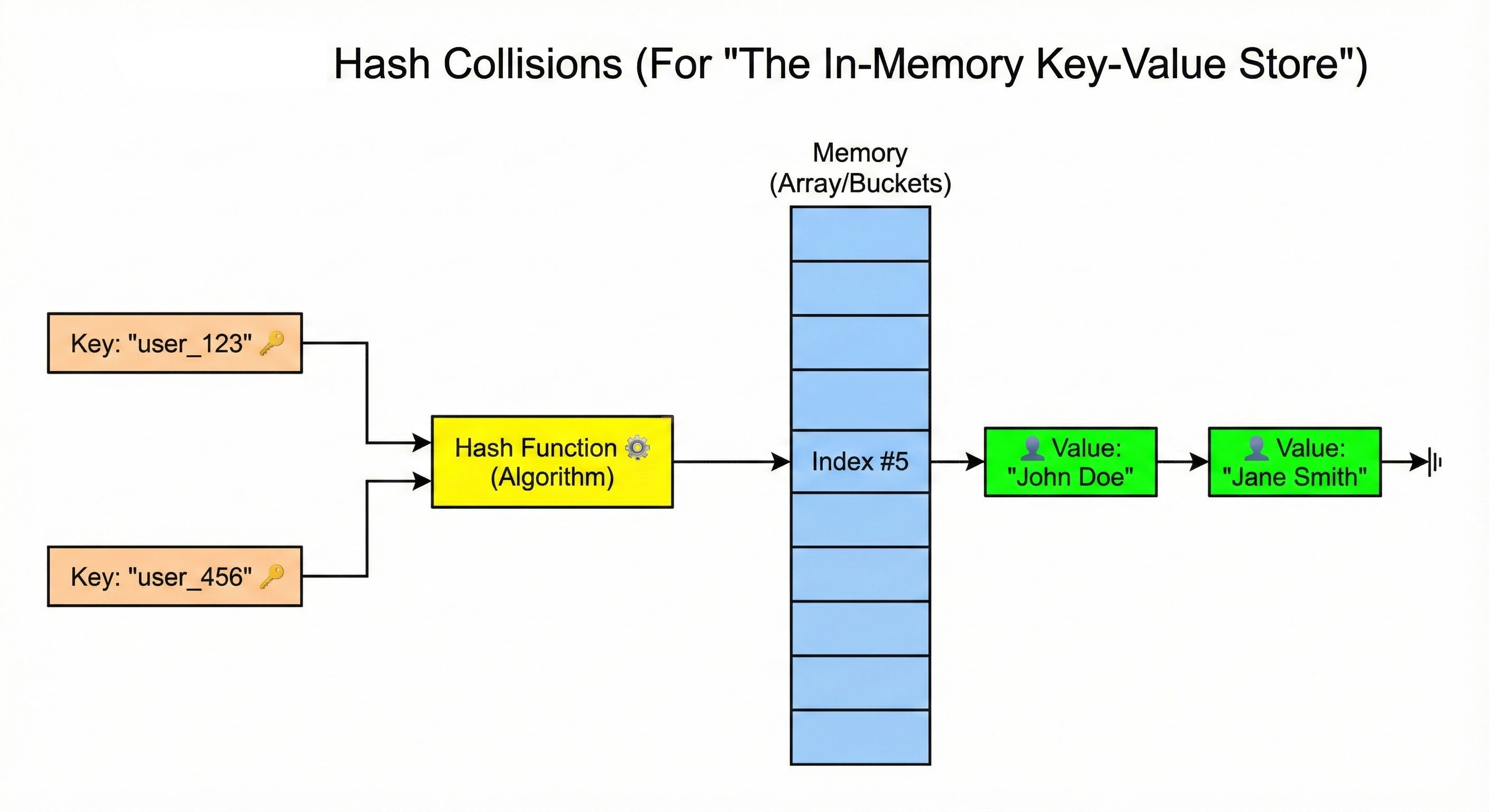
A HashMap takes a key (like the string “user_123”) and passes it through a hashing function. This function is a mathematical algorithm that converts the input string into a specific number (an integer). This number corresponds to an index (a specific slot) in your computer’s memory.
When you implement this, you will encounter a critical engineering problem: a collision.
A collision occurs when two different keys result in the same mathematical hash result.
For example, “user_123” and “user_456” might both point to slot number 5.
To solve this, you must write logic to handle the conflict. You might use chaining, where slot number 5 actually holds a list of items rather than a single item.
This project proves you understand time complexity and how computers actually organize memory.
2. The Custom Rate Limiter
In a professional environment, software services are often bombarded with requests.
If too many users try to access a server at the exact same time, the server can crash. To prevent this, engineers build systems to control the flow of traffic.
The Concept
A Rate Limiter is a piece of code that controls the amount of incoming and outgoing traffic to or from a network. It effectively enforces a rule such as “User A is allowed to make 10 requests per minute.
If they try to make an 11th request, we will block it.”
This project demonstrates your ability to write control logic and manage state.
You are not just transforming data; you are making decisions based on the history of events. It is a fantastic way to show you understand how to protect backend systems.
Behind the Scenes
To make this work, you need to track time and usage counts.
You cannot simply reset a counter at the start of every minute, or all your users might send requests at the very last second of the minute and then again at the first second of the next minute, causing a spike in traffic.
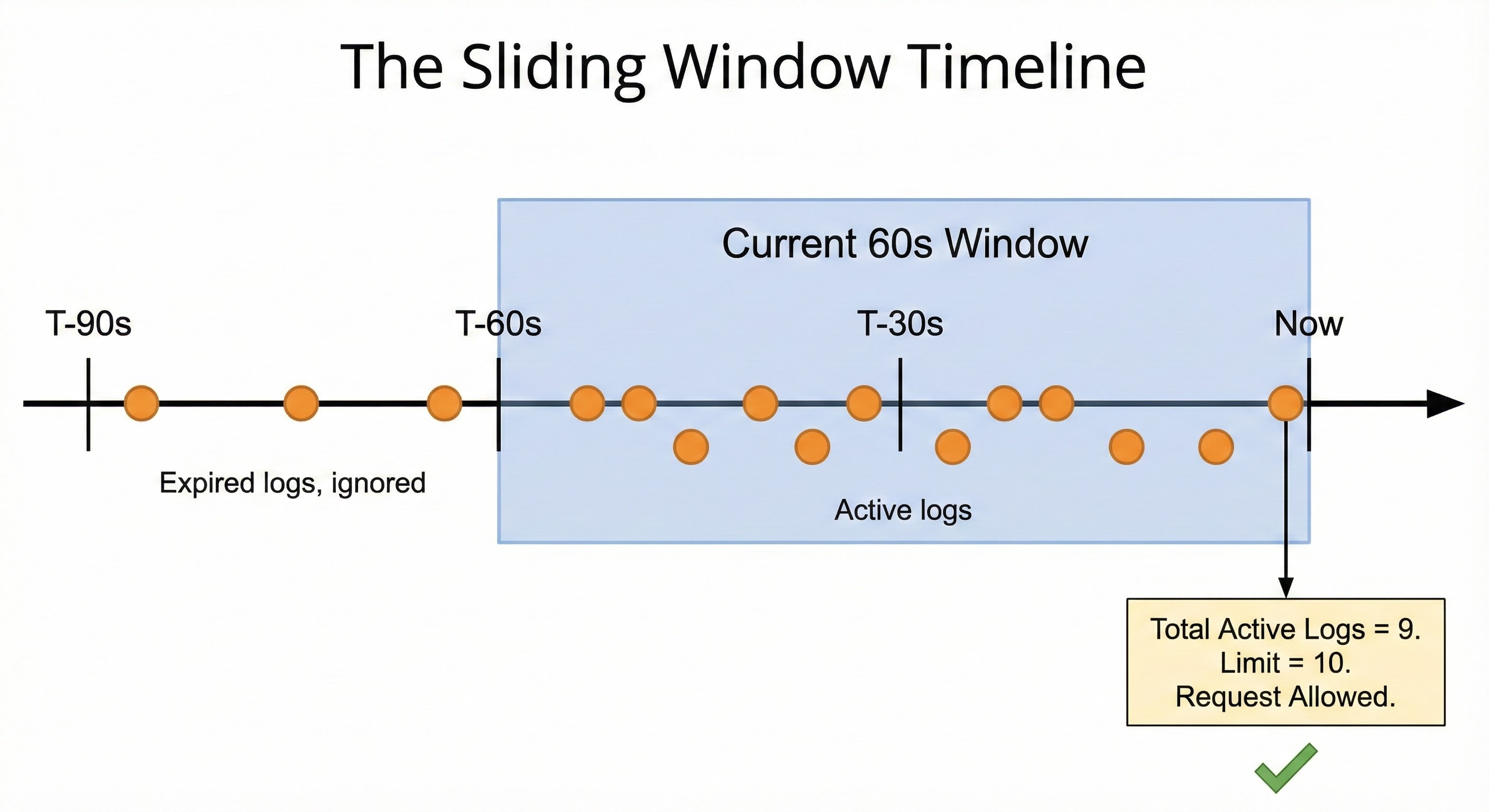
You will likely implement the Sliding Window Algorithm.
In this approach, you maintain a timestamped log of requests for each user.
When a new request arrives, you first remove any logs that are older than your defined time window (for example, older than 60 seconds).
Then, you count how many logs remain.
If the count is below the limit, you allow the request and add a new timestamp.
If the count is equal to the limit, you reject the request.
Implementing this requires you to work with timestamps and precision timing.
You will need to calculate the difference between the current time and the recorded events to determine validity. This highlights your ability to work with algorithm efficiency in a real-time context.
Read more: A Developer’s Guide to Rate Limiting and Throttling
3. The Concurrent Job Scheduler
One of the most difficult concepts for beginners to grasp is concurrency.
Most simple code runs sequentially: Line 1 executes, then Line 2, then Line 3. However, modern software often does many things at once.
The Concept
A Job Scheduler is a system that manages a list of tasks that need to be executed. Instead of running them one by one in a strict line, the scheduler might run three or four tasks simultaneously to save time.
This is the gold standard for backend engineering interviews.
It tests your knowledge of Multi-threading, Asynchronous Programming, and Race Conditions.
Behind the Scenes
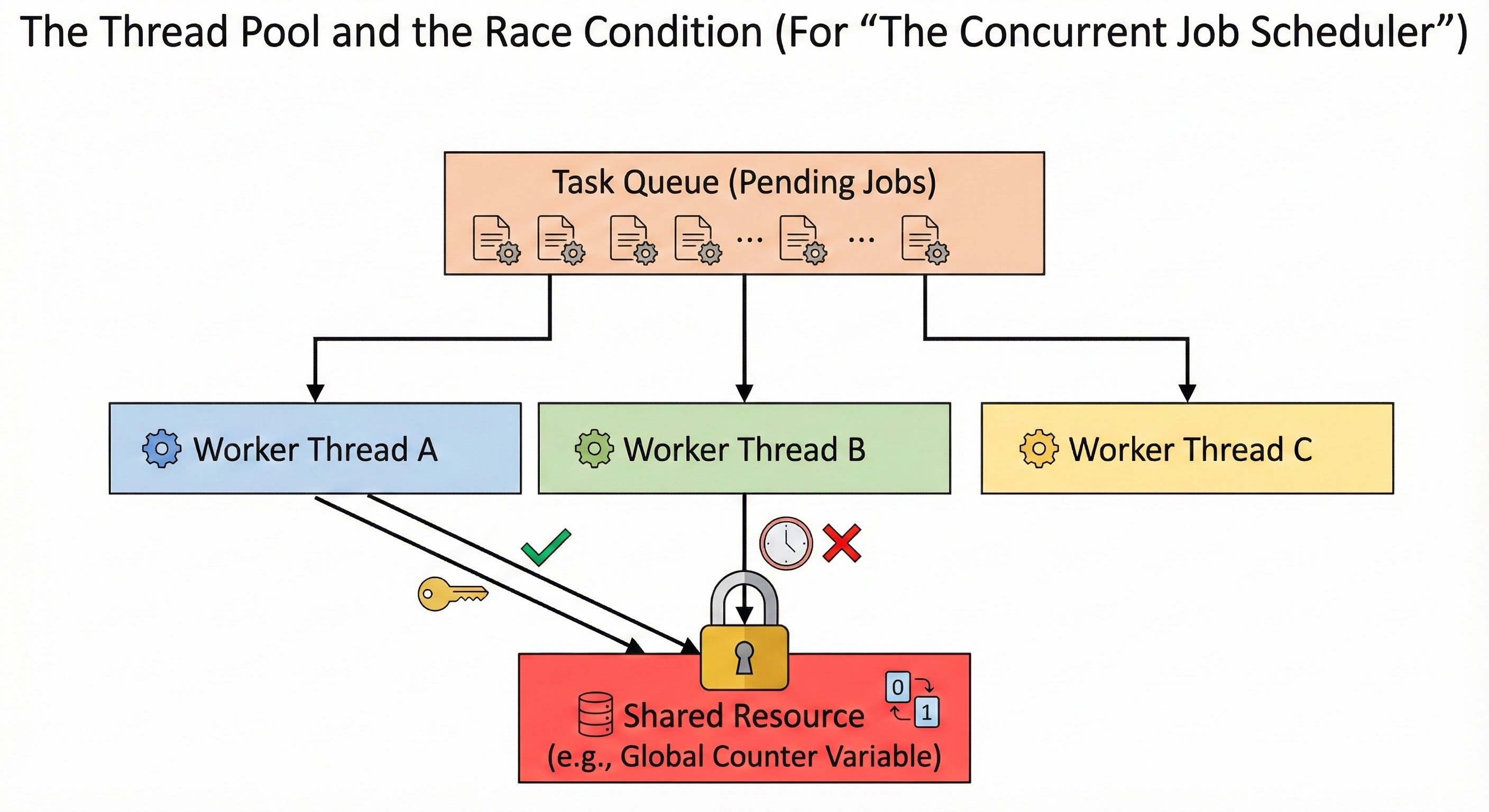
When you write this application, you will create a “pool” of worker threads.
Think of a thread as a separate unit of execution.
Your program will assign tasks to these threads.
The challenge arises when two threads try to access the same piece of data at the same time. This is called a Race Condition.
If Thread A reads a variable, and Thread B changes that variable before Thread A is done, your program will produce incorrect results or crash.
To fix this, you must implement Locks or Mutexes (Mutual Exclusions).
A Lock allows one thread to claim a piece of data, preventing other threads from touching it until the first thread is finished.
By building a scheduler that can handle different task priorities (e.g., “High Priority” tasks run before “Low Priority” tasks) while managing these locks, you demonstrate deep technical maturity.
You show the interviewer that you understand the dangers of parallel processing and know how to mitigate them.
4. The Text Pattern Search Tool
Handling large amounts of text is a common task in software engineering.
Whether you are searching through logs for an error or filtering user inputs, you need to process strings efficiently.
The Concept
This project involves building a command-line tool that takes a specific text pattern (like a word or a partial phrase) and a large text file, and then returns every line in the file where that pattern appears.
This project moves you away from simple string methods provided by your programming language and forces you to understand Search Algorithms and File I/O (Input/Output).
Behind the Scenes
A naive approach would be to check every single character in the file against every single character in your search pattern. This is incredibly slow for large files.
To optimize this, you might implement the Knuth-Morris-Pratt (KMP) algorithm or the Boyer-Moore algorithm. These algorithms use pre-computed data about your search pattern to skip ahead in the text when a mismatch occurs, rather than starting over from the beginning.
Furthermore, this project requires you to handle Streams.
If the file you are searching is 50 gigabytes in size, you cannot load the whole thing into your computer’s RAM.
You must write code that reads the file in small chunks (buffers), processes that chunk, and then discards it to make room for the next chunk. This demonstrates an understanding of hardware limitations and resource management.
How to Present These Projects
Building the project is only half the battle.
To truly succeed in an interview, you must be able to articulate what you built.
When you add these to your resume or discuss them in an interview, focus on the constraints and the trade-offs.
Documentation
Your project repository should have a documentation file that explains not just how to run the code, but the decisions you made.
Why did you choose a specific algorithm?
What happens if the input size doubles?
What was the hardest bug you had to solve?
Testing
Senior engineers value reliability.
For every project listed above, you should write Unit Tests.
A Unit Test is a small script that checks a specific part of your code to ensure it behaves as expected.
For example, in your Rate Limiter, write a test that intentionally tries to send too many requests and asserts that the system correctly blocks them. This shows you care about stability.
Conclusion
The transition from a coding student to a professional engineer is defined by your ability to manage complexity.
Tutorials give you clean paths with predictable outcomes.
Engineering projects force you to deal with messy data, memory limits, and timing conflicts.
By building a Key-Value Store, a Rate Limiter, a Job Scheduler, or a Text Search Tool, you are doing more than just writing code. You are building a mental model of how computers actually work.
Key Takeaways:
Move beyond syntax: Focus on projects that require logic, state management, and data structures.
Understand memory: Build projects like Key-Value stores to learn how data is indexed and retrieved.
Master concurrency: Use Job Schedulers to learn how to manage multiple tasks and prevent race conditions.
Optimize for scale: Build Rate Limiters and Search Tools to understand efficiency and resource management.
Test everything: Prove your code works by writing automated tests that verify your logic.
When you walk into an interview with these projects under your belt, you are no longer asking for a chance to learn; you are demonstrating that you are ready to build.