
4 API Versioning Strategies Every Developer Should Know
Learn the fundamentals of API versioning. Discover how to update your software without breaking existing integrations using URI, Header, and Query strategies.

Software is never finished. It is in a constant state of motion.
As a system grows, the business requirements shift, new features are added, and bugs are fixed.
In a monolithic application where all the code lives in one place, these changes are relatively easy to manage.
You simply update the code, deploy it, and the entire system moves forward together.
However, modern software development rarely happens in isolation.
Most systems are distributed. They consist of different services talking to each other over a network. One service provides data, and another service consumes it.
The mechanism that connects them is the Application Programming Interface, or API.
When the code on one side of this connection changes, it creates a ripple effect.
If the provider changes the structure of the data it sends, the consumer might not understand the new format. This can cause errors, crashes, and data corruption. This problem makes API stability one of the most critical challenges in system design.
The solution to this problem is API versioning.
Versioning allows a system to evolve and improve without breaking the applications that rely on it. It provides a way to manage the transition from old behaviors to new ones.
Understanding how to implement versioning is a mandatory skill for any developer working on large-scale systems.
Key Takeaways
APIs are contracts: An API is a strict agreement on how data is exchanged. Breaking this agreement breaks the system.
Backward compatibility is essential: Versioning is only necessary when a change breaks the existing contract; additive changes usually do not need a new version.
Visibility vs. Cleanliness: Path-based versioning is the most visible and easiest to debug, while header-based versioning keeps URLs clean and architectural.
Semantic Versioning: Using a standard numbering system like Major.Minor.Patch helps consumers understand the risk level of an update.
Deprecation is a process: You must have a clear strategy for removing old versions, including communication and timelines, to avoid maintaining legacy code forever.
Understanding the API Contract
To master versioning, you must first understand the concept of the API contract.
In the context of distributed systems, an API is not just a set of endpoints. It is a promise.
The provider promises that if the client sends a request to a specific URL, the provider will return a response with a specific structure. This structure includes the names of the fields, the data types (such as numbers, strings, or booleans), and the organization of nested objects.
When a developer builds a client application, they write code that relies on this promise. They might write a function that expects a field called “userID” to be a number.
If the server suddenly changes that field to be a string of text, the client function will likely fail. This violation of the promise is what we call a breaking change.
Breaking vs. Non-Breaking Changes
To understand versioning strategies, it is essential to first understand the “API Contract.”
When two systems communicate, they agree on a format. The server promises to send data in Format A, and the client promises to read data in Format A.
As long as this contract is upheld, everything works smoothly.
However, changes to the server code can alter this contract. These changes fall into two categories:
Breaking Changes
These are changes that physically alter or remove parts of the accepted contract. Common examples include:
Renaming a field: Changing
userNametofullName.Changing a data type: Changing an ID from a number (
123) to a string ("123-abc").Removing a field: Deleting the
emailfield entirely.Changing requirements: Making an optional field mandatory.
In these scenarios, the existing code on the client side will fail to execute as expected. This is where versioning becomes necessary.
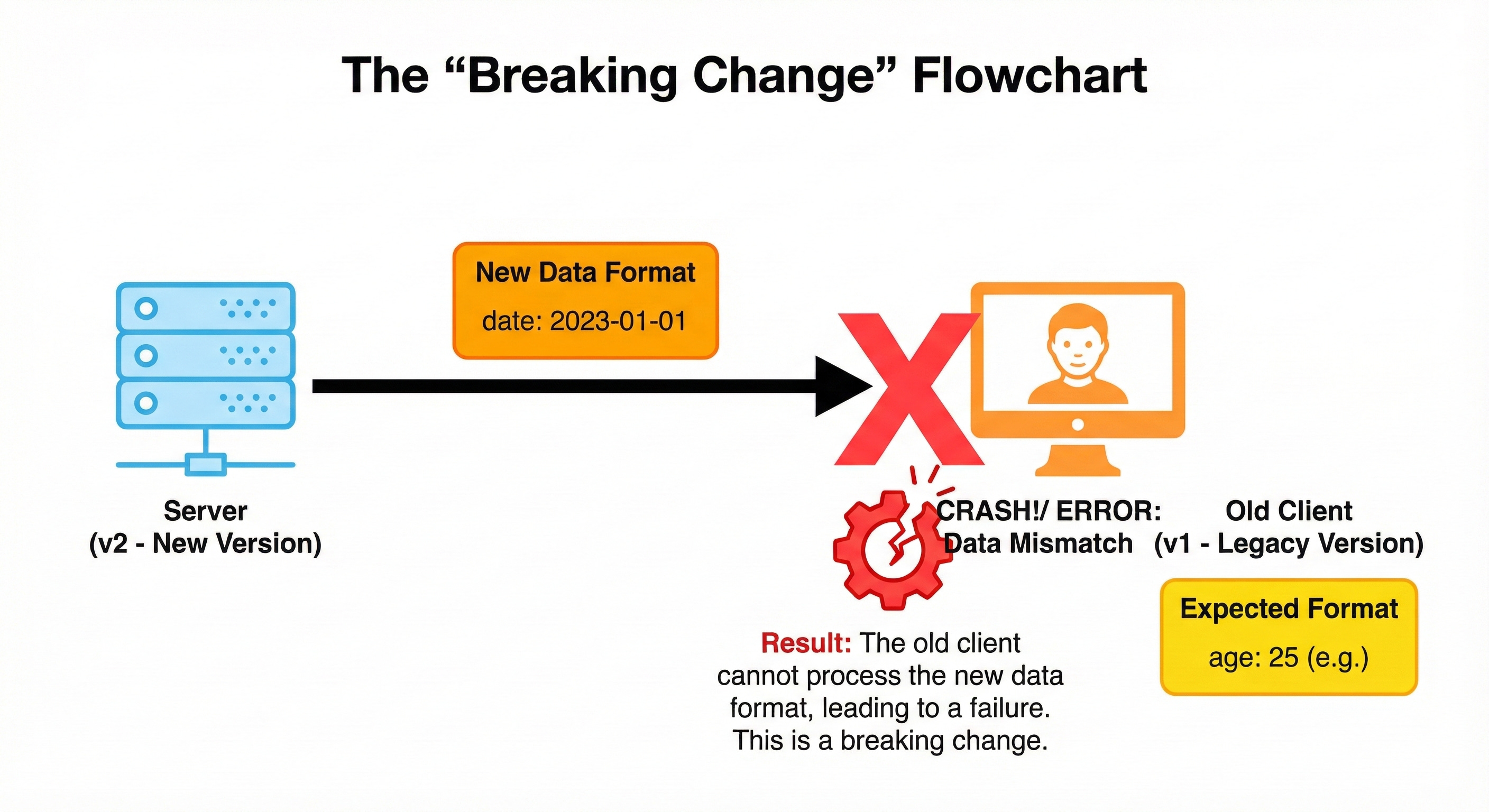
It allows you to introduce the new behavior (the breaking change) under a new label while keeping the old behavior available for existing clients.
Non-Breaking Changes
These are changes that do not violate the contract.
Keep reading with a 7-day free trial
Subscribe to System Design Nuggets to keep reading this post and get 7 days of free access to the full post archives.