30 System Design Patterns Compared in One Table (Pick the Right One in 60 Seconds)
The One-Page Reference That Helps You Pick the Right System Design Pattern in Under a Minute, Across Scaling, Data, Communication, and Resilience

What This Blog Will Cover
Thirty patterns in one table
What each pattern does
When to pick each one
The main trade-off of each
How to decide in seconds
System design has dozens of well-known patterns, and most engineers learn them one at a time, in isolation. They study caching one week, sharding the next, and circuit breakers the week after.
This builds a collection of facts, but it does not build the skill that actually matters, which is choosing the right pattern quickly when a problem appears.
The trouble with learning patterns in isolation is that real decisions happen in context and under time pressure.
In an interview or a design review, the question is rarely whether someone has heard of a pattern.
The question is whether they can look at a problem, recognize which pattern fits, and explain why in a sentence or two. That speed and clarity is what separates someone who knows the patterns from someone who can use them.
A decision table solves this.
When every pattern sits side by side, each with a clear note on what it does, when to use it, and what it costs, the choice becomes fast and obvious.
Instead of recalling a long article about each pattern, the engineer scans for the situation in front of them and lands on the right tool.
The comparison itself becomes the skill.
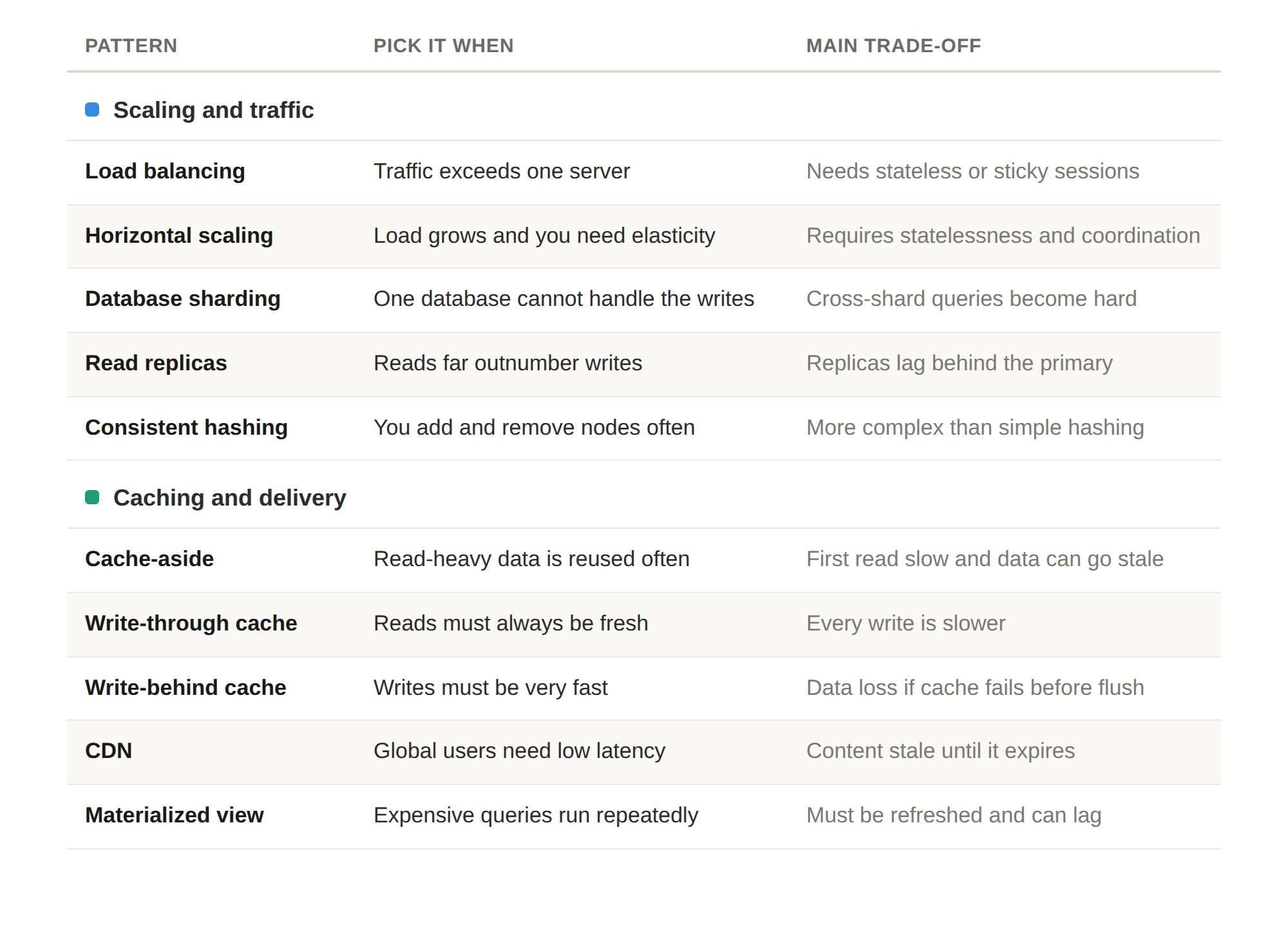
This guide puts thirty essential system design patterns into one table, grouped by category.
For each pattern, the table shows what it does, the situation that calls for it, and the main trade-off it carries.
The goal is to make pattern selection a sixty-second decision rather than a memory test.
How to Use This Table in 60 Seconds
The table is built for fast decisions, so it helps to know how to read it.
Start with the situation in front of you, then scan the “Pick It When” column for the row that matches. That column is the heart of the table, because it maps a real problem to the pattern that solves it.
Once a candidate pattern is found, the “Main Trade-off” column tells you what you are giving up by choosing it. This matters because every pattern has a cost, and naming that cost out loud is exactly what strong engineers do.
The “What It Does” column is there as a quick reminder of the mechanism.
The categories group patterns by the kind of problem they solve, so you can jump straight to the relevant section. Scaling problems live in one group, data problems in another, and so on.
The 30 System Design Patterns