
SQL vs NoSQL vs Time Series. The Only Database Basics You Really Need
Confused by all the database choices? This guide breaks down SQL, NoSQL, and time series databases in plain language. See real use cases, common subtypes, and clear rules for when to use each one in production systems.

Ever notice how apps instantly load your feed, track your workout stats, or show your order history without missing a beat?
Behind all that magic sits a database doing quiet but powerful work.
The tricky part is that there is no single database that fits every problem. Different workloads need different designs.
But you do not need to memorize every database out there.
You only need to understand the three big categories that shape how modern systems store and manage data.
Each one solves a different kind of problem, and once you see what makes them unique, choosing the right database becomes surprisingly simple.
In this guide, you will learn the three essential categories of databases that every beginner and interview candidate must understand.
You will also see how each category works, when to use it, and which subtypes matter in real engineering decisions.
SQL or Relational Databases
Relational databases store data in structured tables that look like spreadsheets.
Each table has rows and columns, and every value follows a fixed schema. This structure makes the data clean, predictable, and easy to query using SQL.
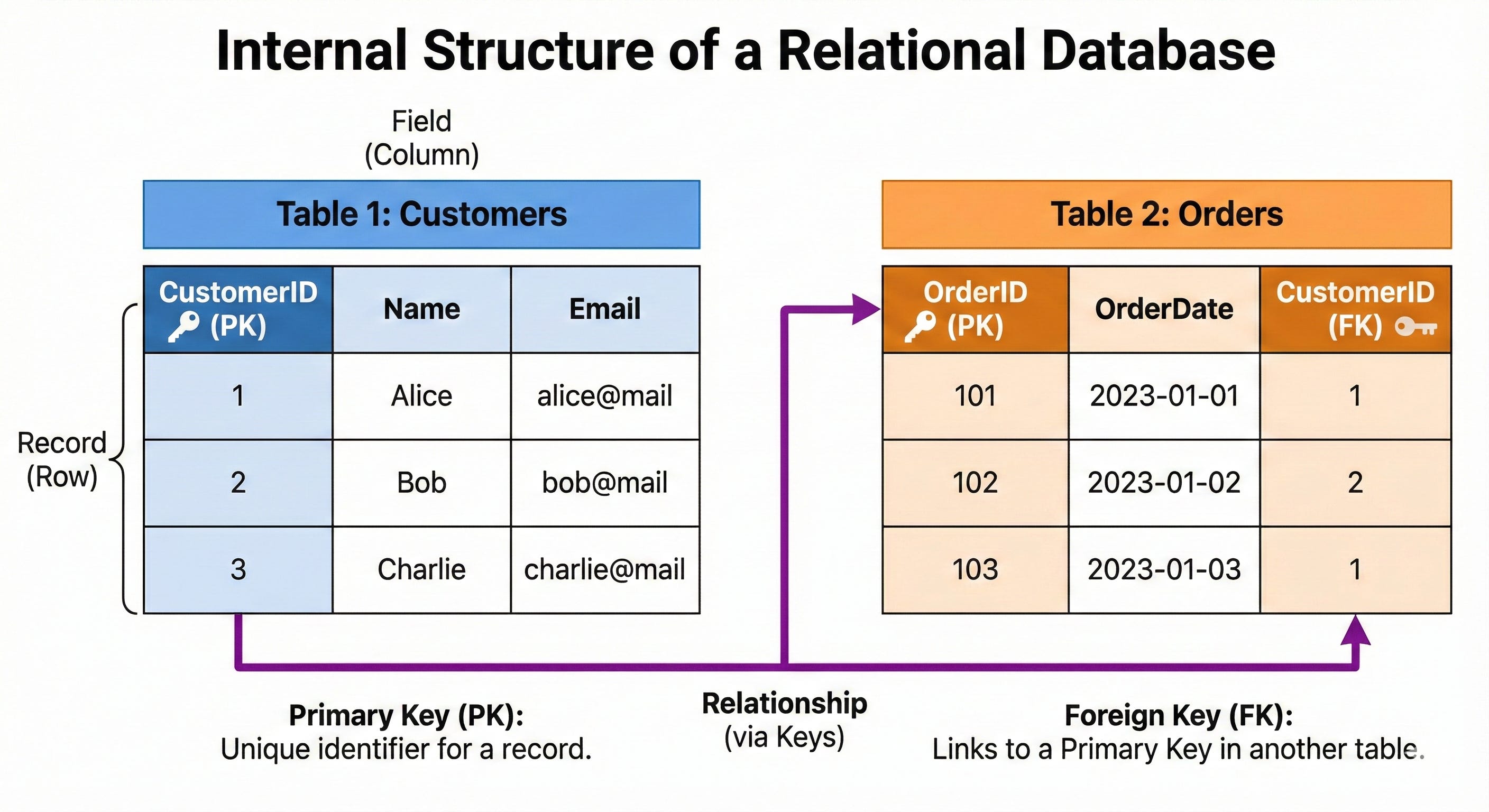
They shine when you need accuracy, relationships between tables, and strong consistency. Banking, e-commerce, enterprise software, and anything that depends on reliable transactions rely on relational systems.
Key Types of SQL Databases
OLTP Databases
These power real-time applications, where many small reads and writes happen every second. They are designed for quick lookups, instant updates, and very fast transactions. Think of booking a ride or transferring money.OLAP Databases
These handle analytical workloads. The focus is not on single transactions but on scanning huge volumes of data for insights. They support complex queries and aggregations for dashboards, business reporting, and analytics teams.Distributed SQL Databases
These look like traditional SQL databases but scale across many machines. They keep strong consistency and relational structure while supporting massive workloads that normal single-node databases cannot handle.Columnar SQL Databases
Instead of storing data by rows, these store values column by column. That makes analytical queries extremely fast because the database reads only the required columns. They are common in reporting and data warehouse systems.
NoSQL Databases
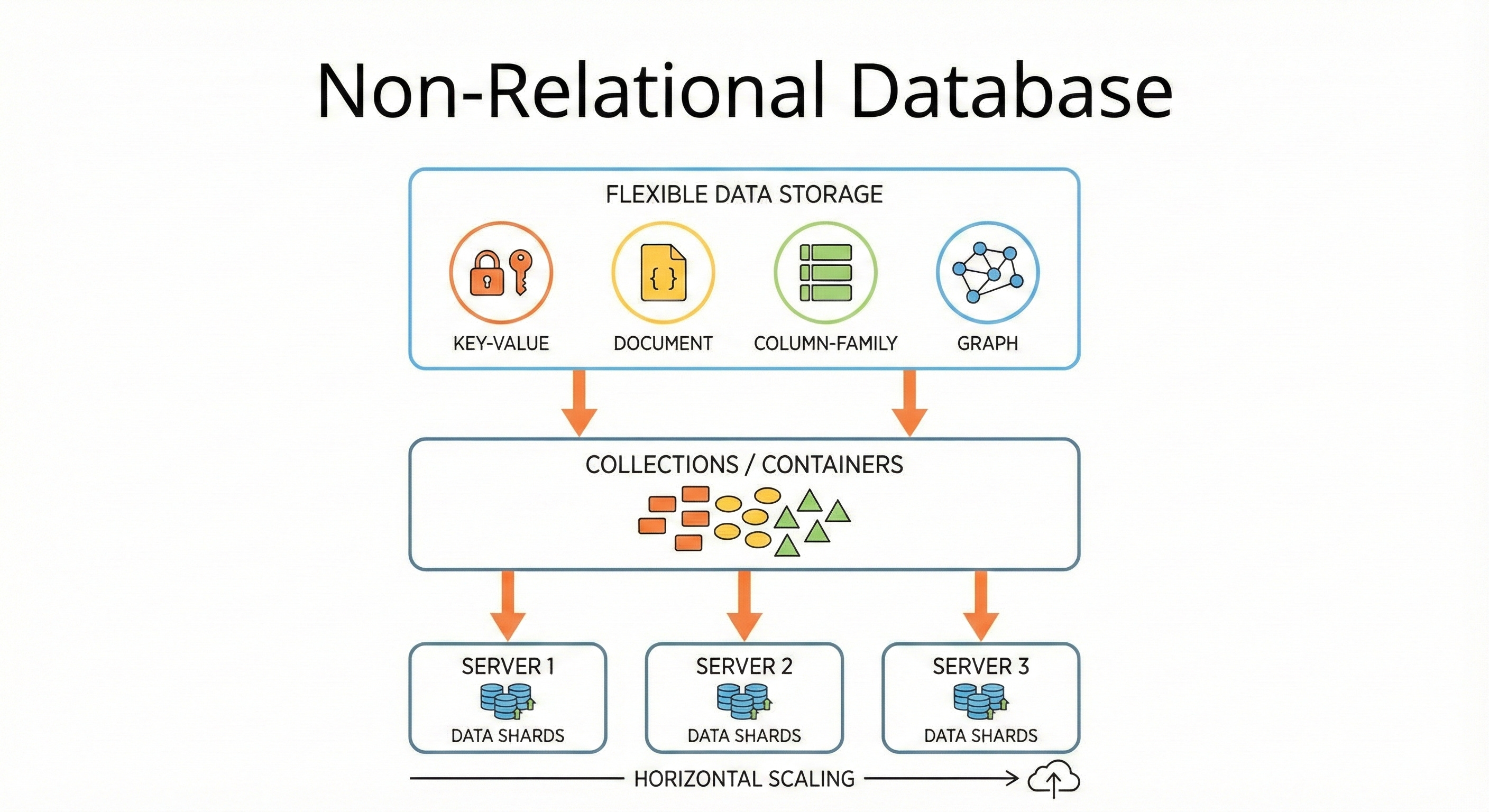
NoSQL databases were created to handle flexible data structures, massive scale, and high-velocity workloads that relational databases struggle with.
They do not require a fixed schema.
This gives developers freedom to store data in a more natural format.
NoSQL systems shine in applications involving social feeds, recommendation engines, logs, catalogs, real-time apps, and distributed systems.
Key Types of NoSQL Databases
Key Value Databases
These store data as a simple key and its associated value. They are extremely fast because the system jumps straight to the value using the key. Perfect for caching, user sessions, and quick lookups.Document Databases
These store records as JSON-like documents. Each document can have different fields. This makes them ideal for product catalogs, user profiles, and evolving data structures where flexibility matters.Wide Column Databases
Data is stored in column families instead of tables. They scale horizontally across many machines and can handle high write throughput. They are ideal for event logs, sensor data, or large real-time datasets.Graph Databases
These store data as nodes and relationships. They are great for social networks, fraud detection, recommendation engines, and anything that needs to analyze connections between data points.
Time Series Databases
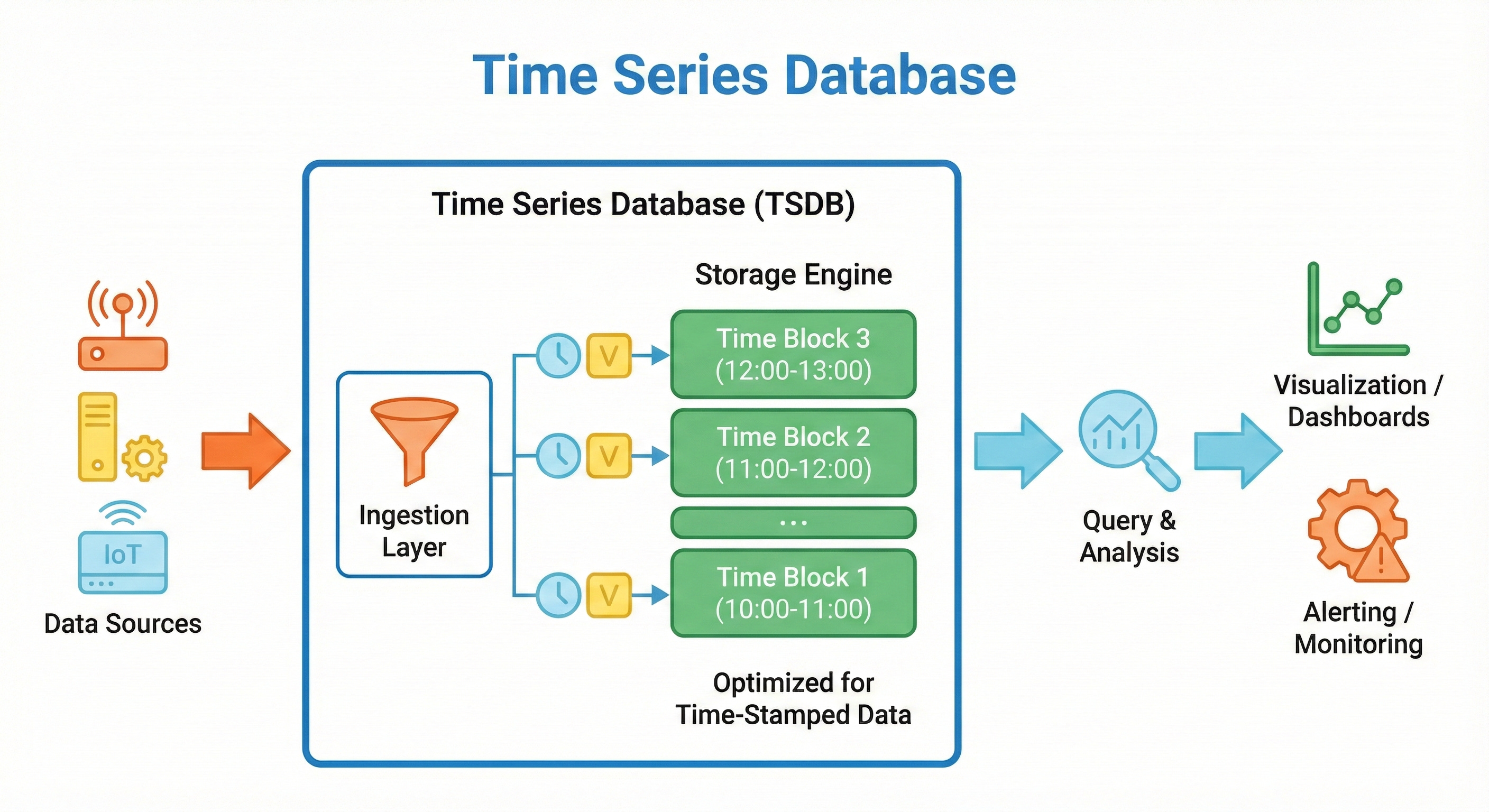
Time series databases are designed to handle data that changes over time.
Instead of just storing values, they track how those values evolve.
Every entry includes a timestamp, which makes them perfect for monitoring metrics, sensors, IoT devices, stock data, and performance logs.
They prioritize fast ingestion of new events and efficient queries on historical patterns.
Key Types of Time Series Databases
Monitoring Focused Time Series Databases
These are designed for system metrics like CPU, memory, latency, and errors. They compress data efficiently and allow fast queries so engineers can view real-time dashboards and detect incidents.Financial Time Series Databases
These specialize in storing price movements, trading volumes, and market signals. They handle extremely frequent updates and allow quick retrieval for backtesting strategies.IoT Focused Time Series Databases
These ingest data from thousands or millions of devices. They manage high write throughput and store long time windows of data coming from sensors, smart devices, and edge systems.Event Driven Time Series Databases
These store timestamped events such as logs, user actions, or application traces. They help teams discover patterns, debug issues, or detect anomalies in large event streams.
When to Use Each Database Type
SQL works best when your data is structured, relationships matter, and correctness is critical.
NoSQL shines when you need scale, flexible data models, and high-speed ingestion.
Time series databases are the best choice when your data is tied to time and you care about trends, spikes, or changes over long periods.
FAQs
Q1. What makes SQL databases different from NoSQL databases?
SQL is schema-based and relational, while NoSQL is more flexible and can scale more easily across machines.
Q2. Is a time series database a subtype of NoSQL?
Some are NoSQL, but time series databases form their own category because they are optimized for timestamped data.
Q3. Which database type is best for interviews?
Start with SQL since it is foundational, then learn NoSQL and time series concepts for distributed system questions.
Q4. Why do companies use more than one type of database?
Different workloads need different designs. One system might require accurate transactions while another needs high-speed writes.
Q5. Are time series databases only for metrics?
No. They are also used for IoT, financial data, event logs, analytics, and forecasting.