
25 System Design Diagrams Every Engineer Should Memorize
The Definitive Set of 25 System Design Diagrams for 2026, Explained Simply, With When to Use Each and the One Insight It Captures


What This Blog Will Cover
The 25 most essential diagrams
Core architecture through modern AI
What each diagram shows
When to draw each one
The key insight behind each
System design is a visual discipline.
Engineers think in boxes, arrows, and flows, and the clearest way to express a design is to draw it.
In interviews, the diagram is the primary artifact the interviewer evaluates.
In real work, a diagram communicates an architecture faster and more precisely than paragraphs of explanation. The ability to sketch the right diagram quickly is one of the most practical skills an engineer can have.
The problem is that the field contains an overwhelming number of possible diagrams, and most are rarely useful.
Memorizing all of them is neither possible nor worthwhile. What matters is a curated set of diagrams that, together, cover the situations engineers actually face.
A focused set of essential diagrams turns a sprawling subject into a manageable toolkit, where each diagram has a clear job and a clear moment to be drawn.
This list contains 25 diagrams chosen for one reason: they are the ones that truly matter for engineers in 2026. They span the full field, from the timeless foundations of web architecture and data scaling to the modern realities of real-time streaming and artificial intelligence.
Older diagrams that no longer reflect how systems are built have been left out, and newer patterns that now appear constantly have been added.
Each diagram below comes with a short description, a note on when to draw it, and the single most important insight it captures.
The goal is to make each one simple enough to draw from memory and clear enough to explain in a sentence.
Master these 25, and you will be equipped to reason about almost any system.
A Quick Word on How to Use This List
The diagrams are grouped into seven categories that follow the natural layers of a system, from its overall shape down to its data, communication, reliability, and modern extensions.
Reading them in order shows how a complete system is assembled, though each diagram also stands on its own.
For each one, the goal is not just to recognize it but to be able to reproduce it quickly and state its key insight.
In an interview, you draw a handful of these depending on the question.
In real work, they become the shared vocabulary you use to discuss and document systems.
With that in mind, here are the 25 diagrams.
Category 1: Core Architecture
Diagram 1: The Universal Web Architecture
This is the skeleton that fits most web systems.

A request travels from the client through a load balancer to a set of application servers, which read and write to a database, with a cache in front for hot data and a content delivery network serving static files.
A message queue offloads heavy background work from the main path.
When to use it: At the start of almost any system design, as the base you then customize for the specific problem.
The key insight: Every web system is a pipeline from client to storage, and good design is mostly about knowing where to short-circuit that pipeline. The cache shortcuts hot data, the content delivery network shortcuts static content, and the queue moves slow work off the critical path.
Diagram 2: Horizontal Scaling with a Load Balancer
This diagram shows a load balancer, a component that distributes incoming requests, sitting in front of several identical application servers. As traffic grows, more servers are added behind it, and the load balancer spreads requests across them using a strategy such as round robin or least connections.
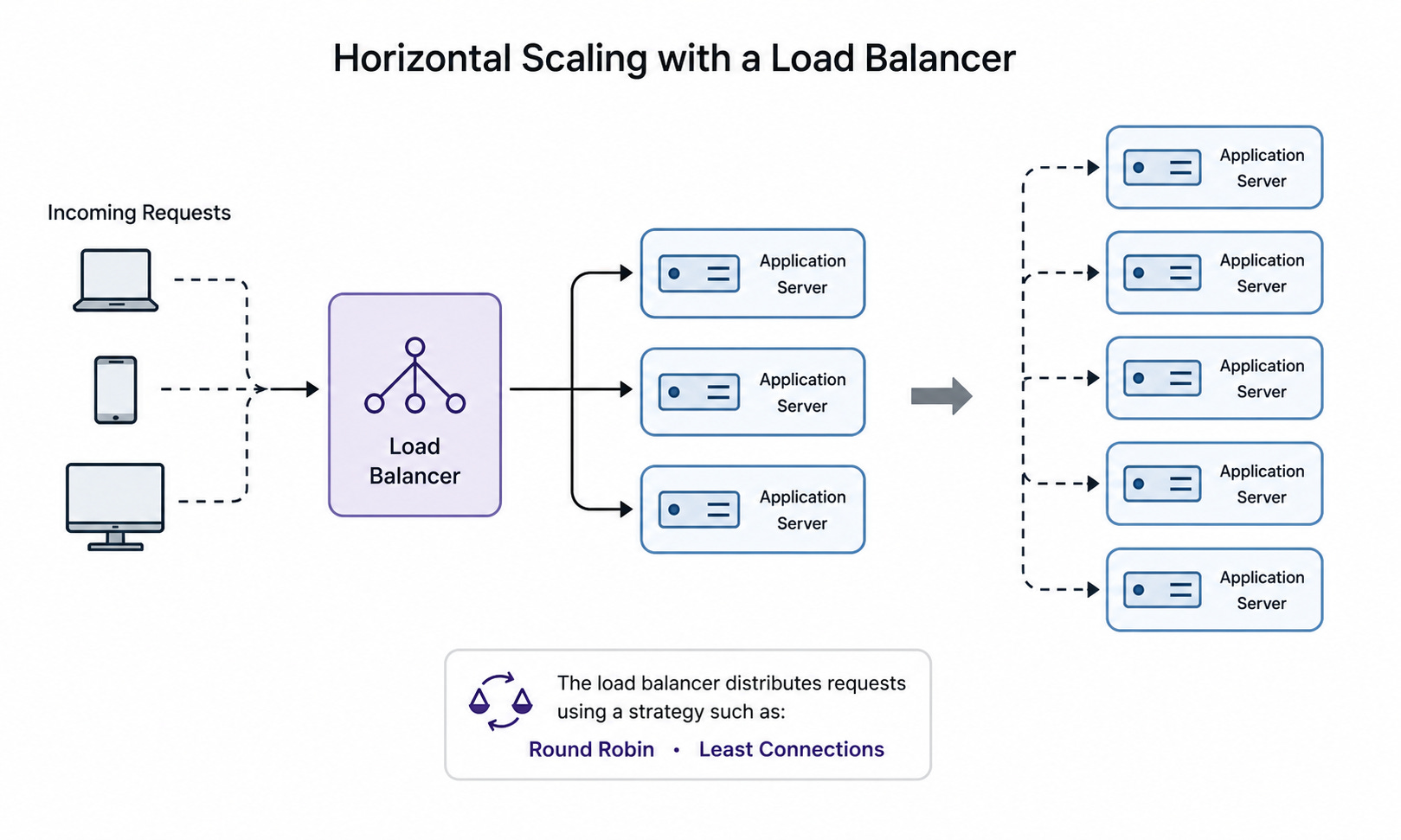
When to use it: Whenever the discussion turns to handling more traffic, which is most designs.
The key insight: Horizontal scaling works only when the servers are stateless, meaning any server can handle any request. Any session or connection state must live in a shared store. Adding more machines scales further than making one machine bigger, which is why it is the default approach at scale.
Diagram 3: Microservices Architecture
This diagram shows a system split into independent services, each responsible for one business area such as users, orders, or payments.
Each service owns its own database, and services communicate through APIs or events rather than sharing data directly.

When to use it: When a system has multiple distinct domains, when teams are large enough to own separate services, or when components need to scale independently.
The key insight: Each service owning its own data is what enables independence, since a service can change its internals without breaking others. The cost is real, including network latency between services, the difficulty of transactions that span services, and significant operational complexity. Microservices are powerful but should not be the default for small systems.
Diagram 4: The Modular Monolith
This diagram shows a single deployable application organized internally into well-defined modules with clear boundaries, all sharing one database and one deployment.
The modules are separated in code but not split into separate services.
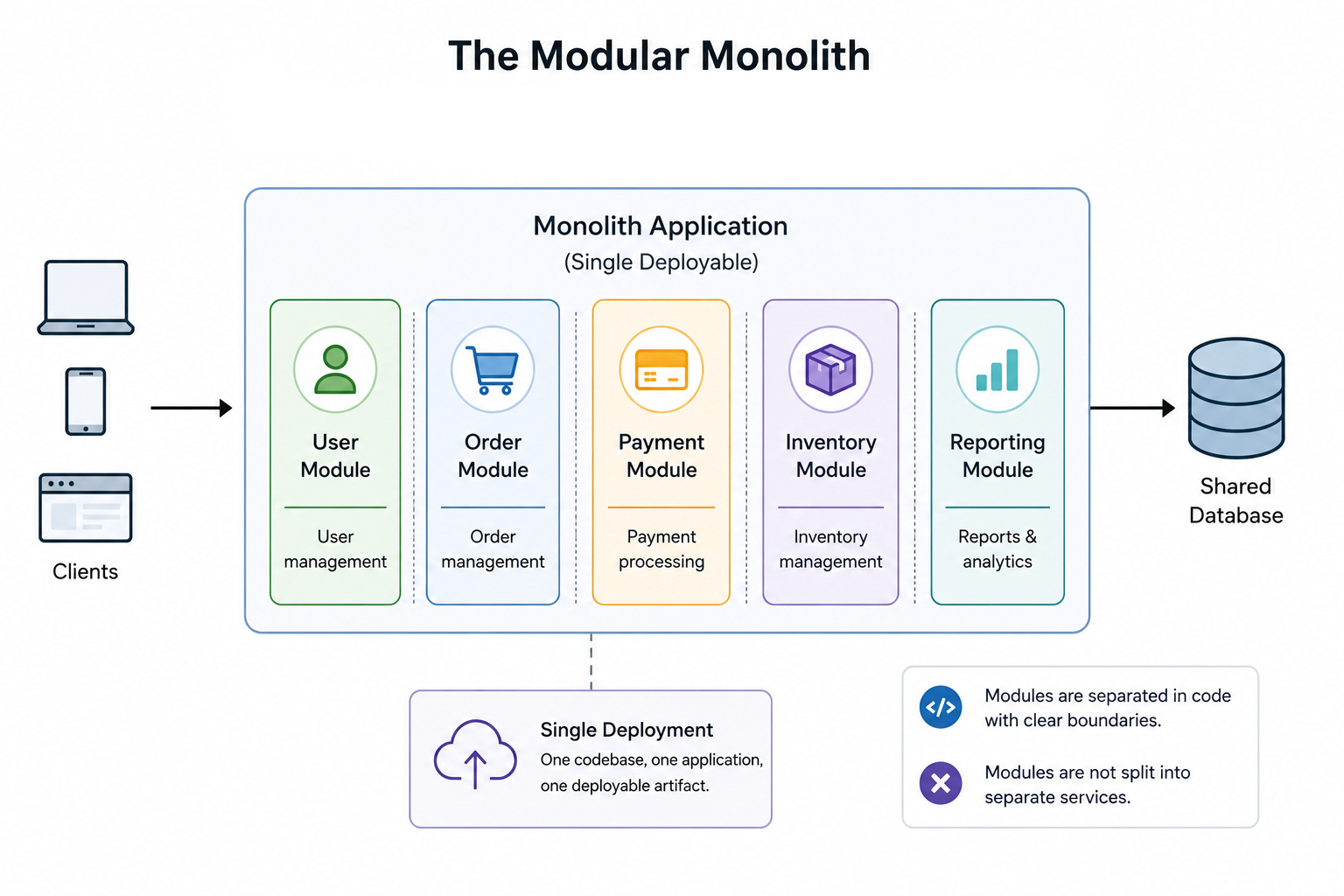
When to use it: For small teams, early-stage products, or any system where full microservices are not yet justified.
The key insight: A modular monolith captures much of the organizational benefit of clean boundaries while avoiding most of the operational cost of microservices. Many successful systems run on this design far longer than people expect, and starting here rather than with microservices is often the wiser choice.
Keep reading with a 7-day free trial
Subscribe to System Design Nuggets to keep reading this post and get 7 days of free access to the full post archives.