
16 Non Functional Requirement Concepts Every Software Engineer Must Know
Learn sixteen essential non functional requirement concepts with simple definitions and clear real world examples every software engineer must understand.

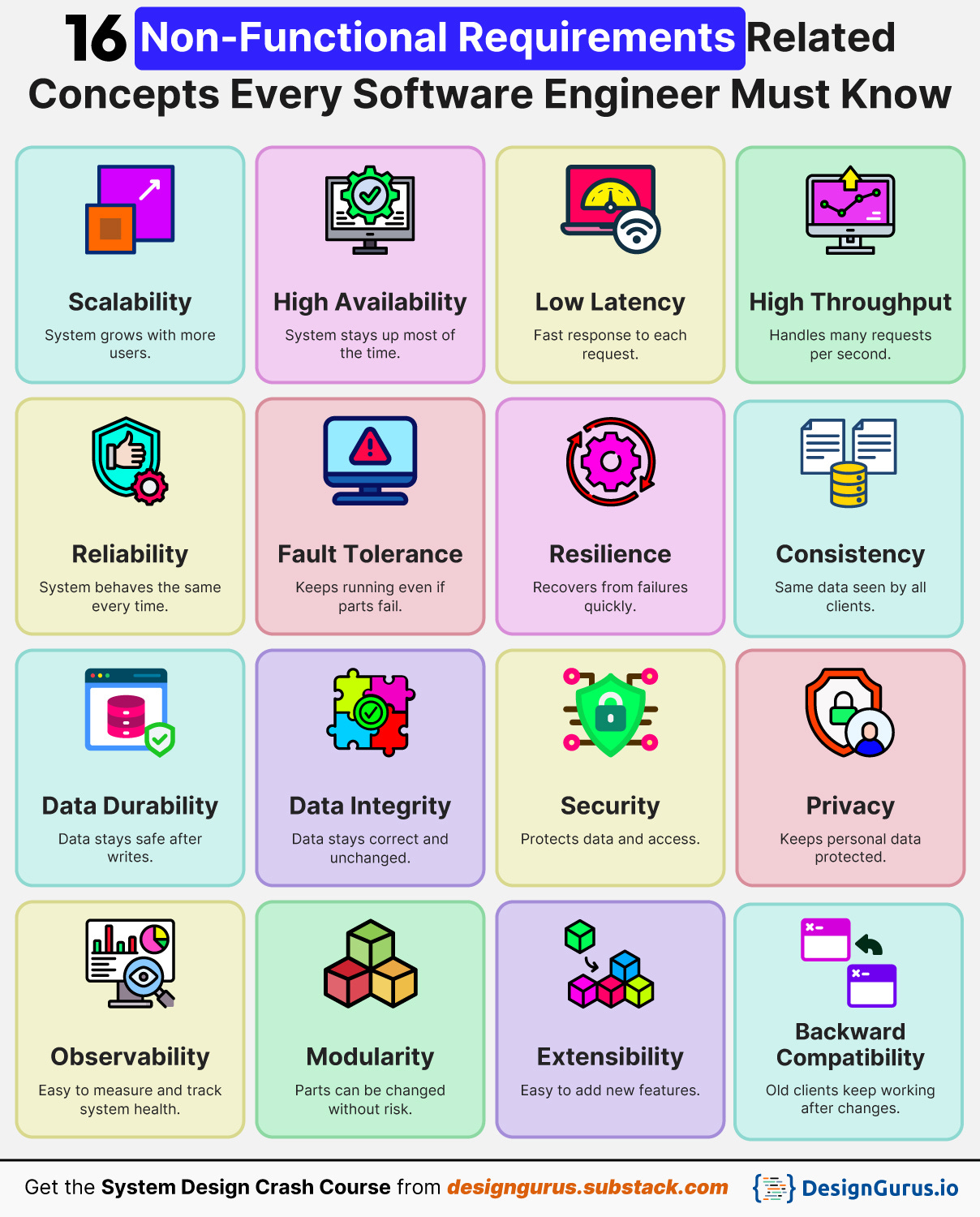
Every software system is judged by more than just its features.
Users may love what your product does, but they stay only if it feels fast, safe, stable, and reliable.
This is where non-functional requirements come in.
They describe how a system should behave under real pressure, real failures, real traffic, and real user expectations.
These concepts are often misunderstood by beginners because they sound abstract. But once you learn them with simple definitions and real-world examples, they become easy to understand and even easier to explain during interviews.
The sixteen ideas below are the foundation of strong system design. They show up in almost every discussion about backends, scalability, and architecture.
If you understand these concepts clearly, you can design systems that scale, survive failures, protect data, and grow without breaking.
What Are Non-Functional Requirements
Non-functional requirements describe how a system should behave, not what features it should offer.
They define qualities like speed, stability, safety, and growth. These ideas shape the real-world performance of any product and appear in almost every system design interview.
Once you understand them with simple definitions and relatable examples, they become easy to explain and apply.
Let’s go through each of the sixteen must-know concepts.
1. Scalability
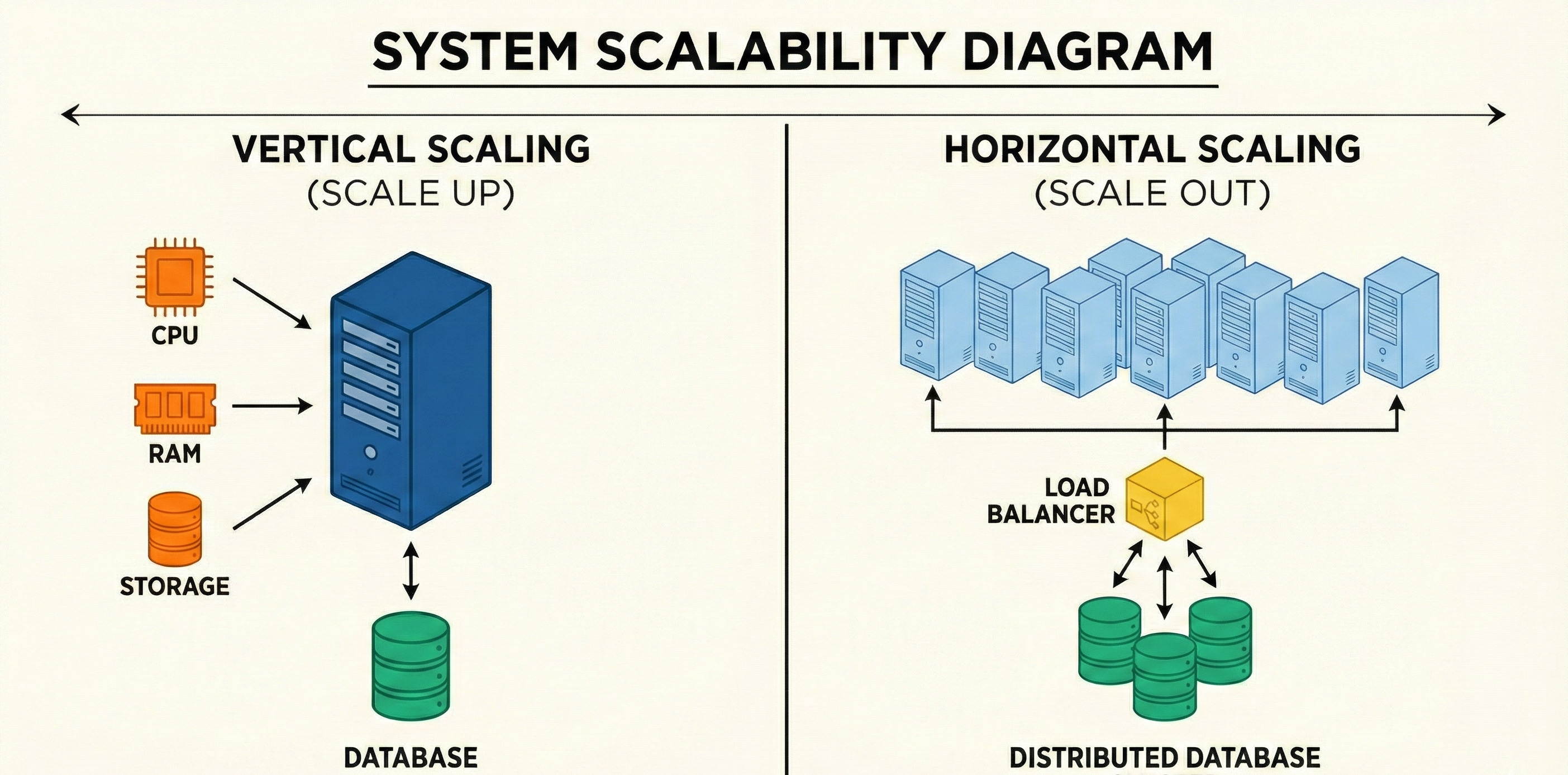
Scalability is a system’s ability to grow and handle an increasing amount of work (like more users, transactions, or data) efficiently.
It is a measure of how easily a system can be modified to accommodate greater demand without significantly sacrificing performance or efficiency.
A system that scales well ensures that adding resources (like more servers) provides a proportional increase in capability.
Example
Think of an e-commerce website during a major holiday sale like Black Friday.
A scalable system can handle the sudden jump from 1,000 requests per minute to 100,000 requests per minute by automatically or manually adding more web servers and database capacity (vertical or horizontal scaling) to maintain a fast checkout experience.
If it wasn’t scalable, the site would slow down or crash, resulting in lost sales.
2. High Availability
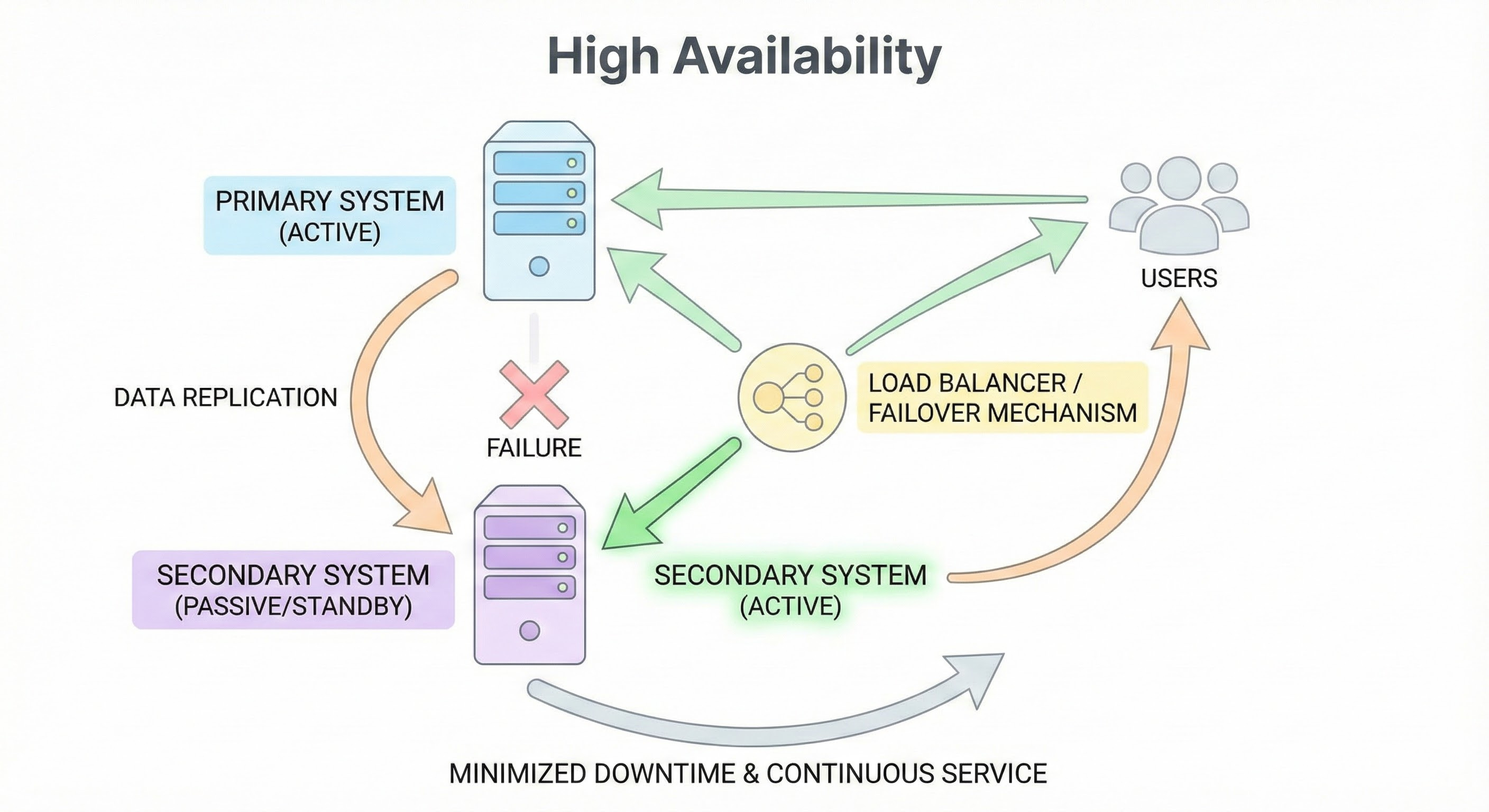
High Availability (HA) refers to the goal of having the system or its core components operational and accessible for a very high percentage of the time.
It is often expressed as “nines” of availability (e.g., 99.999% or “five nines”).
Achieving high availability involves eliminating single points of failure so that if one component fails, a redundant component can immediately take over.
Example
Consider a critical internal tool used for processing customer service inquiries.
If the primary database server goes down, an HA setup means there is a redundant, mirrored database standing by that can instantly become the primary server.
Customers and support agents experience little to no interruption in service, ensuring continuous business operations.
3. Low Latency
Latency is the time delay between a request being sent and the first part of the response being received.
Low Latency is the objective of minimizing this delay, resulting in a fast and responsive user experience. It’s often critical in real-time applications where every millisecond counts, such as trading or gaming.
Example
When a user clicks the “Post” button on a social media app, the system should ideally confirm the post submission within a few hundred milliseconds.
If the latency is high (e.g., several seconds), the user perceives the application as slow and unresponsive, which degrades their overall experience and can lead to them clicking the button multiple times.
